The contenders
Side by side
 Stock photo
The optic for longer shots: $1,000 to $2,000
ATN ThOR 6 Elite LRF 384 3.5-28x
$1,000 to $2,0008.5/10A 12 µm 384 sensor behind a 35 mm lens, with a built-in 1,000 m rangefinder and ballistic calculator (maker's claim), IP67, a 6000 J rating and a five-year warranty. The 3.5x base is narrow up close.
Check price · Amazon#ad · Price set by Amazon · How we make money for the link to ATN ThOR 6 Elite LRF 384 3.5-28x
- Stock photo
The optic for longer shots: $2,000 and up
RIX Storm S6R 640 (35 mm)
$2,000 and up7.8/10A 640x512 sensor at a wide 2x base, with a built-in 1,312 yd rangefinder and ballistic calculator (maker's claim), a 6000 J rating and a five-year warranty. Plan on spare batteries: about 4 hours each.
Check price · Amazon#ad · Price set by Amazon · How we make money for the link to RIX Storm S6R 640 (35 mm)
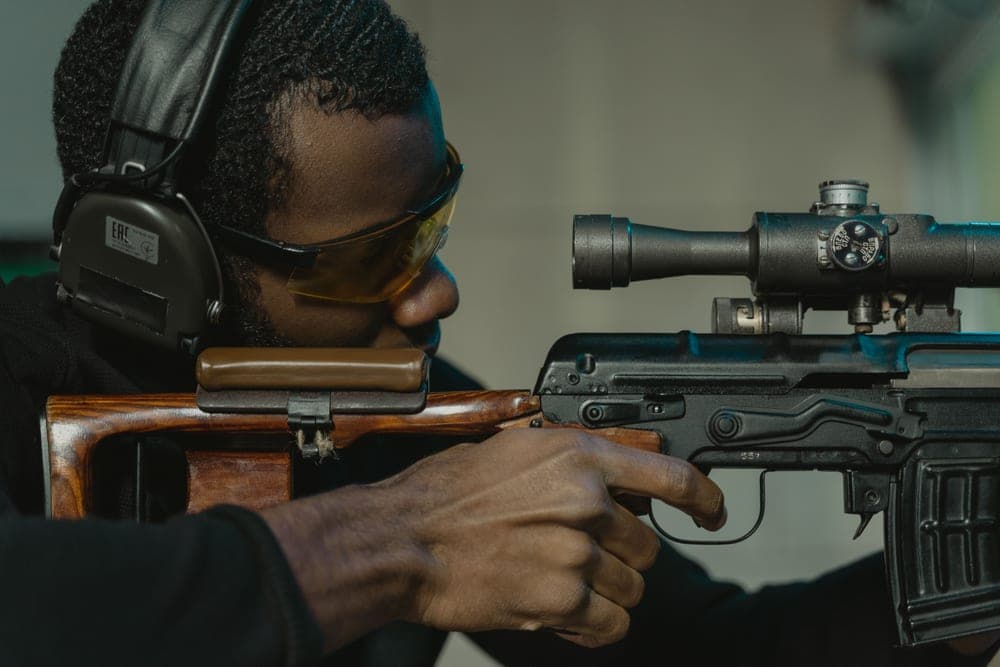
Why the products on this page are scopes
This is a cartridge comparison, not a product comparison. Amazon doesn't sell ammunition or rifles, and we don't link either. The optic is the product we can link, so the two picks above are thermal scopes. Because the Grendel's case is longer shots, we chose two with built-in rangefinders and ballistic calculators: one between $1,000 and $2,000, one above $2,000. We haven't tested these units; scores come from published specs and the rubric on our How We Choose page.
The cartridge facts come from SAAMI (the U.S. ammunition industry's standards body), Texas A&M AgriLife, a national feral-pig shooting standard and named hunting writers. For the wider question of which cartridges suit hogs, see our guide to the best caliber for hogs.
6.5 Grendel vs 300 Blackout at a glance
| 6.5 Grendel | 300 AAC Blackout | |
|---|---|---|
| Bullet diameter (SAAMI max) | .2643 in | .309 in (.308 groove) |
| SAAMI reference loads | 115 and 123 gr, both at 2,580 fps | 90 to 220 gr (16 in test barrel); 125 gr at 2,185 fps |
| Muzzle energy, 123 gr vs 125 gr | About 1,818 ft-lb (our math) | About 1,325 ft-lb (our math) |
| Against the .243 / 80 gr / 1,819 ft-lb minimum (NATSOP-PIG003) | At the energy line; bullet larger and heavier than the minimum | Below on energy; bullet larger and heavier |
| Maximum average pressure (SAAMI) | 52,000 psi | 55,000 psi |
| Case head (SAAMI) | .441 in | .378 in, the same as .223 Remington |
| Max overall length (SAAMI) | 2.260 in | 2.260 in |
| What changes on an AR-15 | A different bolt face; the magazine well length stays the same (American Hunter) | The barrel only; no bolt or magazine swap (RCBS) |
| Designed for | Accuracy "with very little recoil" and reliable performance to 800 yards (American Hunter) | Suppressor use "from the ground up" (RCBS) |
| Subsonic reference load | None listed by SAAMI | 190 gr at 1,040 fps and 220 gr at 1,020 fps |
| SAAMI standard issued | January 17, 2011 | January 17, 2011 |
Every SAAMI figure above comes from the Z299.4-2025 centerfire rifle standard. Its velocities are test-barrel reference values; SAAMI says there should be no expectation of duplicating them in firearms, and that barrel length adds to the difference. Check the maker's published velocity for the load and barrel length you actually use.
Energy at the muzzle and downrange
At the muzzle, the gap is real. SAAMI's 123 grain Grendel load at 2,580 fps works out to about 1,818 ft-lb (bullet weight in grains × velocity², divided by 450,240). The 300 Blackout's supersonic reference loads from 90 to 150 grains work out to roughly 1,175 to 1,420 ft-lb by the same math, and 125 grains at 2,185 fps lands at about 1,325. American Hunter's Jeff Johnston cites about 1,450 ft-lb for a full-power Blackout load (2018). Across those figures, the Grendel starts with roughly 25 to 55% more energy.
Downrange, the difference grows, because the two were built for different jobs. Philip Massaro (American Hunter, 2024) describes the Grendel as one of the first cartridges to rely on ballistic coefficient rather than muzzle velocity for long-range performance. His example: a 123 grain hunting load zeroed at 200 yards drops 9.1 inches at 300 yards and still carries just under 1,200 ft-lb there. He calls it fully capable on deer inside 300 yards, while noting most game is taken inside 200.
The Blackout was never meant for that. Massaro (2017) notes that a Blackout hunting load zeroed at 200 yards has to sit about five inches high at 100, and suggests a 100 yard zero with deer shots kept to about 100 or 125 yards. RCBS claims supersonic Blackout loads with controlled-expansion bullets are effective on hogs inside 200 yards (maker's claim).
Australia's national standard for ground shooting feral pigs, NATSOP-PIG003, gives a useful frame. Its recommended minimum is .243 inch caliber, an 80 grain bullet and 1,819 ft-lb of muzzle energy. By our math the Grendel's 123 grain reference load sits essentially on that energy line with a bigger, heavier bullet; the Blackout's supersonic loads sit below it. That standard is Australian animal-welfare guidance, not U.S. or Texas law, and Texas A&M AgriLife's own advice is simply to use a rifle you'd use for other large game (AgriLife).
What each asks of your AR
This is where the Blackout wins. RCBS says it was developed so an AR-15 needs only a barrel change, with no bolt or magazine swap, and SAAMI lists the same .378 inch case head as the .223 Remington. If you already own an AR, a Blackout barrel or upper is the whole job.
The Grendel asks more. Its case head measures 0.441 inches, "requiring a different bolt face than the standard AR-15 provides," Massaro writes. Its 2.26 inch overall length matches the .223, so the same length magazine and magazine well can be used. In practice that means a Grendel upper with its own bolt, and magazines chosen for the cartridge; ask the rifle maker which ones it specifies. Massaro also notes the Grendel is chambered in bolt-action rifles, not only ARs.
Suppressed and subsonic use
RCBS says 300 Blackout was built from the ground up with suppressor use in mind, and SAAMI lists subsonic reference loads for it (190 grains at 1,040 fps and 220 grains at 1,020 fps, about 456 and 508 ft-lb by our math). SAAMI lists no subsonic load for the Grendel. If quiet matters most to you, that is the Blackout's ground.
Just don't confuse quiet with enough. Johnston calls subsonic loads marginal for big game "for all but the closest, perfectly placed shots," and argues a suppressed full-power load does everything a subsonic one can, better. Massaro adds that 220 grain bullets move too slowly to expand reliably. Suppressors are legal for taking wildlife in Texas, but all federal, state and local laws still apply (TPWD); for the federal side, go to the ATF National Firearms Act Division.
What longer reach doesn't change
A cartridge that can reach farther doesn't make farther shots a good idea. The sources are consistent:
- Closest practicable range. NATSOP-PIG003 says the objective is to fire at the closest range practicable to reduce the risk of wounding, and its acceptable examples, including the .308 Winchester, top out at 200 meters.
- Prove your accuracy first. The same standard expects shooters to put three shots inside 7.5 cm (about 3 inches) at 100 meters from a bench rest, and to judge distance and wind. A rest matters in the field too; see our picks for shooting sticks and tripods.
- Know what's beyond. TPWD's shooting safety rules: know what is in front of and behind your target, have a safe backstop, never shoot at animals on ridges or hilltops, and know how far bullets travel. A longer shot means a longer stretch of ground to be sure of.
- Placement still decides it. AgriLife warns that a boar's shoulder shield can let a pig survive poorly placed shots, and the Australian standard prefers side-on chest shots on boars for the same reason.
Optics for the longer shot
If you choose the Grendel for reach, the optic has to keep up: you need to identify the hog, see its surroundings and know the distance. Both picks carry a built-in laser rangefinder and ballistic calculator, publish a 6000 J recoil rating and a five-year warranty.
| Published spec | ATN ThOR 6 Elite LRF 384 3.5-28x | RIX Storm S6R 640 (35 mm) |
|---|---|---|
| Budget tier | $1,000 to $2,000 | $2,000 and up |
| Sensor | 384x288 (12 µm VOx) | 640x512 |
| Pixel pitch | 12 µm | 12 µm (listing title) |
| NETD | ≤15 mK | <20 mK |
| Lens | 35 mm germanium, F/1.0 | 35 mm |
| Magnification | 3.5-28x (1x, 2x, 4x, 8x digital zoom) | 2x base; 1-4x digital |
| Field of view | 7.53° x 5.65° | — |
| Rangefinder | Built-in, 1,000 m, ±1 m (905 nm, Class 1); ballistic calculator (maker's claim) | Built-in, 1,312 yd, ±1.09 yd; ballistic calculator (maker's claim) |
| Battery | Two 18650s (one internal, one replaceable), about 9 h; USB-C external power | Swappable 18650, about 4 h at 72°F; 5 V USB-C external power |
| Recoil rating | 6000 J (1000 g over 0.4 ms) | 1000 g / 6000 J |
| IP rating | IP67 | — |
| Warranty | 5 years | 5 years |
| Score | 8.5/10 | 7.8/10 |
A worked example from those specs. Each sensor pixel covers an angle of pixel pitch divided by focal length. Both scopes pair 12 µm pixels with a 35 mm lens, so each pixel covers about 0.34 milliradians: roughly 1.2 inches at 100 yards, 2.5 inches at 200 and 3.7 inches at 300. Per pixel, the detail is the same. The difference is how many pixels: the RIX's 640x512 sensor spreads that same detail across a wider view. ATN publishes 7.53° x 5.65° for the ThOR 6 Elite, which the same math reproduces. RIX's page doesn't list a field of view for the S6R, but the math gives about 12.5° x 10.0°, and oneleaf.ai publishes 12.5° x 10.1° for its own 640x512, 12 µm, 35 mm scope (oneleaf.ai), which suggests the figure is sound. That wider view matters when a sounder spreads out, and the 2x base helps when hogs come close after all.
The rangefinder earns its place with the Grendel's trajectory: with a 200 yard zero, Massaro's 123 grain example drops 9.1 inches at 300. A ranged, calculated hold is the difference between a clean shot and a guess.
Choose the ATN ThOR 6 Elite LRF 384 if
- Your budget is $1,000 to $2,000 and you want a rangefinder and ballistic calculator built in.
- You want the longer battery of the two (about 9 hours from two 18650s, one of them replaceable).
- You value a published IP67 rating and a published NETD of ≤15 mK.
Choose the RIX Storm S6R 640 if
- You want the wider view of a 640x512 sensor at a 2x base, for hogs that range from close to far.
- You're fine carrying spare 18650s: RIX states about 4 hours each.
- You accept that RIX's S6R page publishes no IP rating.
For more choices in the middle tier, see the best thermal scopes under $2,000, and for what sensor resolution buys, our 256 vs 384 vs 640 guide. Before any night hunt, check the Texas night-hunting rules.
Which one for your hogs
If your hogs come to a feeder at close range and you want quiet, the 300 Blackout is the simpler, cheaper step from an AR you already own, as long as you respect its distance limits and keep its ammunition apart from any .223 or 5.56. If your hogs cross open ground, the 6.5 Grendel gives you more energy at the muzzle and much more left at distance, at the cost of a dedicated upper and bolt. If your question is really 300 Blackout against the rifle you already have, read 300 Blackout vs 5.56.
Whichever you choose, remember what shooting is for in hog control: finishing what trapping starts. The full plan lives in our hog control hub.
In detail
The contenders, in full
Stock photoThe optic for longer shots: $1,000 to $2,000
ATN ThOR 6 Elite LRF 384 3.5-28x
A 12 µm 384 sensor behind a 35 mm lens, with a built-in 1,000 m rangefinder and ballistic calculator (maker's claim), IP67, a 6000 J rating and a five-year warranty. The 3.5x base is narrow up close.
Published specsResearched · not tested by us
| Sensor | 384x288 (12 µm VOx) |
|---|---|
| Pixel pitch | 12 µm |
| NETD | ≤15 mK |
| Lens | 35 mm germanium, F/1.0 |
| Magnification | 3.5-28x (1x, 2x, 4x, 8x digital zoom) |
| Refresh rate | 50 Hz |
| Field of view | 7.53° x 5.65° |
| Detection range | 2,750 mMaker's claim |
| Display | 0.49 in OLED, 1920x1080 |
| Battery | Two 18650s (one internal, one replaceable), about 9 h; USB-C external power |
| Recording | 64 GB internal; Recoil Activated Video; Wi-Fi to ATN Connect 6 app |
| Rangefinder | Built-in, 1,000 m, ±1 m (905 nm, Class 1); ballistic calculatorMaker's claim |
| IP rating | IP67 |
| Recoil rating | 6000 J (1000 g over 0.4 ms) |
| Operating temperature | -22°F to 131°F (-30°C to 55°C) |
| Weight | 830 g (1.83 lb) |
| Mount | 30 mm rings (not included) |
| Warranty | 5 years |
How the 8.5 score breaks down
- Sensor & lens for hog ID (30%)
- 8.5
- Usability at night (20%)
- 8
- Battery & power (15%)
- 8
- Durability (15%)
- 9
- Warranty & support (10%)
- 9
- Value within its tier (10%)
- 8.5
What the specs support
- Lowest published NETD in this list (≤15 mK) on a 12 µm 384 sensor
- Built-in laser rangefinder feeds the ballistic calculator; six ballistic profiles
- Full HD 1920x1080 OLED, 64 GB storage and Recoil Activated Video
- IP67, 6000 J and a five-year warranty, all published
Where it falls short
- 3.5x base on a 35 mm lens is a narrow 7.5° view for close feeder work
- Rings aren't included
- Only one of the two 18650s is replaceable in the field
Skip this if…
…You mostly shoot hogs inside 75 yards; the 3.5x base is tight up close, and the ThOR 6 384 2.5-20x gives a wider 10.5° view.
#ad · Price set by Amazon · How we make money for the link to ATN ThOR 6 Elite LRF 384 3.5-28x
Stock photoThe optic for longer shots: $2,000 and up
RIX Storm S6R 640 (35 mm)
A 640x512 sensor at a wide 2x base, with a built-in 1,312 yd rangefinder and ballistic calculator (maker's claim), a 6000 J rating and a five-year warranty. Plan on spare batteries: about 4 hours each.
Published specsResearched · not tested by us
| Sensor | 640x512 |
|---|---|
| Pixel pitch | 12 µm (listing title) |
| NETD | <20 mK |
| Lens | 35 mm |
| Magnification | 2x base; 1-4x digital |
| Refresh rate | 50 Hz |
| Detection range | About 1,969 ydMaker's claim |
| Display | 1024x768 AMOLED |
| Battery | Swappable 18650, about 4 h at 72°F; 5 V USB-C external power |
| Recording | 32 GB built-in; Recoil-Activated Video; Wi-Fi to RIX+ app |
| Rangefinder | Built-in, 1,312 yd, ±1.09 yd; ballistic calculatorMaker's claim |
| Recoil rating | 1000 g / 6000 J |
| Weight | About 1 lb |
| Mount | Picatinny QD mount included |
| Warranty | 5 years |
How the 7.8 score breaks down
- Sensor & lens for hog ID (30%)
- 9
- Usability at night (20%)
- 8
- Battery & power (15%)
- 5.5
- Durability (15%)
- 6
- Warranty & support (10%)
- 9
- Value within its tier (10%)
- 8.5
What the specs support
- 640x512 with <20 mK NETD at a wide 2x base: a big view for sounders with detail to zoom into
- Built-in 1,312 yd rangefinder and ballistic calculator
- About 1 lb with a 6000 J rating and a five-year warranty
Where it falls short
- About 4 h per 18650 is the shortest runtime among the 640s here
- No IP rating on RIX's S6R page
Skip this if…
…You won't manage spare batteries on a long sit; the AGM Clarion's up-to-11-hour claim or a Pulsar's 10 h fits better.
#ad · Price set by Amazon · How we make money for the link to RIX Storm S6R 640 (35 mm)
How we scored this
Units we claim to have tested: 0
Plenty of gear sites say they field-tested everything they list. We haven't, and we say so. Every pick here is labeled Researched: we read each maker's published specs, manuals and warranty terms, compare products only against others in the same budget tier, and score them on a public rubric. Every figure links to where it came from, and seller performance numbers are labeled “maker's claim.”
Scores are editorial judgments from that documented research, not test results. Commissions never set a score or decide a pick. The rubric and its weights are published.
What changed
- Published.
Questions
Frequently asked
Is 6.5 Grendel good for hog hunting?
Is 6.5 Grendel better than 300 Blackout for hogs?
Does the 6.5 Grendel need a different bolt?
How far can you shoot a hog with a 6.5 Grendel?
Which is better with a suppressor, 6.5 Grendel or 300 Blackout?
Can a 300 Blackout round go in the wrong rifle?
Receipts
Sources
- SAAMI: Z299.4-2025 Voluntary Industry Performance Standards, Centerfire Rifle (velocity, pressure and cartridge drawings) (checked 2026-09-19)
- SAAMI: Generally Accepted Firearms and Ammunition Interchangeability, Oct. 8, 2021 (checked 2026-09-19)
- RCBS: How to reload 300 AAC Blackout (cartridge background and safety warning) (checked 2026-09-19)
- NRA Blog: Avoiding the .300BLK AR-15 'ka-boom!', Jason J. Brown, Sep. 1, 2016 (checked 2026-09-19)
- American Hunter (NRA): Behind the Bullet, 6.5 Grendel, Philip Massaro, Dec. 28, 2024 (checked 2026-09-19)
- American Hunter (NRA): .300 AAC Blackout for Deer?, Philip Massaro, Aug. 8, 2017 (checked 2026-09-19)
- American Hunter (NRA): Opinion, Subsonic Ammo Sucks for Big-Game Hunting, Jeff Johnston, Apr. 5, 2018 (checked 2026-09-19)
- Texas A&M AgriLife, Coping with Feral Hogs: Selective Shooting (checked 2026-09-19)
- Terrestrial Vertebrate Working Group (Australia): NATSOP-PIG003, Ground Shooting of Feral Pigs, 2024, via PestSmart (checked 2026-09-19)
- TPWD Hunter Education: Shooting Safety Rules (checked 2026-09-19)
- TPWD: Outdoor Annual 2026-27, General Regulations: Means and Methods (checked 2026-09-19)
- ATF: National Firearms Act Division (seen in search results 2026-09-19; the site blocks automated fetches)
- ATN: ThOR 6 LRF 384x288 3.5-28x (Elite series) product page and spec table (checked 2026-09-19)
- RIX Optics: STORM S6R product page and FAQ (checked 2026-09-19)
- oneleaf.ai: Mars MT1000LRF product page and spec table (field of view cross-check) (checked 2026-09-19)
We haven't tested the gear on this page and we don't pretend to. Specs come from each maker's own pages or the product listing (linked on every product), hog biology and trapping advice from Texas A&M AgriLife, and rules from TPWD and Texas statute. Prices are set by Amazon and change often, so we don't print them. Where a figure isn't published, we say so. Read the full method.