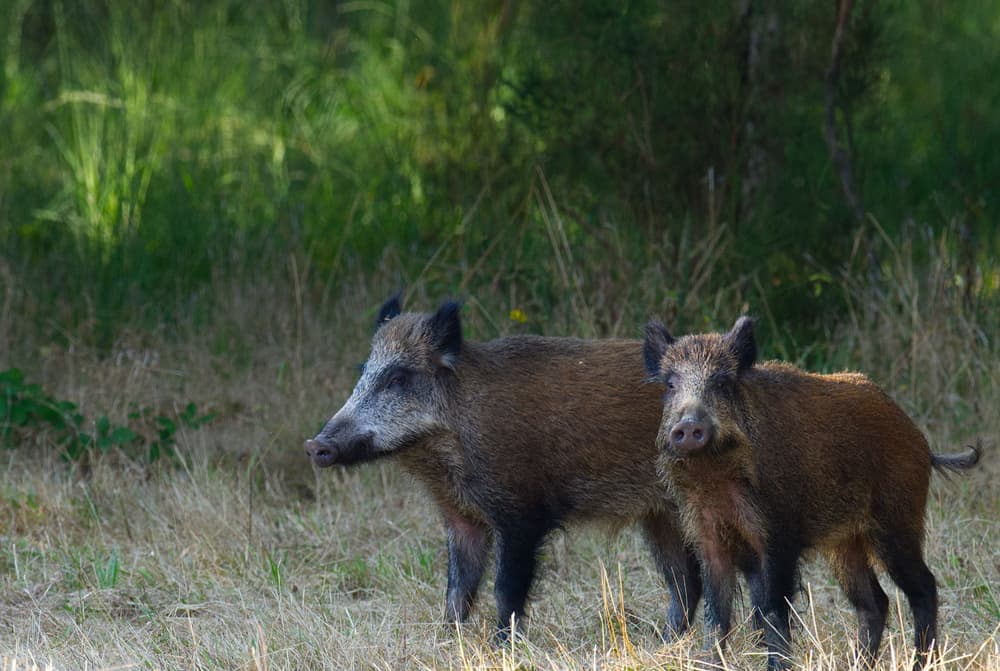
Every thermal box leads with a sensor size: 256, 384 or 640. It's the first number buyers compare and the one most often misread. A 640 isn't automatically the better buy for your hogs, and two 384 scopes can show the same hog very differently. What you actually care about, standing over a feeder or a field edge in the dark, is how many sensor pixels cover the hog at the distance you'll shoot. That number comes from three published specs, and you can work it out yourself.
We haven't tested these units. Everything below is geometry from the makers' published specs, labeled as illustrative, not a field test. The scores on the picks come from the rubric on our How We Choose page.
What 256, 384 and 640 mean
The number is the width of the sensor in pixels. The full resolutions are 256x192, 384x288 and 640x512 (some 640s, like ATN's ThOR 5 640 and Pulsar's Oryx, use 640x480). In total pixels:
- 256x192 = 49,152 pixels
- 384x288 = 110,592 pixels, 2.25 times a 256
- 640x512 = 327,680 pixels, about 3 times a 384 and 6.7 times a 256
Pulsar's comparison guide puts the general rule simply: "More pixels provide more detail and preserve more information under digital magnification." The same guide also warns that "sensor resolution alone does not decide image quality" ( Pulsar). The piece most buyers miss is where those pixels go: spread across a wide view, or packed onto the hog.
The formula: how many pixels land on a hog
Each sensor pixel covers a small slice of the scene. How big that slice is depends on two published specs: the pixel pitch (the size of each pixel, 12 or 17 micrometers on the scopes we track) and the lens focal length in millimeters. The ratio of the two is the angle one pixel sees. Turned into inches at hunting distances, it becomes:
Worked example: the ATN ThOR 6 Mini 256 publishes 12 µm pixels and a 15 mm lens (ATN). At 100 yards, one pixel covers 100 × 0.036 × 12 ÷ 15 = 2.88 inches. A 60-inch hog is about 21 pixels long.
Notice what's missing from the formula: the sensor's total pixel count. Resolution (256, 384 or 640) sets how wide the view is at a given detail, through the field-of-view line. Detail on the hog comes from pitch and focal length alone.
Checking the math against the makers
If the geometry is right, it should reproduce the field of view each maker publishes. It does, within a tenth of a degree, on every scope below. Calculated figures are ours; published figures link to the maker.
| Scope | Sensor / pitch / lens | Calculated field of view | Published field of view |
|---|---|---|---|
| ATN ThOR 6 Mini 256 | 256 / 12 µm / 15 mm | 11.7° | 11.7° |
| AGM Rattler V2 19-256 | 256 / 12 µm / 19 mm | 9.2° | 9.3° |
| Athlon Cronus ATS PRO 25P-250 | 256 / 12 µm / 25 mm | 7.0° | 7.0° |
| Pulsar Talion XQ35 Pro | 384 / 17 µm / 35 mm | 10.7° | 10.7° |
| ATN ThOR 6 Elite LRF 384 | 384 / 12 µm / 35 mm | 7.5° | 7.53° |
| Pulsar Thermion 2 XQ50 Pro | 384 / 17 µm / 50 mm | 7.5° | 7.5° |
| AGM Clarion 384 Dual Focus | 384 / 12 µm / 25 or 50 mm | 10.5° / 5.3° | 10.5° / 5.3° |
| oneleaf Mars MT1000LRF | 640 / 12 µm / 35 mm | 12.5° | 12.5° |
| Pulsar Oryx LRF XG35 (monocular) | 640 / 12 µm / 35 mm | 12.5° | 12.5° |
One maker's figure doesn't fit: GOYOJO lists 6.5° x 4.5° for the GRL335 (384, 12 µm, 35 mm), where the geometry gives about 7.5°, the same as ATN's identical sensor-and-lens combination (GOYOJO). We can't tell from the outside which is right, so we note it rather than guess.
Pixels on a hog at 50, 100 and 200 yards
| Setup (sensor / pitch / lens) | Inches per pixel at 100 yd | Pixels along a 5 ft hog at 50 / 100 / 200 yd | Pixels up a 3 ft hog at 50 / 100 / 200 yd | Width of view at 100 yd |
|---|---|---|---|---|
| 256 / 12 µm / 15 mm (ATN ThOR 6 Mini) | 2.88 | 42 / 21 / 10 | 25 / 13 / 6 | About 61 ft |
| 256 / 12 µm / 19 mm (AGM Rattler V2 19-256) | 2.27 | 53 / 26 / 13 | 32 / 16 / 8 | About 49 ft (AGM lists 49 x 36 ft) |
| 256 / 12 µm / 25 mm (Athlon Cronus 25P-250) | 1.73 | 69 / 35 / 17 | 42 / 21 / 10 | About 37 ft |
| 384 / 17 µm / 35 mm (Pulsar Talion XQ35 Pro) | 1.75 | 69 / 34 / 17 | 41 / 21 / 10 | About 56 ft |
| 384 / 12 µm / 35 mm (ATN ThOR 6 Elite LRF 384) | 1.23 | 97 / 49 / 24 | 58 / 29 / 15 | About 39 ft |
| 384 / 17 µm / 50 mm (Pulsar Thermion 2 XQ50 Pro) | 1.22 | 98 / 49 / 25 | 59 / 29 / 15 | About 39 ft |
| 384 / 12 µm / 50 mm (AGM Clarion, 50 mm lens) | 0.86 | 139 / 69 / 35 | 83 / 42 / 21 | About 28 ft |
| 640 / 12 µm / 35 mm (oneleaf Mars MT1000LRF) | 1.23 | 97 / 49 / 24 | 58 / 29 / 15 | About 66 ft |
Read the last two columns together. The ATN 384 and the oneleaf 640 put exactly the same pixels on the hog, because they share a 12 µm pitch and a 35 mm lens. The 640 simply sees 66 feet of ground at 100 yards where the 384 sees 39. And the Pulsar Thermion's bigger 50 mm lens gets it no more detail than the ATN's 35 mm, because its pixels are bigger, too.
How many pixels is enough to identify a hog?
There's no official hog number, but there is a classic yardstick. In 1958, John Johnson, working in what Sandia's history calls the Night Vision Equipment Branch, measured how many "cycles" (a cycle is one light-and-dark line pair) observers needed across a target to perform each task with a 50% chance of success. Sandia National Laboratories' history of the Johnson criteria summarizes his figures as about 1.0 cycle for detection, 4.0 for recognition and 6.4 for identification (Sandia, SAND2015-6368).
A cycle takes at least two pixels to draw, so at that theoretical minimum Johnson's numbers work out to roughly 2 pixels to detect, 8 to recognize and 13 to identify. Apply the identification figure to a hog's 3-foot height (the smaller dimension, to stay conservative) and you get the distance where each setup drops to about 13 pixels:
- 256 behind 15 mm: about 100 yards
- 256 behind 19 mm: about 125 yards
- 256 behind 25 mm, or 384 at 17 µm behind 35 mm: about 160 to 165 yards
- 384 or 640 at 12 µm behind 35 mm, or 384 at 17 µm behind 50 mm: about 230 yards
- 384 or 640 at 12 µm behind 50 mm: about 325 yards
Those line up with the cautions in our own product notes on budget scopes: skip the 15 mm and 19 mm 256s if you regularly shoot past about 150 yards across open fields. But treat the numbers as a rough guide, not a rule. Sandia's report stresses that Johnson's figures were a simplification that "would change based on viewing angles and the contrast transfer function" of the optics, and that "the implications and required conditions of the criteria are often forgotten." A 50% chance for an average observer isn't a standard you'd want for a shot. Add a margin.
256 vs 384: what the step up buys
Put both behind the same lens, and a 384 gives you the same detail on the hog with a view 1.5 times wider. In practice the two rarely share a lens. Under $1,000, seven of the eight thermal riflescopes we track use a 256x192 sensor (every one that publishes its lens uses 15 to 25 mm), and only one (the GOYOJO GRL335) pairs a 384 with a 35 mm lens. From $1,000 to $2,000, the 384s sit behind 35 to 50 mm lenses.
So in the real market, "256 vs 384" mostly means "short lens vs longer lens." A budget 256 with a 15 or 19 mm lens gives a wide view that suits a sounder milling around a feeder at 40 to 80 yards. A 384 with a 35 mm lens roughly doubles the pixels on each hog and keeps a usable view out past 200 yards. If your shots are inside 100 yards, a 256 is enough by the numbers. Past about 150, it isn't. Our best thermal scopes under $1,000 sorts the budget options by exactly this trade-off.
384 vs 640: more view, or more detail, not both for free
At the same 12 µm pitch and 35 mm lens, a 640 puts the same pixels on a hog as a 384, as the table shows. What it adds is ground: 12.5° against 7.5°. That's the answer to "is 640 worth it for hogs?" It's worth it when you want to watch a whole field or a spread-out sounder at full detail without panning, or when you want a longer lens for more detail without ending up with a narrow tube-view.
The oneleaf Mars shows the second route. oneleaf sells optional 50 mm and 75 mm lenses for it (oneleaf). By the same geometry, the 640 behind a 50 mm lens puts about 69 pixels along a 5-foot hog at 100 yards (the Thermion 2 XQ50 Pro manages about 49) while still covering about 8.8°, wider than the Thermion's 7.5°. That is what the extra pixels buy: the freedom to choose.
If your hogs come to one feeder at 60 yards, a 640 is more than you need. If you hunt big fields, crop edges or pasture where hogs can show anywhere from 50 to 250 yards, it's where the money makes a visible difference. The oneleaf is the one 640 riflescope in our $1,000-to-$2,000 tier; see our best thermal scopes under $2,000.
What else decides the image: pitch, NETD, refresh, display, zoom
- Pixel pitch (12 vs 17 µm). Smaller pixels put more of them on the hog behind the same lens, which is why 12 µm scopes reach the same detail with shorter, lighter lenses. Pulsar's guide gives the other side: "A larger-pitch element presents more surface area to incoming radiation and can favor raw sensitivity."
- NETD (sensitivity). The smallest temperature difference the sensor separates from noise; lower is better. ATN's ThOR 6 page puts it as "Lower NETD = finer temperature differentiation." It matters most on warm nights, when Pulsar notes "hot backgrounds can approach target temperature."
- Refresh rate. Most scopes here run 50 Hz. AGM says moving the Rattler V2 from 25 Hz to 50 Hz gives "smoother image performance and improved target tracking while scanning or engaging moving animals" (AGM).
- Display. The screen you look at is usually higher resolution than the sensor. Pulsar notes a high-resolution display "prevents the eyepiece screen from discarding detail captured by the sensor," but it can't add sensor pixels to the hog.
- Digital zoom. Beyond the base magnification, thermal zoom enlarges the same sensor pixels. It makes the hog bigger on the screen; it doesn't change the pixel counts in the table above.
One pick per sensor size
These are the models we'd start with at each sensor size, chosen for fully published pitch and lens specs (so you can run the math yourself) and their scores on our rubric.
Our picks for this job
A 256, a 384 and a 640 worth starting with
One per sensor size, each with published pitch and lens so the pixels-on-target math above applies directly. Budget tiers reflect the Amazon price seen when we researched.
 Stock photo
Best entry thermal for feeder distances
AGM Rattler V2 19-256
$500 to $1,0007.1/10Researched256 / 12 µm / 19 mm: about 26 pixels along a 5 ft hog at 100 yards and a 49 ft wide view. Up to 11.5 hours per battery with a spare in the box. A feeder-distance scope.
Check price · Amazon#ad · Price set by Amazon · How we make money for the link to AGM Rattler V2 19-256
- Stock photo
Best all-around thermal for hogs at field distance
Pulsar Thermion 2 XQ50 Pro
$1,000 to $2,0008.6/10Researched384 / 17 µm / 50 mm: about 49 pixels along a 5 ft hog at 100 yards, good to roughly 230 yards on the identification yardstick. IPX7, 6000 J, up to 10 hours.
Check price · Amazon#ad · Price set by Amazon · How we make money for the link to Pulsar Thermion 2 XQ50 Pro
- Stock photo
Best 640 sensor under $2,000
oneleaf.ai Mars MT1000LRF (35 mm)
$1,000 to $2,0008.1/10Researched640 / 12 µm / 35 mm: the same detail per hog as a 12 µm 384 on a 35 mm lens, with a 66 ft view at 100 yards, a built-in rangefinder and optional 50 and 75 mm lenses. About 5 hours per battery.
Check price · Amazon#ad · Price set by Amazon · How we make money for the link to oneleaf.ai Mars MT1000LRF (35 mm)
Which sensor for your shots
| Where your hogs show up | Sensor and lens that fits, by the math | Where to shop |
|---|---|---|
| A feeder or trap inside about 100 yards | 256 behind 15 to 19 mm; the wide view matters more than reach | Under $1,000 |
| Small fields and lanes, 100 to 175 yards | 256 behind 25 mm, or a 384 behind 35 mm | Under $1,000 or under $2,000 |
| Open pasture and crop edges, 150 to 250 yards | 384 at 12 µm behind 35 mm, or 17 µm behind 50 mm | Under $2,000 |
| Big fields where hogs can be anywhere from 50 to 250+ yards | 640 behind 35 mm or longer, or a dual-lens 384 | Best for hogs, all budgets |
What each of those tiers costs is broken down in how much a thermal scope costs, and if you're weighing thermal against a cheaper night vision scope for short feeder shots, see thermal vs night vision for hog hunting. Before the first night out, read whether you can hunt hogs at night in Texas. More on every sensor size is on the thermal and night vision hub.
How we scored this
Units we claim to have tested: 0
Plenty of gear sites say they field-tested everything they list. We haven't, and we say so. Every pick here is labeled Researched: we read each maker's published specs, manuals and warranty terms, compare products only against others in the same budget tier, and score them on a public rubric. Every figure links to where it came from, and seller performance numbers are labeled “maker's claim.”
Scores are editorial judgments from that documented research, not test results. Commissions never set a score or decide a pick. The rubric and its weights are published.
Questions
Frequently asked
What resolution do I need in a thermal scope for hogs?
Is a 640 thermal worth it over a 384 for hog hunting?
Is a 256 thermal enough for hogs?
How far can a thermal scope see?
Does digital zoom add detail on a thermal scope?
Is 12 micron better than 17 micron pixel pitch?
Receipts
Sources
- Sandia National Laboratories: History and Evolution of the Johnson Criteria (SAND2015-6368, 2015; via OSTI, checked 2026-09-19)
- Pulsar: Thermal vs Night Vision: Full Comparison Guide (updated July 23, 2026; checked 2026-09-19)
- Texas A&M AgriLife Extension: Feral Hogs in Texas, B-6149 (2004; PDF, checked 2026-09-19)
- ATN: ThOR 6 Mini 256x192 2-16x product page and spec table (checked 2026-09-19)
- AGM Global Vision: Rattler V2 19-256 product page and spec table (checked 2026-09-19)
- Athlon Optics: Cronus ATS PRO 25P-250 product page and specification (checked 2026-09-19)
- Pulsar: Talion XQ35 PRO product page and full specification (checked 2026-09-19)
- ATN: ThOR 6 LRF 384x288 3.5-28x product page and spec table (checked 2026-09-19)
- Pulsar: Thermion 2 XQ50 PRO product page and full specification (checked 2026-09-19)
- AGM Global Vision: Clarion 384 Dual Focus product page and spec table (checked 2026-09-19)
- oneleaf.ai: Mars MT1000LRF product page and spec table (checked 2026-09-19)
- Pulsar: Oryx LRF XG35 Thermal Monocular product page and spec table (checked 2026-09-19)
- GOYOJO Optics: GRL Series (GRL335) product page and spec table (checked 2026-09-19)
- GOYOJO Optics: GRS Series (GRS225) product page and spec table (checked 2026-09-19)
We haven't tested the gear on this page and we don't pretend to. Specs come from each maker's own pages or the product listing (linked on every product), hog biology and trapping advice from Texas A&M AgriLife, and rules from TPWD and Texas statute. Prices are set by Amazon and change often, so we don't print them. Where a figure isn't published, we say so. Read the full method.