Not legal advice. This page summarizes Texas rules from the official sources linked in the text (TPWD Outdoor Annual, valid Sep 1, 2026 through Aug 31, 2027). Rules checked . Laws change: confirm the current rules with Texas Parks and Wildlife and your local game warden before you rely on them.
Most trapping advice stops at the moment the gate drops. In Texas, what happens next is regulated, because the state treats the movement of live feral hogs as a disease-control issue. This page summarizes the rules from the primary sources: the TPWD Outdoor Annual (valid Sep. 1, 2026 through Aug. 31, 2027), the Texas Animal Health Commission (TAHC) and its rule at 4 Texas Administrative Code §55.9. It is not legal advice. If anything here doesn't fit your situation, call TAHC or your local game warden before you move a hog. For the full set of Texas hog rules (licenses, night hunting, suppressors), see our Texas hog hunting laws summary.
What the law says
TPWD's page gives TAHC's number for questions: (800) 550-8242. TPWD also asks night hunters, as a courtesy, to contact the local game warden.
Your four lawful options
Put the rules together and a landowner with a full trap has four lawful outcomes:
| Option | What it takes | Rule |
|---|---|---|
| 1. Dispatch on the property | A safe, legal shot inside the trap; then field dressing or disposal | No live movement, so the transport rule isn't triggered |
| 2. Haul to a recognized slaughter facility | A trailer, an escape-proof cage, a direct trip | 4 TAC §55.9(b)(1) |
| 3. Sell or deliver to an approved holding facility (buying station) | A facility on TAHC's approved list, a direct trip | 4 TAC §55.9(b)(2); TAHC swine page |
| 4. Deliver to an authorized hunting preserve | Males only, individually identified, a preserve that takes them | 4 TAC §55.9(b)(3) |
What's not on the list: turning them loose on your place, dropping them on a lease, or trucking them to another property you own. AgriLife's Hog Trap Design page is blunt about it: "Do not re-release hogs that are trapped as this just causes problems for other landowners."
Option 1: dispatch on site
Dispatching the hogs where they were trapped keeps you clear of the transport rules entirely, and it is the step AgriLife's trapping page assumes before its advice on post-baiting: "Once you have successfully trapped, dispatched, and removed pigs from the trap..." Do it quickly and cleanly, with a safe backstop behind the target.
Two TPWD rules still apply to any shot you take, trap or no trap (Means and Methods, 2026-27):
- It is unlawful to discharge a firearm on or across a public road. A trap near a county road needs a shooting angle that respects that.
- It is unlawful to knowingly fire a projectile across a property line unless you own both sides or have written permission from the owner of the land it crosses.
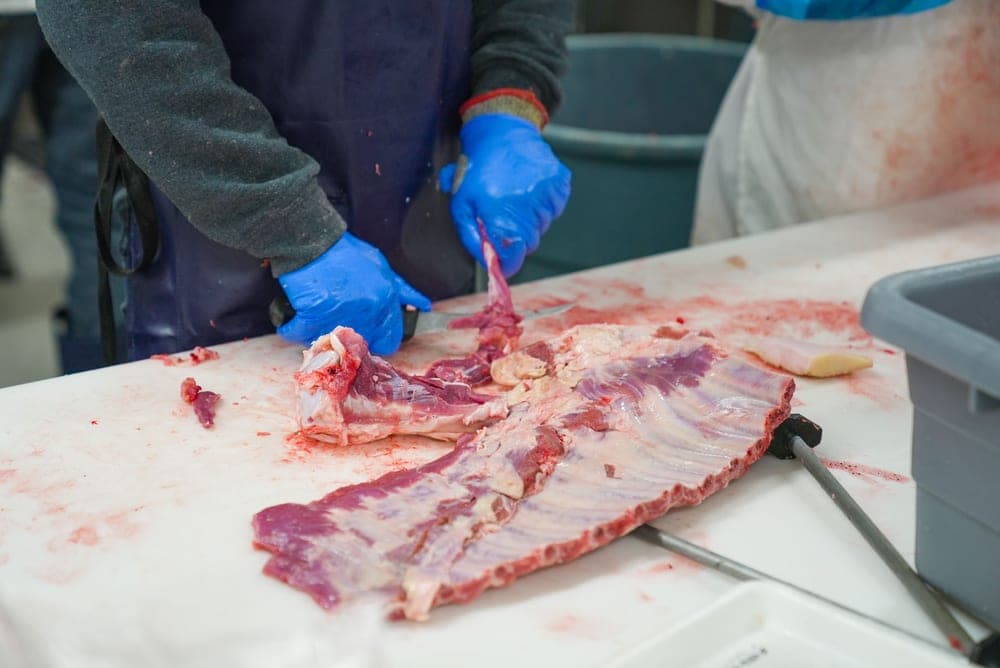
After that, the carcass is either meat or waste. If you plan to keep the meat, read the disease notes below and our step-by-step guide to how to field dress a hog. We haven't found a TPWD or TAHC page on carcass disposal in the sources we checked, so ask your county extension office what's expected where you are.
Options 2 to 4: haul them live
If you'd rather move the hogs alive, the rule is short and strict. Under 4 TAC §55.9(b), the requirements apply to "any person who traps feral swine and moves live feral swine from the premises where the feral swine were trapped," and live movement is prohibited except as the rule lists. For a trapper, the listed moves all start the same way: directly from the trap premises.
To a recognized slaughter facility
The simplest legal destination on paper. Call ahead: the rule allows the move, but it doesn't oblige any facility to accept your hogs.
To an approved holding facility (a buying station)
This is the buying-station route. TAHC describes an Approved Holding Facility as "a temporary place to hold feral swine" before they move to slaughter, a preserve or another holding facility, and says approved facilities may purchase trapped feral swine. TAHC stays out of the deal: it is "not involved in any aspect of the purchase transaction," so price and terms are between you and the facility. TAHC's swine page links a printable list of approved facilities and a map tool to find one near you.
To an authorized hunting preserve
Only male feral swine, boars and barrows, may be trapped, moved and released on a hunting preserve, and each must be individually identified before release (4 TAC §55.9). Sows and other females from your trap can't go this route. This is a preserve's regulated business, not a way for a landowner to relocate a sounder.
Holding, loading and the 7-day limit
The seven-day provision in 4 TAC §55.9(b)(7) is narrower than it sounds. It covers hogs "trapped and ... held for transportation to an authorized location," kept in an escape-proof cage on the vehicle or trailer that transported them from the trap site, or within the transport trailer itself. It is a window for getting hogs to a lawful destination, not permission to keep them.
AgriLife's trap guidance plans for the trailer from the start:
- Build for loading. The design page puts the gate at the narrow end of a teardrop-shaped trap so hogs funnel toward a trailer backed up to it.
- Load from behind. Its method for hogs going to a processor: back the trailer to the trap door, place a cross tie across the gate opening so they can't go under the trailer, and circle wide around to the back of the trap. The hogs move away from you and funnel into the trailer.
- Pick a site a trailer can reach. AgriLife's corral trap publication (L-5524) says that if hogs will be sold to a processor, choose a trap site a truck and trailer can reach in all weather.
If you haven't built the trap yet, our guide to how to trap feral hogs covers site choice with the trailer in mind.
Why Texas regulates live hogs
According to the TAHC swine page, the 80th Texas Legislature in 2007 had TAHC regulate the movement of live feral swine "as a measure to control the spread of disease." TAHC gives two figures from historical test data: about 10 percent of feral swine are infected with swine brucellosis, and approximately 20 percent may be infected with pseudorabies. A hog moved alive carries whatever it has to the next place, which is the whole point of the rule.
If you keep the meat
The same disease risk applies to the person handling the carcass. The CDC's brucellosis guidance for hunters says people can get brucellosis from undercooked meat or from handling animal tissues and fluids unsafely. Its advice:
- Wear eye protection and latex or rubber gloves when handling carcasses.
- Thoroughly cook meat from any animal that could be infected before eating it.
Our hog field dressing guide covers the steps and the gloves, and our hog knife picks cover the blades.
Does anyone pay for trapped hogs?
Two different things get called "getting paid for hogs" in Texas:
- Selling live hogs to an approved holding facility. TAHC confirms approved facilities may buy trapped feral swine; the price is a private deal.
- County bounties. We haven't found a statewide bounty program in the sources we checked, but some counties run their own. The Texas Association of Counties reported in January 2024 that many counties pay $5 to $15 for a tail or ears as proof of a kill. Bosque County's 2026 program flyer shows how the rules can look: hogs must be taken in the county, participants must be legal to hunt in Texas (including Hunter Education) and attend an AgriLife Extension feral hog class, tails are turned in frozen at the courthouse on set days until the money runs out, and the bounty comes to $10 per tail. It is not paid to commercial buying stations.
Programs, amounts and rules differ by county and change year to year. Your county extension office is the place to ask whether one runs where you are.
After the catch
One sounder in the trap doesn't mean the job is done. AgriLife's trapping page recommends a short period of post-baiting after hogs are dispatched and removed: it shows whether the whole sounder was caught and whether other sounders are in the area. The trap-and-remove cycle is one step in a larger plan, laid out in our guide to getting rid of feral hogs for good.
Why there are no product picks on this page: it's about the law, not gear. If you're still choosing a trap, our hog trap system rankings and the rest of the hog traps hub cover the equipment.
Questions
Frequently asked
What do they do with trapped hogs in Texas?
Does Texas pay to kill hogs?
Can you release trapped hogs in Texas?
Can I sell trapped feral hogs?
How long can you keep trapped hogs before moving them?
Receipts
Sources
- TPWD Outdoor Annual, Nongame and Other Species (Feral Hogs and Coyotes), valid Sep. 1, 2026 to Aug. 31, 2027 (checked 2026-09-19)
- TPWD Outdoor Annual, Means and Methods, valid Sep. 1, 2026 to Aug. 31, 2027 (checked 2026-09-19)
- 4 Tex. Admin. Code §55.9, Feral Swine: Authorized Movement (via Cornell LII; checked 2026-09-19)
- Texas Animal Health Commission, Swine (feral swine holding facilities) (checked 2026-09-19)
- Texas A&M Natural Resources Institute, An update on feral pig laws and regulations in Texas, Apr. 1, 2026 (checked 2026-09-19)
- Texas A&M AgriLife, Coping with Feral Hogs: Trapping (checked 2026-09-19)
- Texas A&M AgriLife, Hog Trap Design, Higginbotham and Neuendorff (checked 2026-09-19)
- Texas A&M AgriLife Extension, L-5524 Corral Traps for Feral Hogs, 2011 (PDF, checked 2026-09-19)
- CDC, Brucellosis and animals: wild hog hunters, last reviewed June 2, 2026 (checked 2026-09-19)
- Texas Association of Counties, County magazine: Feral hog abatement programs are working, Jan. 29, 2024 (checked 2026-09-19)
- Bosque County Feral Hog Abatement Program flyer, hosted by Texas A&M AgriLife Extension, 2026 (PDF, checked 2026-09-19)
We haven't tested the gear on this page and we don't pretend to. Specs come from each maker's own pages or the product listing (linked on every product), hog biology and trapping advice from Texas A&M AgriLife, and rules from TPWD and Texas statute. Prices are set by Amazon and change often, so we don't print them. Where a figure isn't published, we say so. Read the full method.