Not legal advice. This page summarizes Texas rules from the official sources linked in the text (TPWD Outdoor Annual, valid Sep 1, 2026 through Aug 31, 2027). Rules checked . Laws change: confirm the current rules with Texas Parks and Wildlife and your local game warden before you rely on them.
You found the pasture rooted up, the feeder emptied or the food plot flattened, and you want the hogs gone. The hard truth first: there is no single product that does it. Hogs breed fast, learn fast and move in groups, so the approach that works is a system aimed at the whole group. This guide lays that system out in four steps, shows what the problem costs if you leave it, and points you to the detailed guide for each step. Everything here is drawn from Texas A&M AgriLife, TPWD and other agencies, linked where it's used. It's the front door to our hog control and Texas rules section.
The system in one page
Texas A&M AgriLife's feral hog management guidance recommends an integrated pest management approach, which it defines as "a variety of tools are used together to improve the overall success of feral hog management." Its own example is the backbone of this plan: "Corral traps may be used for a period of time to capture large quantities of feral hogs, then selective shooting may be used as a follow up tool to remove remaining hogs after trapping success begins to decrease."
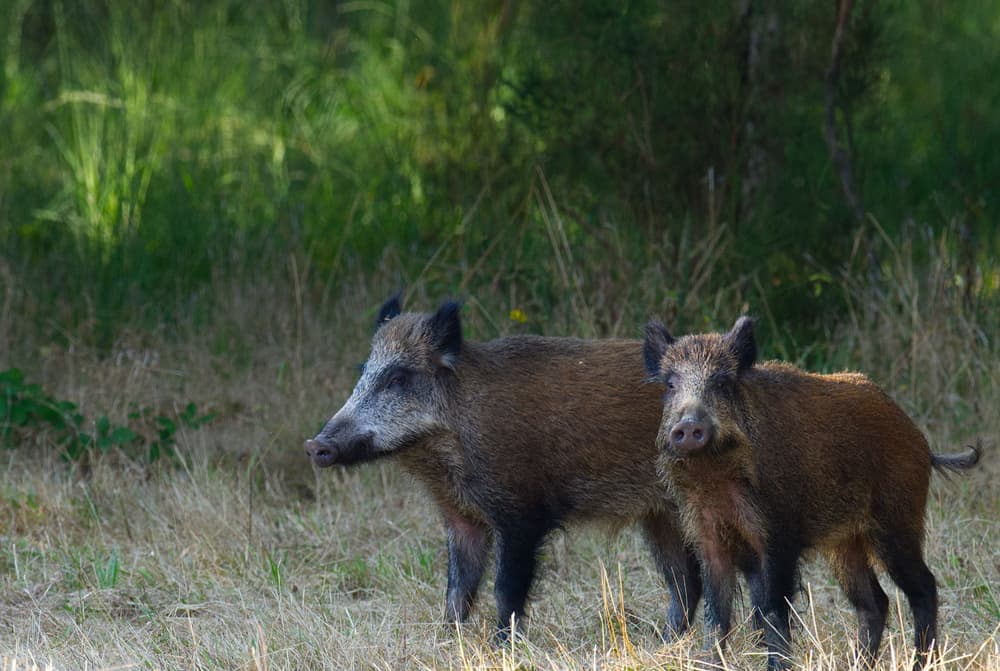
The unit you are removing is the sounder, the group that hogs travel and feed in. Take the whole group and the problem shrinks. Take one or two and the rest get harder to catch. Every step below follows from that.
| Step | What you're doing | Main tools | Go deeper |
|---|---|---|---|
| 1. Pattern | Find where and when the sounder feeds, and count it | Cellular trail cameras, a bait site | Best cellular trail cameras |
| 2. Trap | Catch the entire sounder at once | Corral or net trap, drop gate, remote trigger, trap camera, bait | How to trap feral hogs |
| 3. Shoot | Remove the few that avoided the trap | Thermal or a hunting light, a rest, a blind | Best thermal scopes for hogs |
| 4. Exclude | Protect feeders, gardens and plots from the next group | Hog panels, electric fence | Best electric fence for hogs |
What doing nothing costs
Hog damage is easy to underestimate. AgriLife Today notes that because wild pigs are largely nocturnal, you're more likely to see the damage than the animals. The published cost numbers come from different studies, years and places, so we list each one with its source rather than blending them.
- How many hogs: AgriLife Today put Texas at "an estimated population of 2.6 million feral hogs" in January 2026. An August 2023 AgriLife Today article said there were "more than 3 million." These are separate estimates, not a trend line.
- Statewide damage: the same August 2023 article said those hogs "cause more than $500 million in damage to agriculture and private property throughout Texas each year."
- Per operation: AgriLife's impacts page cites a 2021 Texas study that found costs to individual producers can run upwards of two hundred thousand dollars a year once losses, management efforts and lost opportunities are counted.
- Crops, multi-state: the same page cites a 2020 study of 12 states that put crop-production losses at $272 million in a single year.
- Nationally: USDA APHIS puts the minimum annual cost of feral swine damage in the United States at $3.4 billion (APHIS).
On the ground, AgriLife describes the damage this way: rooting that damages pastures and can open the door to weeds, hogs eating supplemental feed meant for livestock, disease risk to livestock, predation on young goats, sheep and in some cases young calves, and rooting and wallowing that muddy streams and ponds. Our feral hog damage guide goes through each kind, and how to repair hog damage in pastures covers the cleanup.
The reproduction math
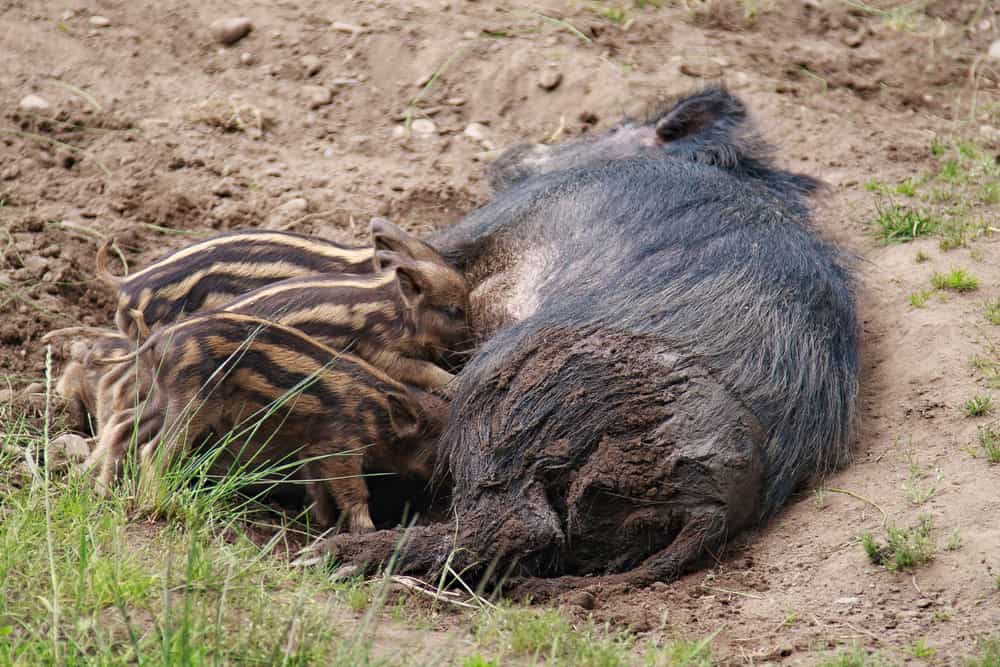
The reason half-measures fail is arithmetic. Texas A&M's Natural Resources Institute (NRI, November 2019) reports that "a sow can average 1.5 litters a year and each litter typically produces five to six piglets." Multiply it out:
- 1.5 litters × 5 piglets = 7.5 piglets per sow per year
- 1.5 litters × 6 piglets = 9 piglets per sow per year
The same NRI piece says Texas would "need to eliminate 66% of our wild pig population annually" just to stop it from growing. As a rough illustration only (the 66% is a statewide figure, not a rule for one ranch): if 30 hogs use your place, holding that number level means removing about 20 of them in a year (30 × 0.66 = 19.8). That is to stand still, not to get ahead. Shooting a hog here and there will not keep pace. Catching whole sounders at a time can. Our explainer on how fast feral hogs reproduce goes through the numbers in more detail.
Step 1: Pattern them
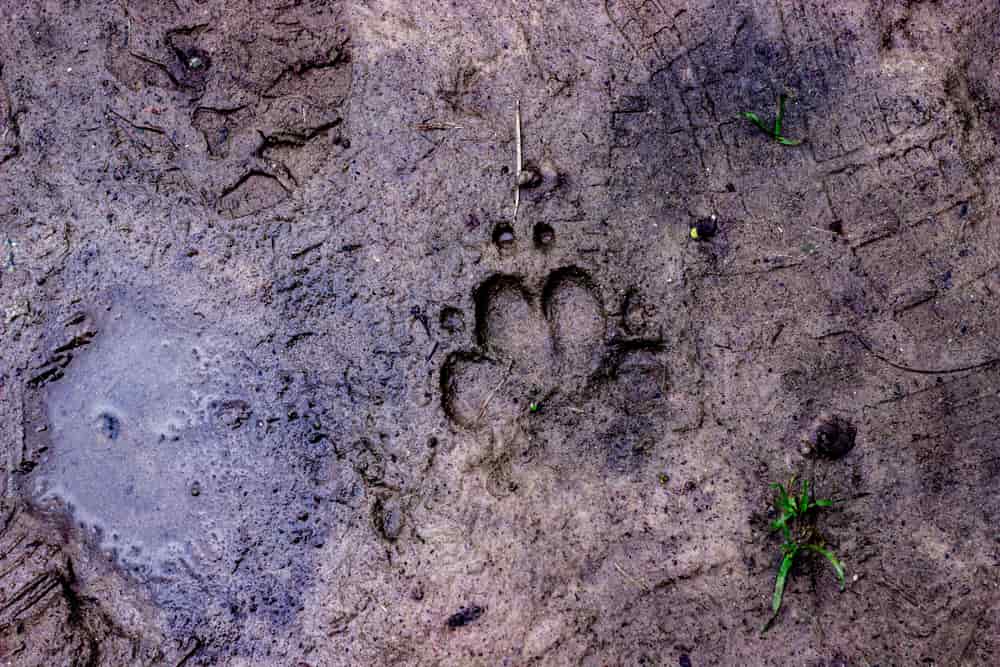
You can't trap what you haven't found. AgriLife's trapping guidance starts with finding an area hogs use often, and lists the signs: scat, tracks, rooting damage and wallows. Its 2011 publication on placing and baiting feral hog traps says to set traps "on or along hog trails linking resources such as food, cover, and water."
Then find out when. TPWD's wild pig page says hogs are generally active at dusk and dawn, but that human activity and climate can push them toward feeding at night. That's why a camera beats sitting and waiting. Our guide to when hogs are most active covers the timing.
What the cameras are for
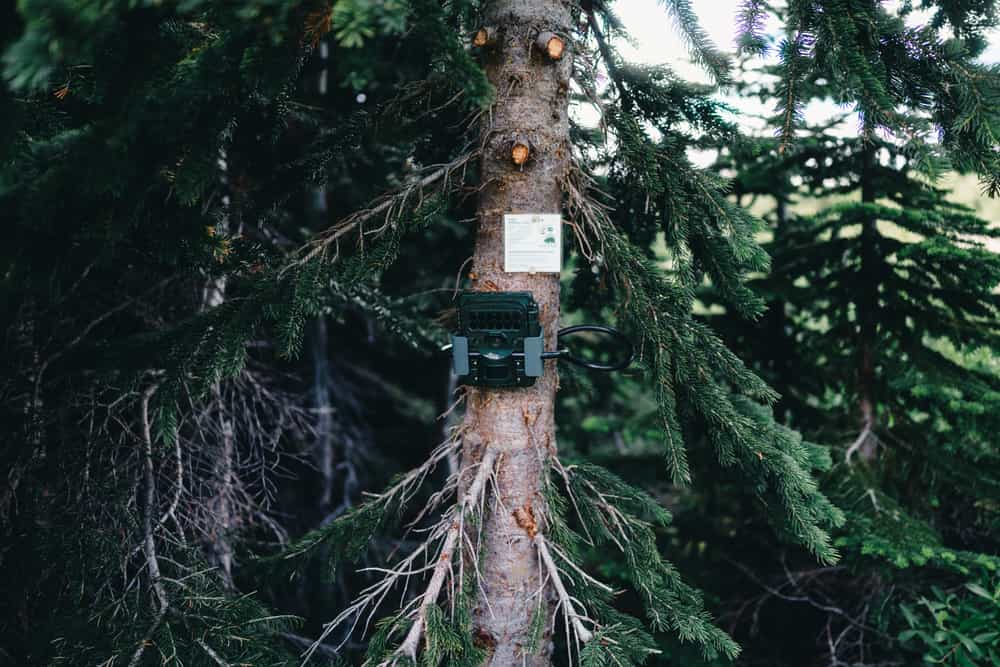
- Counting. You need to know how many hogs are in the sounder, because that number tells you when the trap is full. AgriLife notes that a camera-based remote trigger "can allow managers to see exactly how many pigs are present before closing the gate." The count you build now is the one you'll check against later.
- Timing. Photo time stamps show when the group arrives, which is when you'll watch the trap or sit the stand.
- Fewer trips. A cellular camera sends images to your phone, so you aren't walking in every day to pull a card. Given TPWD's note that human activity can push hogs toward night feeding, fewer visits is one more reason to check by phone.
Start the bait once you know where they travel. AgriLife lists common baits as "deer corn, soured corn, manufactured baits, or ripening crops," and our ranking of the best hog trap baits covers the store-bought options. For cameras, our best cellular trail cameras page compares networks, no-glow flash and data plans, and the feeders and trail cameras hub covers the rest of the bait-site setup.
Step 2: Trap the whole sounder
Trapping does the heavy lifting in this plan, so it gets its own full guide: Step 2, in full: how to trap feral hogs. Here is the short version and why it works.
Go big: corral over box
AgriLife calls corral traps "a very successful trap style for catching feral hogs because their large size can facilitate capturing entire sounders at once." Box traps are mobile but catch fewer pigs, and AgriLife's trap design page notes some "trap-wise" hogs avoid them altogether. TPWD cites studies that found corral traps "provided a capture rate greater than four times that of individual box traps" (TPWD). Our corral trap vs box trap comparison goes further.
AgriLife's corral design, by Billy Higginbotham and Don Neuendorff, comes down to a few rules:
- Sheep and goat panels (4 in. x 4 in. squares, 5 ft high) or similar, held by T-posts about every 4 feet.
- A teardrop shape with the gate in the narrow end, and no hard corners where hogs can pile up and go over the top.
- No gaps along the bottom.
- A door 32 to 36 inches wide in total opening.
If you're building one, our guide on how to build a hog trap walks through materials and layout.
Pre-bait until they all come in
AgriLife says to keep bait available "every single day" so the site becomes part of the sounder's regular route. Once the trap is up, its placing-and-baiting publication says to keep pre-baiting inside it "for few more days to ensure the entire sounder (group) is comfortable entering the trap," then to bait all the way back to the trigger when you're ready to catch.
You decide when the gate drops
The trigger is where whole-sounder trapping succeeds or fails. AgriLife separates nonspecific triggers (pressure plates, trip wires) from pig-specific ones such as a rooter stick or a bucket, and describes a camera-based remote trigger that lets you see exactly how many pigs are inside before you close the gate. With the count from Step 1, you wait until the last sow and her piglets are in, then drop it. AgriLife also notes that traps can be checked in person or with cameras that send monitoring to your phone.
After the catch
Plan this before the gate drops. Live hogs can be moved only under Texas Animal Health Commission rules, and relocating and releasing them is illegal. See what to do with trapped hogs in Texas for your options, and how to field dress a hog if you're keeping the meat.
Step 3: Shoot the ones that got away
Trapping doesn't always get every hog. AgriLife's selective shooting page calls shooting "a great way to finish off a sounder (or group of pigs) that was only partially removed through trapping," and says it's especially useful when hogs first show up on a property in very small numbers. Paired with thermal imagery or night vision, AgriLife says, shooting can remove the final hogs that have avoided other efforts.
Order matters. Missouri's Department of Conservation, which is working toward eradicating feral hogs in that state, warns that "shooting one or two hogs scatters the sounder and makes trapping efforts aimed at catching the entire group at once more difficult" ( MDC). So don't shoot at a site you're pre-baiting for a trap. Trap first, then shoot what the trap didn't catch.
Seeing hogs at night
Much of this shooting happens after dark, which is legal on private land in Texas (see can you hunt hogs at night in Texas?). You have two ways to see:
- Thermal finds hogs by their heat, with no light on them. Our best thermal scopes for hog hunting ranks scopes by budget tier, and the thermal and night vision hub explains sensors, lenses and what each price tier buys.
- Lights cost less. A motion-activated light at the bait site lets you watch without a beam sweeping the pasture; our best hog feeder lights page ranks them. The hunting lights hub covers scope-mounted lights and colors.
Set up a rest and a place to sit where the shot angles into a safe backstop. The blinds, rests and field gear hub covers ground and box blinds and shooting sticks. For cartridges, our editorial guide to the best caliber for hogs covers the options (we don't sell firearms or ammunition). AgriLife stresses that "correct shot placement is important to ensure the process is quick and humane."
Step 4: Fence what you must protect
A fence doesn't remove hogs. It keeps the next group out of the few places you can't afford to lose: a garden, a food plot, a deer feeder, a hay meadow near the house. AgriLife's preventative options page gives three versions:
- Net-wire perimeter. "A strong, 6-foot net-wire perimeter fence will deter most feral hogs," installed with the bottom touching the ground everywhere so hogs can't crawl under a high spot.
- Electric. At least two strands, with the lower one low enough to hit juvenile and adult pigs on the nose, at about 8 and 18 inches. Keep vegetation cleared so the fence doesn't ground out. AgriLife warns the charge has to be strong enough that this is inadvisable where people are often around, and that hogs can become desensitized if food is scarce or the fence is overused, so it may not be a permanent fix.
- Around feeders. "A short fence 28 inches to 34 inches in height can be constructed around the perimeter of the area where food is spread." A December 2025 NRI article reported that a 20-inch fence reduced hog access but didn't stop it, while 28 to 34 inches kept hogs out completely, and recommended 34-inch hog panels in a 30 ft by 30 ft circle.
AgriLife also lists attractants to remove: pet food, bird seed, livestock feed and garbage. For the details, see our best electric fence for hogs ranking (chargers rated on output joules), our guide to keeping hogs away from a deer feeder, and the best hog-proof deer feeders.
What the plan needs
Put the four steps together and the shopping list is short: a camera to pattern and count, a trap that holds a whole sounder with a gate you control, a way to see at night for the cleanup, and a fence charger for the spots you protect. Budgets vary a lot here. A complete net trap system sits in our $2,000 and up tier as seen on Amazon on 2026-09-19, while the camera, the entry thermal and the charger below sit well under that. If the trap is out of reach, the cheaper route is a DIY corral from farm-store panels with a drop gate and a cellular trigger, covered in our hog trap rankings. One pick per step:
Our picks for this job
One pick for each step of the plan
Chosen from our rankings for the job each step does. Every figure is the maker's published spec; we haven't tested these units.
 Stock photo
Best whole-sounder trap system on Amazon
Boar Blanket Feral Pig Net Trap
$2,000 and up6.2/10ResearchedStep 2. A round, 20 ft suspended net on 8 T-posts: the corral-style layout that catches groups, with no steel panels to haul. The remote drop needs a HogEye camera bought separately, and T-posts aren't included.
Check price · Amazon#ad · Price set by Amazon · How we make money for the link to Boar Blanket Feral Pig Net Trap
 Stock photo
Best overall cellular trail camera
Tactacam Reveal Pro 4.0 Solar
Under $5008.5/10ResearchedStep 1. Selectable no-glow flash, GPS and a solar listing, so it can watch a bait site for weeks and send the count to your phone. Live View costs extra.
Check price · Amazon#ad · Price set by Amazon · How we make money for the link to Tactacam Reveal Pro 4.0 Solar
 Stock photo
Best entry thermal for feeder distances
AGM Rattler V2 19-256
$500 to $1,0007.1/10ResearchedStep 3. An entry thermal for feeder and trap distances, with up to 11.5 hours per battery and a spare in the box. The 256 sensor limits positive ID past about 150 yards.
Check price · Amazon#ad · Price set by Amazon · How we make money for the link to AGM Rattler V2 19-256
 Stock photo
Best charger for a food plot without power
Patriot P10 Dual Purpose Fence Energizer
Under $5007.6/10ResearchedStep 4. 1.0 output joule from a 12 V battery or a wall plug, so it can power a two-strand hog fence at a plot with no outlet. Battery and solar panel are sold separately.
Check price · Amazon#ad · Price set by Amazon · How we make money for the link to Patriot P10 Dual Purpose Fence Energizer
What's legal in Texas
Texas gives landowners a lot of room with feral hogs, with a few hard lines. The short list is below; our full guide to Texas hog hunting laws covers each rule with its source.
For night work specifically (lights, thermal, vehicles, public land), read our night hunting guide.
What doesn't work
Shooting a hog here and there
AgriLife Today put it plainly in 2019: "recreational hunting alone cannot control the wild pig problem." Missouri's Department of Conservation adds that "with their high reproductive rate, removing one or two hogs does not help to reduce populations," and that hogs "become trap-shy and more wary of baited sites" ( MDC). The Internet Center for Wildlife Damage Management says "unsuccessful attempts will cause wild pigs to stay under cover and to change feeding habits, making control more difficult" (ICWDM). Every hog that survives a close call is a hog that's harder to catch.
Small traps that catch one or two
The same logic applies to traps. AgriLife Today: "If you set a trap that only captures one or two animals at a time, odds are pretty good you won't catch any other wild pigs that saw the earlier misfortune of their brethren." TPWD adds that hogs not caught from a large sounder "may develop learned behavior which makes them more difficult to trap in the future."
Repellents and scare devices
On repellents for wild pigs, ICWDM says: "None are registered." On frightening devices: "No frightening devices are effective for the control of wild pigs." It notes that hunting pressure may move pigs out of an area for a limited time, which isn't the same as removing them.
Poison as a do-it-yourself fix
Warfarin, sold as Kaput Feral Hog Bait, is a state-limited-use pesticide in Texas when used as a feral hog toxicant, effective January 31, 2024. Only licensed pesticide applicators, or people under their direct supervision, may buy it (TDA). AgriLife says the label requires a hog-specific feeder and a detailed pre-baiting process, and that following it is critical to use the product legally (AgriLife chemical control). It isn't a landowner shortcut, and we don't recommend or link it.
Drones to find them
A thermal drone sounds like the perfect scouting tool. In Texas it is unlawful to use aircraft, drones included, to hunt, locate or photograph wildlife without an activity-specific permit (TPWD means and methods). The permit is TPWD's Aerial Wildlife Management permit. Use cameras on the ground instead.
Catch and release somewhere else
AgriLife: "Relocation to release is not a feasible option and in Texas is illegal." A fence alone isn't the answer either; as noted above, hogs can get used to an electric fence when food is short.
When to call a professional
Some jobs are bigger than one landowner with a trap: a lot of acreage, hogs that keep coming after you've trapped, a sounder that splits across several properties, or simply no time to run a trap every evening. These are the public resources we can point you to:
- Your county AgriLife Extension office. AgriLife Extension's feral hog management program says "Looking for solutions in your county? Contact your local extension experts." Find your office in the AgriLife Extension county directory.
- Texas Wildlife Services Program. Part of Texas A&M AgriLife, it works "through a cooperation with federal, state, and private entities," using "technical assistance and direct control services" (Texas Wildlife Services). Its who-to-contact page lists district offices around the state.
- Aerial control. Helicopter work over private land runs under TPWD's Aerial Wildlife Management permit, so it's a job for permitted operators, not a landowner with a drone.
If you hire a private trapper, ask what happens to the hogs. Anyone moving them alive has to follow the TAHC rule: straight to a recognized slaughter facility, an approved holding facility or an authorized hunting preserve.
Keep at it
AgriLife is direct about the timeline: "Long-term success will require long-term management and the flexibility to adapt as the situation changes." After a good catch, leave the cameras up and keep watching the bait site. New hogs can move in and survivors can come back. Talk to your neighbors, too. MDC credits its progress to "concentrated trapping efforts by state and federal employees and private landowner partners," and the same idea works across a fence line.
When you're ready, start with the camera, then Step 2: trap the whole sounder.
How we scored this
Units we claim to have tested: 0
Plenty of gear sites say they field-tested everything they list. We haven't, and we say so. Every pick here is labeled Researched: we read each maker's published specs, manuals and warranty terms, compare products only against others in the same budget tier, and score them on a public rubric. Every figure links to where it came from, and seller performance numbers are labeled “maker's claim.”
Scores are editorial judgments from that documented research, not test results. Commissions never set a score or decide a pick. The rubric and its weights are published.
Questions
Frequently asked
What is the most effective way to get rid of feral hogs?
Does hunting feral hogs reduce the population?
How many hogs do you have to remove to control them?
Do hog repellents work?
Is it legal to poison feral hogs in Texas?
Can you get rid of feral hogs for good?
Who can help with feral hogs in Texas?
Receipts
Sources
- Texas A&M AgriLife: Coping with Feral Hogs, Feral Hog Management (checked 2026-09-19)
- Texas A&M AgriLife: Coping with Feral Hogs, Trapping (checked 2026-09-19)
- Texas A&M AgriLife: Coping with Feral Hogs, Hog Trap Design (checked 2026-09-19)
- Texas A&M AgriLife: Placing and Baiting Feral Hog Traps, IRNR-PU-060, Feb. 2011 (checked 2026-09-19)
- Texas A&M AgriLife: Coping with Feral Hogs, Selective Shooting (checked 2026-09-19)
- Texas A&M AgriLife: Coping with Feral Hogs, Preventative Options (checked 2026-09-19)
- Texas A&M AgriLife: Coping with Feral Hogs, Impacts (checked 2026-09-19)
- Texas A&M AgriLife: Coping with Feral Hogs, Chemical Control (checked 2026-09-19)
- AgriLife Today: publication on urban and suburban feral hog management, Jan. 15, 2026 (checked 2026-09-19)
- AgriLife Today: feral hog toxicant article, Aug. 31, 2023 (checked 2026-09-19)
- AgriLife Today: Things you need to know about wild pigs, Oct. 4, 2019 (checked 2026-09-19)
- Texas A&M NRI: Startling statistics everyone needs to know about wild pigs, Nov. 2, 2019 (checked 2026-09-19)
- Texas A&M NRI: Using exclusion fencing to prevent feral hog access at feeding stations, Dec. 16, 2025 (checked 2026-09-19)
- Texas A&M AgriLife Extension: Feral Hog Management program page (checked 2026-09-19)
- Texas A&M AgriLife Extension: County Offices directory (checked 2026-09-19)
- Texas Wildlife Services Program: home page (checked 2026-09-19)
- Texas Wildlife Services Program: Who to Contact (checked 2026-09-19)
- TPWD: Nuisance Wildlife in Texas, Wild Pigs (checked 2026-09-19)
- TPWD: Outdoor Annual 2026-27, Nongame and Other Species (Feral Hogs and Coyotes) (checked 2026-09-19)
- TPWD: Outdoor Annual 2026-27, General Regulations: Means and Methods (checked 2026-09-19)
- TPWD: Law enforcement FAQ, spotlighting coyotes and feral hogs in deer country (checked 2026-09-19)
- TPWD: Aerial Wildlife Management permit (checked 2026-09-19)
- Texas Parks and Wildlife Code §62.005, Hunting with Light (texas.public.law, checked 2026-09-19)
- Texas Parks and Wildlife Code §62.0031, public roads (texas.public.law, checked 2026-09-19)
- 4 Texas Administrative Code §55.9, feral swine movement (Cornell LII, checked 2026-09-19)
- Texas Department of Agriculture: Feral Hog Pesticide (checked 2026-09-19)
- USDA APHIS: Feral Swine, Managing an Invasive Species (damage figures) (checked 2026-09-19)
- Missouri Department of Conservation: Feral Hogs in Missouri (checked 2026-09-19)
- Internet Center for Wildlife Damage Management: Wild Pig Damage Prevention and Control Methods (checked 2026-09-19)
- Boar Blanket: product specs page (checked 2026-09-19)
- Tactacam: REVEAL Pro 4.0 product page and spec table (checked 2026-09-19)
- AGM Global Vision: Rattler V2 19-256 product page and spec table (checked 2026-09-19)
- Patriot: P10 Dual Purpose Fence Energizer product page (checked 2026-09-19)
We haven't tested the gear on this page and we don't pretend to. Specs come from each maker's own pages or the product listing (linked on every product), hog biology and trapping advice from Texas A&M AgriLife, and rules from TPWD and Texas statute. Prices are set by Amazon and change often, so we don't print them. Where a figure isn't published, we say so. Read the full method.