Not legal advice. This page summarizes Texas rules from the official sources linked in the text (TPWD Outdoor Annual, valid Sep 1, 2026 through Aug 31, 2027). Rules checked . Laws change: confirm the current rules with Texas Parks and Wildlife and your local game warden before you rely on them.
What a feeder light is actually for
A feeder light is not a search light and it is not a substitute for thermal. It does exactly one job: it makes the corn scatter visible so you can identify what is standing on it and place a shot. That framing settles most of the setup decisions, because it means the light belongs pointed at the feed, not at you and not down the field.
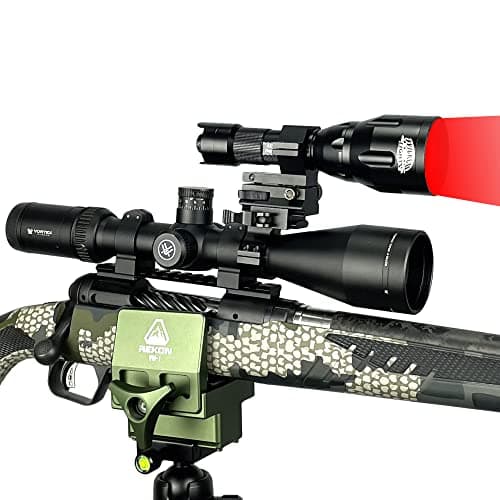
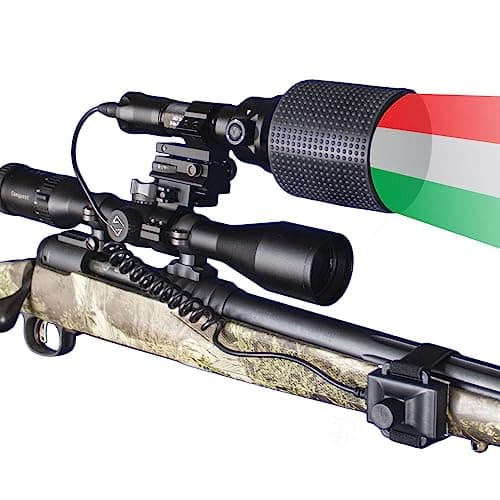
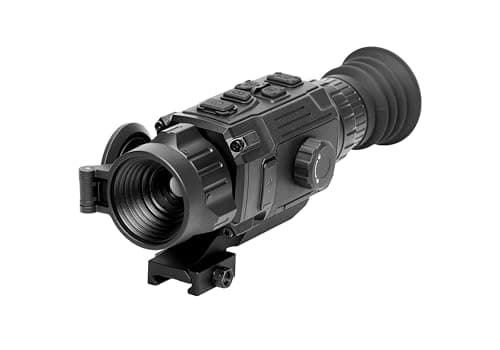
It is also the cheapest honest route into night hunting. If you are not ready to spend on a thermal, a feeder light plus a day scope covers the distance at which most hogs actually get shot. We lay out that whole route on how to hunt hogs at night without thermal, and rank the lights themselves on best hog feeder lights.
Where to mount it
Three options, in order of how well they usually work:
- On a T-post or tree 10 to 15 feet to one side of the feeder. Our preference. Lighting the scatter from an angle gives you shadow and shape, which is what lets you judge body size. A light directly overhead flattens everything into a pale blob.
- On the feeder leg. Simplest, and what most of these lights are designed for. Straps or brackets, no extra post, and the solar panel is already up where the sun is.
- On the blind or stand. Only if nothing else is possible. A light at your position lights the ground between you and the animal, lights you if anything is behind it, and ruins your own dark-adaptation every time it comes on.
Whichever you pick: put it so the light falls across your line of sight rather than straight back toward you. A light shining into your scope is how people end up unable to see the animal they have lit.
Height and aim
Height: about 8 to 10 feet. High enough that hogs cannot reach it, rub on it or root the post over, and high enough to throw a pool of light across the whole scatter. Low enough that you can reach it with a short ladder to clean the lens and check the battery, which you will be doing more than you expect.
Aim: down, at the feed. Set it so the bright center of the pool sits on the scatter and the edges fade into the dark. Two specific aiming errors to avoid:
- Too flat. A light aimed horizontally throws into the brush and silhouettes anything standing in it, which looks dramatic and tells you nothing about whether that is a sow or a shoat.
- Hot spot in your sight picture. If the bright center of the beam is in your scope, your pupil closes down on it and the animal at the edge disappears. Walk to your stand and look before you call the install finished.
Also think about the wind and the approach while you are up the ladder. The light should cover where hogs come in from, not just where the corn lands, so you see them arrive rather than discovering them already feeding.
Which color to run
Green or red. The full argument, including what the published colour-vision research does and does not support, is on red vs green light for hog hunting — the underlying study on pig colour vision is Neitz and Jacobs (1989), and it is more limited than the marketing around it suggests. The practical summary:
- Green gives the human eye the most usable brightness per watt and the best detail for identification. It is the default on most feeder lights for that reason.
- Red preserves your own night vision better and is the quieter choice on a feeder that gets hunted often.
- Amber sits between the two; several lights offer it and few people have a strong view.
- White: no. Not on a feeder you intend to hunt repeatedly.
A light with switchable colours is genuinely useful here, because you can run red for weeks of conditioning and step up to green only on nights you intend to shoot.
Motion, photocell or always-on
| Mode | What it does | Use it when |
|---|---|---|
| Motion-activated | Comes on when something moves in range | Saves battery; good on a feeder you visit rarely. The switch-on is the moment that can spook a wary sounder |
| Photocell (dusk to dawn) | On all night, every night | Best for conditioning, and the mode we would run while hogs are learning the site. Needs the most power |
| Timer / low-mode all night | Low output continuously, brighter when triggered | The best of both, if your light has it |
| Remote control | You turn it on from the stand | Only once hogs are already comfortable; otherwise it is a strobe to an animal that has never seen it |
If your light has an all-night low mode and a motion-triggered bright mode, that combination is the one to run. The low mode does the conditioning work; the bright mode gives you the identification when something arrives.
The two-week conditioning routine
This is the part people skip and it is the part that decides whether the light works. Texas A&M's research summary on feral swine activity patterns and behavioural modification describes animals shifting their routines in response to pressure. A new light at a feeder is pressure until it is furniture.
- Days 1-3: light on, no hunting. Photocell or low mode, dusk to dawn. Do not go near the feeder after dark.
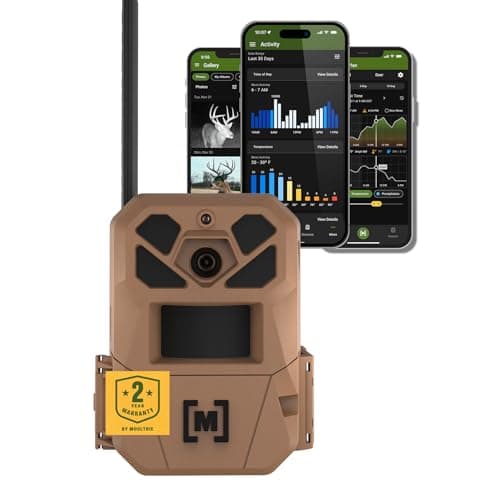
- Days 4-10: keep it running, watch on camera. A cellular camera tells you whether hogs are feeding under it and at what time, without you walking in. See best cellular trail cameras.
- Days 11-14: confirm the whole group is comfortable. Not the first brave shoat — the sounder.
- Then hunt it, once. Then leave it alone for a week or more.
If hogs stop coming when the light goes in, turn it to its lowest setting or to red and start the clock again. Patience here is worth more than any feature on the box. And if you are feeding on a timer, our when are hogs most active page is worth reading alongside this — matching the feed time to their routine shortens the whole process.
Lights that suit this setup
Our picks for this job
Four lights that fit the routine above
What matters for this setup: a colour you can change, an all-night low mode, solar so it survives weeks of conditioning, and a mount that fits a feeder leg or a T-post. Every spec is the maker's published figure; scores come from our published feeder-light rubric.
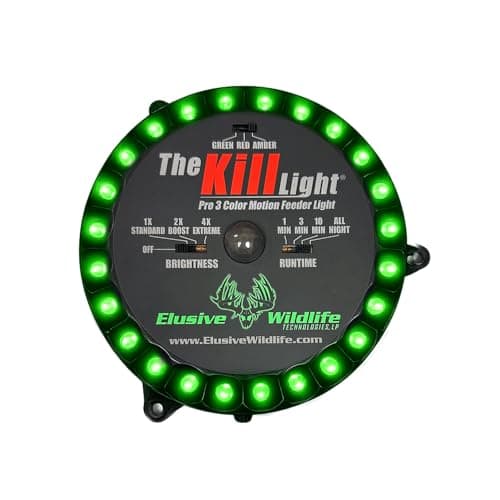
Best multi-color feeder light
Elusive Wildlife 3 Color Motion Activated Feeder Light
Under $5008.3/10ResearchedThe pick for the conditioning routine: switch to red while hogs settle, then green on the night you hunt, from one unit.
$69.99Amazon#ad · Price as of October 11, 2026 · How we make money for the link to Elusive Wildlife 3 Color Motion Activated Feeder Light
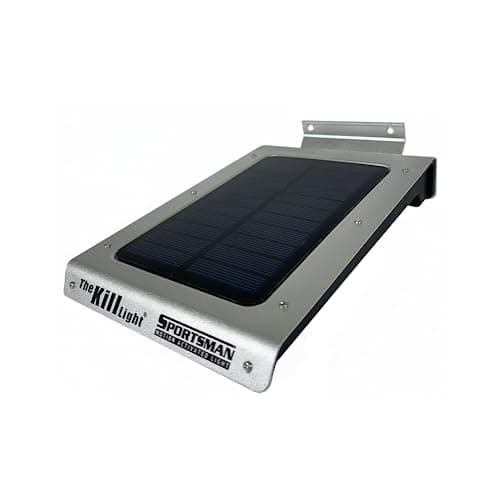
Best solar light with all-night low modes
Elusive Wildlife Sportsman Motion-Activated Light
Under $5007.8/10ResearchedSolar with all-night low modes - the mode combination this page is built around.
$49.99Amazon#ad · Price as of October 11, 2026 · How we make money for the link to Elusive Wildlife Sportsman Motion-Activated Light
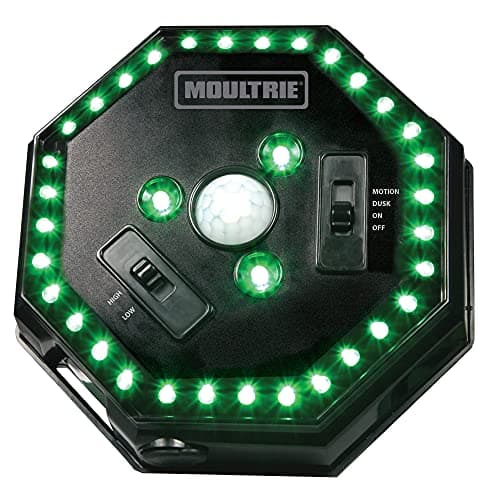
Best for Moultrie feeders
Moultrie Feeder Hog Light
Under $5007.2/10ResearchedThe simple answer if you already run a Moultrie feeder; it is designed to go on that leg.
$47.99Amazon#ad · Price as of October 11, 2026 · How we make money for the link to Moultrie Feeder Hog Light
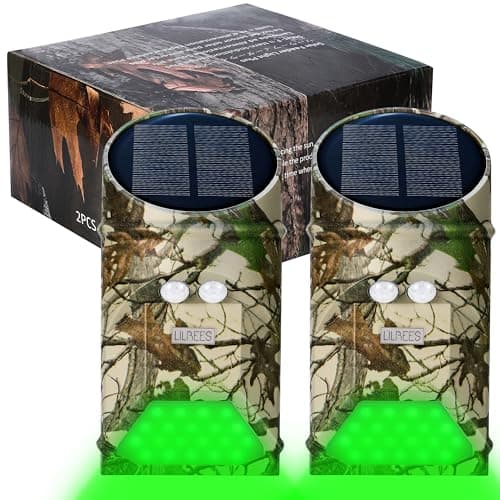
Best two-pack for covering a feeder
LILBEES G300 Solar Hog Feeder Light (2-Pack)
Under $5006.4/10ResearchedTwo lights, which is how you light a scatter from an angle on both sides instead of flattening it from overhead.
$54.99Amazon#ad · Price as of October 11, 2026 · How we make money for the link to LILBEES G300 Solar Hog Feeder Light (2-Pack)
Solar panels and batteries
A feeder light that dies in week two of conditioning has cost you the whole routine, so power is not a footnote.
- Aim the panel south and tilt it. A panel strapped flat to a vertical feeder leg collects a fraction of what it could.
- Watch for shade. The tree that shades the feeder in summer is the reason the light stops working in September.
- Clean the panel and the lens. Dust and pollen on a small panel matter a lot; spider webs across a lens look like fog in a scope.
- Carry spare batteries on every feeder trip. You are already there with a bucket of corn.
- Expect less in winter. Short days and low sun; a light that just managed in July may not in December.
If you are running a motion-activated light on batteries alone, the activation count drives the drain — a busy feeder with raccoons on it all night will flatten it far faster than the spec sheet implies.
Mistakes people make
- Hunting it the first night. The single commonest mistake. Give it two weeks.
- Mounting it too low. Hogs rub, root and knock over anything at their height.
- Aiming it at the shooting lane instead of the feed. You want to see the animal, not the grass.
- Putting the beam's hot spot in your own sight picture. Go and look from the stand before you finish.
- Running white. It works once.
- Maximum brightness, always. Use the least light that lets you identify. More output is more pressure and more battery.
- Forgetting the panel faces the sun.
- No camera on the feeder. Without one you are guessing whether the conditioning worked.
How we scored this
Every score, built from the published record
Every pick here is labeled Researched: we read each maker's published specs, manuals and warranty terms, compare products only against others in the same budget tier, and score them on a public rubric. Every figure links to where it came from, and seller performance numbers are labeled “maker's claim,” so you can see exactly what you are buying.
Scores are our editorial read of that documented evidence. Commissions never set a score or decide a pick. The rubric and its weights are published.
What changed
- Published.
Questions
Frequently asked
How high should you mount a hog feeder light?
Where should a feeder light point?
Do feeder lights spook hogs?
What color feeder light is best for hogs?
Motion-activated or always-on feeder light?
Receipts
Sources
- Elusive Wildlife: Kill Light 3 Color Feeder Light product page, colours and power options (checked 2026-10-11)
- Elusive Wildlife: Kill Light Sportsman motion-activated feeder light product page and modes (checked 2026-10-11)
- Moultrie: Feeder Hog Light product page and mounting detail (checked 2026-10-11)
- Amazon search results for "feeder hog light green motion activated", used to check what the category currently lists (checked 2026-10-11)
- Texas A&M Natural Resources Institute: activity patterns and behavioral modifications of feral swine (checked 2026-10-11)
- Neitz & Jacobs (1989), spectral sensitivity of cones in an ungulate (PubMed abstract; checked 2026-10-11)
- TPWD: Outdoor Annual, Nongame and Other Species, feral hogs (checked 2026-10-11)
- Texas Parks & Wildlife Code §62.004, Hunting at Night (texas.public.law; checked 2026-10-11)
- Texas Parks & Wildlife Code §62.005, Hunting with Light (texas.public.law; checked 2026-10-11)
Specs come from each maker's own pages or the product listing (linked on every product), hog biology and trapping advice from Texas A&M AgriLife, and rules from TPWD and Texas statute. Prices are set by Amazon and change often, so we don't print them. Where a figure isn't published, we say so. Read the full method.