Not legal advice. This page summarizes Texas rules from the official sources linked in the text (TPWD Outdoor Annual, valid Sep 1, 2026 through Aug 31, 2027). Rules checked . Laws change: confirm the current rules with Texas Parks and Wildlife and your local game warden before you rely on them.
Most of this site is about hogs, and this page is about coyotes for a simple reason: if you've built a night rig for hogs, you already own most of what a night coyote hunt needs. Texas treats the two together in places, too. TPWD's answer on spotlights covers "coyotes and feral hogs" in one sentence. What changes is how the animal comes to you: hogs come to feed you put out, and coyotes can be called in. This guide covers the gear, the calling setup as wildlife agencies describe it, and the rules, with every behavior claim cited.
What the agencies say about coyotes at night
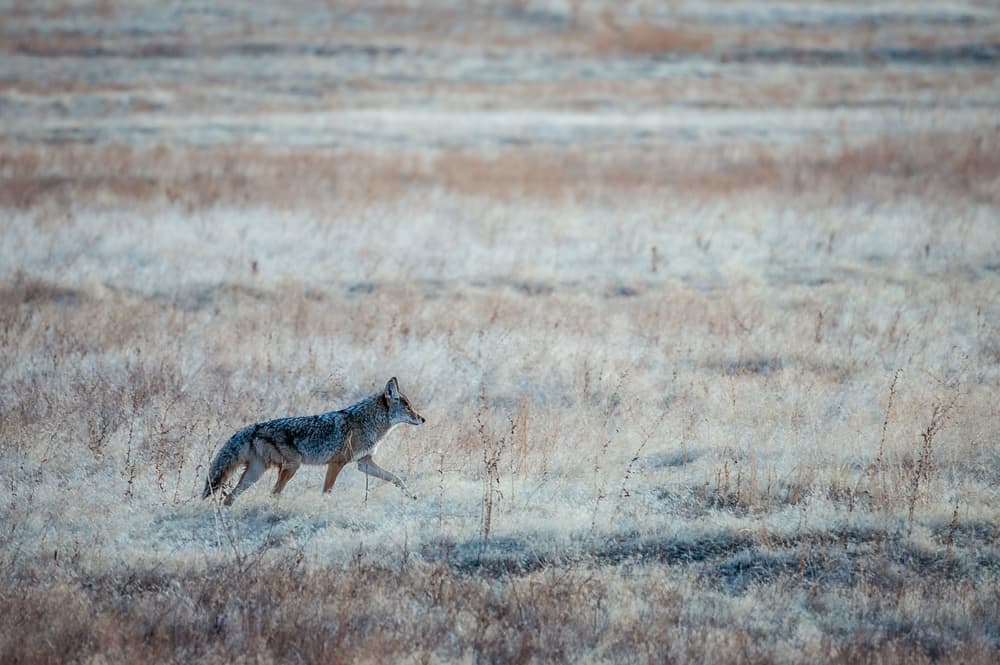
TPWD's species page says the coyote "primarily is nocturnal and very opportunistic," that in Texas "they range throughout the state," and that they're most typically associated "with open plains in the West and brushy areas in the East" ( TPWD, Coyote). TPWD's Junior Naturalists page adds that coyotes "hunt at all hours of the day and night but may be seen more often in the early morning or just before sunset," and that "howls are used to keep in touch with other coyotes in the area" ( TPWD Junior Naturalists).
On calling, the Internet Center for Wildlife Damage Management says coyotes can be called at any time of day, with the first hours after dawn and the last hours before dark usually best. It also says "coyotes may respond to calls of other predators," that "a human imitation of a howl also may work," and that "coyotes often come to a howl without howling back, so the prudent hunter is always ready to shoot" (ICWDM, coyote control methods).
Put those together and the night hunt makes sense: the animal is active after dark, it can be called, and the hard part is seeing it arrive. ICWDM is blunt about that last point: calling without artificial lights "is effective only with snow cover and the light of a full moon or with night vision scopes." Without snow and a full moon, that leaves a light or a thermal to do the work.
Your hog rig already does most of it
| Job | Hogs over a feeder | Coyotes on a calling stand |
|---|---|---|
| Bring the animal in | Feed put out every day at one site | An electronic caller or mouth call |
| See it arrive | A feeder light on the pad, or a thermal | A thermal scanner, or a scope light brought up to look |
| Identify it | Dimmable scope light or thermal scope | Same |
| Shoot steady | A clamping tripod set before dark | A lighter rest you can set up fast at each stand |
| Texas spotlight rule | TPWD answers "Yes" for coyotes and feral hogs in deer country, with a courtesy call to the game warden | |
The optic, the scope light and your safety habits carry straight over. The two things that change are the caller, which we don't rank, and the rest: a feeder sit rewards a heavy clamping tripod, while a calling hunt that moves between stands rewards something lighter and quicker to set. If you're starting from nothing, our hog hunting lights and thermal scopes for hogs rankings cover the core pieces for both animals.
What to look for in a night coyote rig
A scanner that sees heat
A handheld thermal monocular lets you watch the edges of a calling setup without pointing a rifle at anything. What to compare: sensor resolution (384x288 shows more detail than 256x192), lens size (a longer lens reaches farther but narrows the view), battery life and whether the battery is removable, and weight, since it lives in a pocket. TPWD places coyotes on open plains in the West and in brushy areas in the East, and that's a fair way to choose a lens: short and wide for brush, longer for open country. Our best thermal monoculars rank the options by budget.
The best coyote night hunting light for a hog hunter
The light's job is to confirm what the thermal found and let you see the reticle on it. Look for a dimmer, a focus you can tighten to a spot for reaching out, a mount that fits your scope tube, and a color with some evidence behind it for coyotes (more on color below). If you hunt open plains, reach matters more here than it does over a 100-yard hog feeder.
A rest you can set up in seconds
If you move between calling stands in a night, you'll set up the rest several times, quietly and in the dark. A rest that sets its height with one hand and weighs a few pounds suits that better than a heavy clamping tripod. Our shooting sticks and tripods compare both styles, and the Trigger Stick vs DeathGrip comparison covers the trade-off in detail.
Our picks for this job
A night rig for coyotes and hogs
One pick per job, chosen from published specs. Each one earns its keep on a hog feeder as well as a calling stand.
 Stock photo
Best compact 384 scanner
Pulsar Axion Compact XQ19
$500 to $1,0007.6/10ResearchedA 384x288 scanner at 8.8 oz with a removable battery rated up to 8 hours and an IPX7 body. The 19 mm lens favors wide scanning over long-range detail.
Check price · Amazon#ad · Price set by Amazon · How we make money for the link to Pulsar Axion Compact XQ19
 Stock photo
Best middleweight long-range kit
Sniper Hog Lights Hyperion 50 Gun Hunters Kit
Under $5008.1/10ResearchedDial dimmer, lockable focus and a windage-and-elevation mount. Throw claims of 750 yd in red and 1,340 yd in green. The kit ships with one module, so pick your color.
Check price · Amazon#ad · Price set by Amazon · How we make money for the link to Sniper Hog Lights Hyperion 50 Gun Hunters Kit
 Stock photo
Best one-hand shooting stick for stalking
Primos Trigger Stick Gen3 Tall Tripod
Under $5007.5/10ResearchedSets height one-handed from 24 to 62 in at about 3.5 lb, so it moves stand to stand. The yoke cradles the rifle rather than clamping it.
Check price · Amazon#ad · Price set by Amazon · How we make money for the link to Primos Trigger Stick Gen3 Tall Tripod
Setting up a night calling stand
These steps come from what ICWDM and the Missouri Department of Conservation publish about calling coyotes, plus the Texas rules. We haven't called coyotes for this page; the steps follow what those agencies publish.
- Get permission and make the call to the warden. On your own land or with the landowner's permission, make TPWD's recommended courtesy call to the local game warden before you hunt at night.
- Set up downwind. ICWDM: "Coyotes can detect the scent of humans, so shooters should be positioned downwind from where the coyote likely will approach."
- Arrive quietly. MDC's advice: "Make as little noise as possible from the time you arrive until you have settled into your shooting position. Stealth is everything" ( MDC, Getting Started Hunting Coyotes). Set the rest height and check your field of fire before the first call.
- Scan before you call. Sweep the setup with the thermal so you know what's already out there, including cattle, deer and anything you must not shoot.
- Call. MDC notes that "a reliable electronic game caller with animal vocalizations seems to be the most popular call, but predators can be called in with mouth calls that imitate rabbits or rodents in distress."
- Stay ready and keep scanning. ICWDM's point that coyotes often come to a howl without answering is the reason to keep the rifle on the rest and the scanner working the edges.
- Light to identify, then decide. Bring the scope light up, dimmed, only when the thermal shows something worth a look. Confirm the animal and what's behind it before you shoot.
What color light for coyotes?
For coyotes, the one authoritative line we found is ICWDM's: "Red or blue light does not spook coyotes like white light does." It says nothing about green, and we didn't find a field study behind it, so treat it as a published guideline rather than a settled fact.
For hogs, the evidence is different. Pigs have two types of color cones, peaking in the blue and green-yellow range (Neitz & Jacobs, 1989). Hunters use red and green lights on the theory that hogs see those colors poorly; how hogs actually respond varies, and we haven't found a field study that settles it (study abstract).
If one light has to serve both animals, red is the color with a published line behind it for coyotes, and it's one of the two colors hog hunters use. With a one-module kit like the Hyperion 50, that makes red the sensible first module. With a multi-color head you don't have to choose. Our red vs green comparison covers the hog side in depth.
Thermal, night vision or a light?
Thermal shows heat, so it finds a coyote in full darkness without putting any light out, and it doesn't depend on moon or snow. Digital night vision needs infrared illumination to see in full darkness, from a built-in or add-on IR light, so its range is tied to that illuminator; our IR illuminator picks cover the add-ons. A visible light is the simplest, but you only see what you point it at, and scanning with a rifle-mounted light means pointing the rifle at everything you look at.
One practical split: a thermal monocular to scan, and a scope light (or a thermal scope) to identify and shoot. That's the rig in the picks above, and it keeps the rifle pointed at the ground until you've found something worth a look. For the full side-by-side, see thermal vs night vision; the trade-offs it lays out for hogs apply to coyotes too.
Texas rules for night coyote hunting
About licenses: TPWD's statement that "no hunting license is required to hunt feral hogs on private property with landowner authorization" is written for feral hogs. Don't assume it covers coyotes. Check the coyote rules in the same TPWD Outdoor Annual section before you go. For the night rules in full (lights, thermal, vehicles and public land), read our guide to hunting hogs at night in Texas; the light and road rules apply to a coyote hunt the same way. This is a summary, not legal advice.
Outside Texas, check the calendar
Night coyote rules vary a lot by state, and some depend on the date. Missouri is a good example. Its coyote regulations for 2026 allow artificial light, and night vision, infrared or thermal equipment, for coyotes from Jan. 1 to April 19 and from May 11 to Sept. 30. Electronic calls may be used with artificial light or night-vision equipment only when hunting coyotes in those same windows, and coyotes may not be hunted in daylight from April 1 until spring turkey season opens (MDC, Coyote Regulations). Wherever you hunt, read your state agency's current rules before you take a light or a thermal out after dark.
The same rig takes you back to the hogs the next night. For the rest of the night gear, see the hog hunting lights hub.
How we scored this
Units we claim to have tested: 0
Plenty of gear sites say they field-tested everything they list. We haven't, and we say so. Every pick here is labeled Researched: we read each maker's published specs, manuals and warranty terms, compare products only against others in the same budget tier, and score them on a public rubric. Every figure links to where it came from, and seller performance numbers are labeled “maker's claim.”
Scores are editorial judgments from that documented research, not test results. Commissions never set a score or decide a pick. The rubric and its weights are published.
Questions
Frequently asked
Is it legal to hunt coyotes at night in Texas?
What is better for coyote hunting, thermal or night vision?
What color light is best for night hunting coyotes?
What time is best for calling coyotes?
Can I use my hog hunting setup for coyotes?
Do I need a hunting license to hunt coyotes in Texas?
Receipts
Sources
- TPWD: Coyote (Canis latrans) species page (checked 2026-09-19)
- TPWD: Texas Junior Naturalists, Coyote (checked 2026-09-19)
- Internet Center for Wildlife Damage Management: Coyote Damage Prevention and Control Methods (checked 2026-09-19)
- Missouri Department of Conservation: Getting Started Hunting Coyotes, Foxes, and Bobcats (checked 2026-09-19)
- Missouri Department of Conservation: Coyote Regulations (checked 2026-09-19)
- TPWD: Law enforcement FAQ, spotlighting coyotes and feral hogs in deer country (checked 2026-09-19)
- TPWD: Law enforcement FAQ, nuisance coyotes, bobcats and skunks (checked 2026-09-19)
- TPWD: Outdoor Annual 2026-27, Nongame and Other Species (checked 2026-09-19)
- TPWD: Outdoor Annual 2026-27, Means and Methods (checked 2026-09-19)
- Texas Parks & Wildlife Code §62.004, Hunting at Night (checked 2026-09-19)
- Texas Parks & Wildlife Code §62.005, Hunting with Light (checked 2026-09-19)
- Texas Parks & Wildlife Code §62.0031, Hunting on public roads (checked 2026-09-19)
- Neitz & Jacobs: Spectral sensitivity of cones in an ungulate, Visual Neuroscience, 1989 (PubMed; checked 2026-09-19)
- Pulsar: Axion XQ19 Compact Thermal Monocular product page (checked 2026-09-19)
- Sniper Hog Lights: Hyperion 50 Hunters Package (checked 2026-09-19)
- Primos: Gen3 Tall Tripod Trigger Stick product page (checked 2026-09-19)
We haven't tested the gear on this page and we don't pretend to. Specs come from each maker's own pages or the product listing (linked on every product), hog biology and trapping advice from Texas A&M AgriLife, and rules from TPWD and Texas statute. Prices are set by Amazon and change often, so we don't print them. Where a figure isn't published, we say so. Read the full method.