Quick picks
The picks at a glance
| # | Product | Best for | Score | Price |
|---|---|---|---|---|
| 1 |  oneleaf.ai Mars MT1000LRF (35 mm) The only scope here that gives you a 640 sensor, a 1,300 yard rangefinder and a 12.5° x 10.1° field of view at once. On a coyote that combination is worth more than raw magnification: you find the animal, range it and shoot it without changing anything. | Best thermal scope for coyote hunting$1,000 to $2,000 | 8.1/10Researched | Check price · Amazon #ad · Disclosure |
| 2 | ATN ThOR 6 Elite LRF 384 3.5-28x A published NETD of ≤15 mK is the most sensitive figure in our registry. On a 25 to 40 pound canine against cold ground, sensitivity is what separates the animal from the brush behind it. | Best sensitivity for cold nights$1,000 to $2,000 | 8.5/10Researched | Check price · Amazon #ad · Disclosure |
| 3 | RIX Storm S6R 640 (35 mm) A 640x512 sensor, 2x base, rangefinder and ballistic calculator in a 1 lb scope with a five-year warranty; the catch is about 4 hours per 18650. | Best 640 with a QD mount$2,000 and up | 7.8/10Researched | Check price · Amazon #ad · Disclosure |
| 4 | Pulsar Talion XQ35 Pro A compact, magnesium-bodied Pulsar with a 35 mm lens, 2.5x base, IPX7 and 6000 J rating; it gives a wider close-range view than the Thermion XQ50 but uses Weaver-style mounts, not rings. | Best for coyotes called in close$1,000 to $2,000 | 7.9/10Researched | Check price · Amazon #ad · Disclosure |
| 5 | Pulsar Thermion 2 LRF XQ50 Pro The Thermion 2 XQ50 Pro plus an 800 m laser rangefinder and ballistics app support; rugged and long-running, but still a 17 µm 384 in a tier where 640 sensors are common. | Best reach for open country$2,000 and up | 8.6/10Researched | Check price · Amazon #ad · Disclosure |
| 6 | RIX Storm S3 384 (35 mm) A light 0.97 lb 384 scope with a 12 µm sensor, 35 mm F1.0 lens, 6000 J rating and five-year warranty; runtime is short at about 4.5 hours per 18650. | Best lightweight 384$1,000 to $2,000 | 7.4/10Researched | Check price · Amazon #ad · Disclosure |
| 7 | GOYOJO GRL335 The cheapest route to a 384 sensor behind a 35 mm lens with a five-year warranty; the 4x base and 6.5° view are narrow for sweeping a feeder at close range. | Best budget option for coyotes$500 to $1,000 | 7.5/10Researched | Check price · Amazon #ad · Disclosure |
#ad · Prices are set by Amazon and change often, so we don't print them. Scores are ours, built from published specs, manuals and warranty terms, not hands-on tests. Photos are illustrative stock. Tap a row for the full write-up.
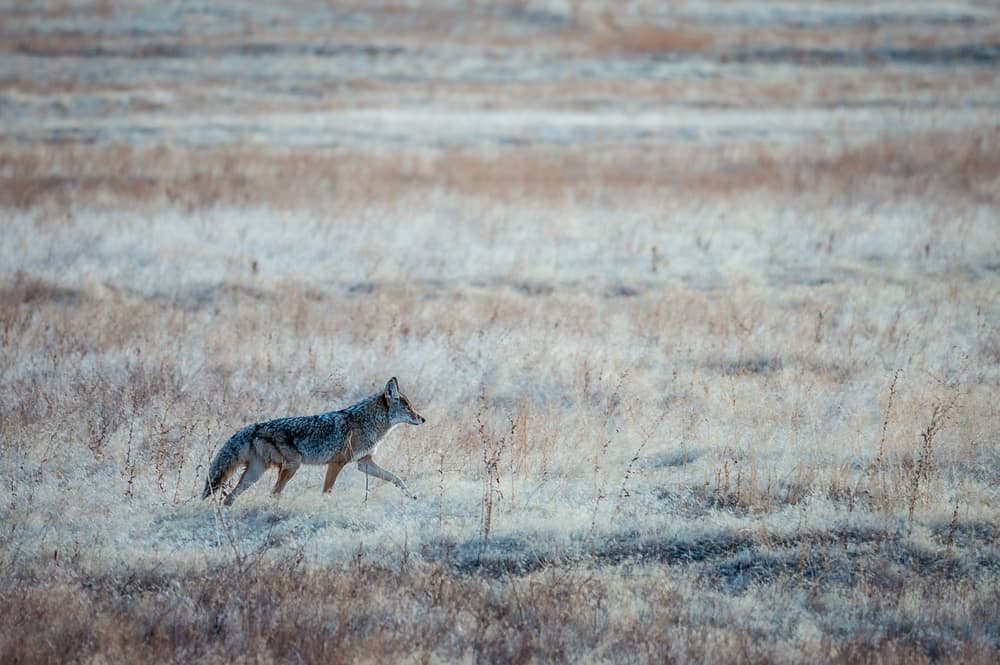
Why a coyote is a harder thermal target than a hog
Most thermal buying advice is written around deer and hogs. A coyote is a different animal in the two ways that decide whether a thermal works: it is much smaller, and it is much cooler.
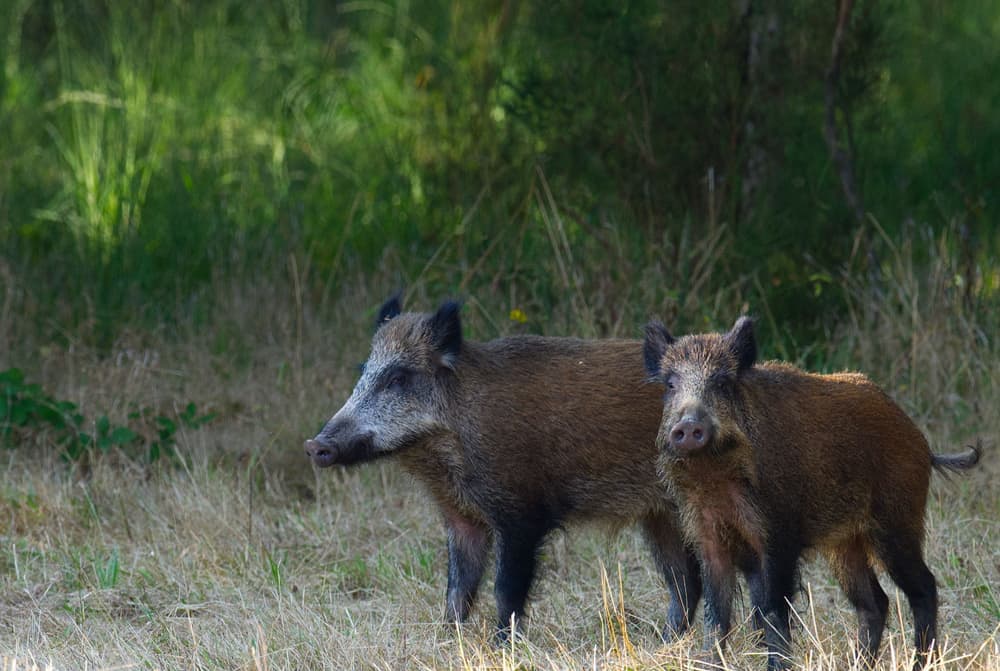
The Missouri Department of Conservation field guide puts a coyote at a total length of 39 to 54 inches with a 10 to 16 inch tail, which leaves a body of roughly 30 inches, and a weight of 18 to 30 pounds. TPWD calls the Texas coyote "very similar in size to a small German Shepherd" at an average of 25 to 40 pounds, primarily nocturnal, ranging throughout the state. Compare that with the feral hog the rest of this site is built around: the same field guide series gives hogs a length "to 5 feet."
Two thirds less animal, and less of it radiating heat. That is the whole argument for buying a different scope than you would for a feeder full of pigs.
The pixel math for a coyote
How well a thermal shows an animal comes down to how many sensor pixels land on it. The formula we use across this site: inches covered by one pixel = distance in yards × 0.036 × pixel pitch in µm ÷ lens focal length in mm. Divide the animal's length by that number.
| Scope (published pitch / lens) | Pixels across a 30 in coyote at 50 / 100 / 200 yd | Published field of view |
|---|---|---|
| oneleaf.ai Mars MT1000LRF (12 µm / 35 mm, 640) | 49 / 24 / 12 | 12.5° x 10.1° |
| RIX Storm S6R 640 (12 µm / 35 mm, 640) | 49 / 24 / 12 | RIX doesn't publish one |
| ATN ThOR 6 Elite LRF 384 (12 µm / 35 mm) | 49 / 24 / 12 | 7.53° x 5.65° |
| RIX Storm S3 384 (12 µm / 35 mm) | 49 / 24 / 12 | RIX doesn't publish one |
| GOYOJO GRL335 (12 µm / 35 mm) | 49 / 24 / 12 | 6.5° x 4.5° |
| Pulsar Talion XQ35 Pro (17 µm / 35 mm) | 34 / 17 / 9 | 10.7° x 8° |
| Pulsar Thermion 2 LRF XQ50 Pro (17 µm / 50 mm) | 49 / 25 / 12 | 7.5° x 5.6° |
Read the first column and the last together, because that is the real decision. Pixels on target depend only on pitch and lens — a 640 sensor does not put more pixels on a coyote than a 384 with the same pitch and lens. What the 640 buys you is field of view: the oneleaf Mars shows 12.5° through the same 35 mm lens where the 384 ThOR 6 Elite shows 7.53° and the GRL335 shows 6.5°.
That matters more on coyotes than on hogs. A hog walks into a feeder and mills around. A called coyote arrives fast, off the line you expected, and often crosses. A wider picture is how you find it before it finds you.
What actually matters for coyotes
- NETD, more than on hogs. A 200 pound hog is a furnace. A 25 pound canine on a cold February night is not. Our picks run from ≤15 mK (ThOR 6 Elite) to <25 mK (Talion, Storm S3, GRL335). Lower is better, and on a coyote you notice.
- Field of view for the close shot. A caller brings animals to inside 100 yards more often than not. The Mars and the Talion publish the widest views here.
- A rangefinder for the hang-up. Coyotes that circle downwind and stop at 180 to 250 yards are the ones you miss. Four of our seven picks have a built-in laser rangefinder; the Mars publishes 5.5 to 1,300 yards and the Storm S6R 1,312 yards.
- Runtime that covers a full set of stands. Calling means moving. The Thermion 2 LRF XQ50 Pro claims up to 10 hours and the ThOR 6 Elite about 9; the two RIX scopes claim about 4 to 4.5 hours per 18650.
- Weight, because you carry it between stands. The Storm S3 is about 0.97 lb; the Thermion 2 LRF XQ50 Pro is 0.97 kg — roughly twice as much.
Detection-range claims are not on that list. Every maker here claims well over a thousand yards of detection, and none of those numbers means you can tell a coyote from a house cat out there.
How we picked
We took every thermal riflescope in our registry with a 35 mm or longer lens — the honest starting point for an animal this small — and read each maker's published spec page and warranty terms again on September 26, 2026. Each is scored on our published thermal rubric: sensor and lens for identifying an animal (30%), usability at night (20%), battery and power (15%), durability (15%), warranty and support (10%) and value within its budget tier (10%).
We have not tested these units. Scores come from published specs, manuals and warranty terms, and the rubric is printed in full on our How We Choose page. Short-lens scopes that do well on hogs at a feeder — the ATN ThOR 6 Mini 256 and the AGM Rattler V2 19-256 on our under-$1,000 ranking — are deliberately not here: 15 to 19 mm of lens is not enough glass for a 30 inch animal past a pasture's width.
The picks side by side
The picks in context
1. oneleaf.ai Mars MT1000LRF (35 mm)
The best coyote scope in our registry on paper, for one reason: it is the only unit that combines a 640x512 sensor, a built-in rangefinder and a genuinely wide view. The 2x base with a 12.5° x 10.1° field is close to twice the width of the 384 scopes at the same 35 mm, so a coyote crossing at 80 yards stays in the picture, and the <20 mK NETD holds it against cold ground. IP67, a 6000 J recoil rating and swappable 50 mm and 75 mm lenses if you later move to longer country. The cost is a three-year warranty where RIX and ATN give five, and about 5 hours per 18650.
2. ATN ThOR 6 Elite LRF 384 3.5-28x
Buy this one if your ground is cold. A published NETD of ≤15 mK is the most sensitive figure anywhere in our registry, and on a small canine that is the spec that decides whether you see an animal or a smudge. It adds a 1,000 m rangefinder, a 1920x1080 display, IP67, a 6000 J rating, about 9 hours on two 18650s and a five-year warranty. The trade-off is the view: 7.53° x 5.65° is workable but narrow, and ATN ships it for 30 mm rings that are not in the box.
3. RIX Storm S6R 640 (35 mm)
A 640 sensor, <20 mK, a 1,312 yard rangefinder with a ballistic calculator, a five-year warranty and a Picatinny QD mount included, in a body about a pound. It ranks below the Mars because RIX publishes no field of view and no IP rating for it, and the battery claim is about 4 hours per 18650 — the shortest here, and a real problem if you are running three or four stands a night.
4. Pulsar Talion XQ35 Pro
The one to buy if you call coyotes in tight. At 10.7° x 8° it has the widest published view of any 384 here, Pulsar quotes the sensor at sNETD <15 mK, and the body is IPX7 with a 6000 J rating and up to 9 hours on an APS 5T pack. The catch is the 17 µm pitch: through the same 35 mm lens it puts about 17 pixels across a coyote at 100 yards where the 12 µm scopes put 24. That is a fair trade for a called-in animal and a bad one for a 250 yard shot.
5. Pulsar Thermion 2 LRF XQ50 Pro
The reach pick. A 50 mm lens brings the 17 µm sensor back level with the 12 µm 35 mm scopes — about 25 pixels on a coyote at 100 yards — and adds an 800 m rangefinder, IPX7, up to 10 hours of runtime and a warranty that runs to five years with registration. It is also the heaviest here at 0.97 kg, mounts in 30 mm rings, and its 7.5° x 5.6° view is tight for a close call. For open plains in West Texas, it is the right tool.
6. RIX Storm S3 384 (35 mm)
Under a pound with a 12 µm 384 sensor, <25 mK, a 6000 J rating, a five-year warranty and a QD mount in the box. That is a lot of scope for the money and easy to carry between stands. It loses ground on runtime (about 4.5 hours per 18650), a missing IP rating and no rangefinder, which is the feature you most want when a coyote stops on the far edge of a field.
7. GOYOJO GRL335
The budget answer, and the only one of these picks that sits under the $1,000 tier. A 12 µm 384 behind a 35 mm lens puts the same 24 pixels on a coyote at 100 yards as scopes costing twice as much, with <25 mK, a five-year warranty, a 1000 g recoil rating and a one-shot zero. The 6.5° x 4.5° view is the narrowest here, it is IP65 rather than IP67, and there is no rangefinder. If money is the constraint, start here and buy the rangefinder later as a handheld.
One rig for hogs and coyotes
Most people reading this already have a hog problem and are adding coyotes, or the reverse. The good news is that the middle of this list serves both. A 35 mm, 12 µm scope with a rangefinder — the Mars, the ThOR 6 Elite or the Storm S6R — has enough field of view for a sounder at a feeder and enough sensitivity for a single canine at 150 yards.
Where the rigs diverge is at the ends. A 15 to 19 mm scope built for a close feeder, of the kind we rank on the under-$1,000 page, runs out of detail on a coyote quickly. And a 50 mm scope bought for open coyote country is hard work when six hogs pour in at 40 yards. If you must pick one, pick 35 mm. Our main thermal scope ranking for hogs and 256 vs 384 vs 640 go deeper on that trade.
Calling technique, lights and the rest of the night setup are covered in our guide to night hunting coyotes, which also has what ICWDM and TPWD publish about when coyotes move.
In detail
The picks, in full
Rank 01
Stock photoBest thermal scope for coyote hunting
oneleaf.ai Mars MT1000LRF (35 mm)
The only scope here that gives you a 640 sensor, a 1,300 yard rangefinder and a 12.5° x 10.1° field of view at once. On a coyote that combination is worth more than raw magnification: you find the animal, range it and shoot it without changing anything.
Published specsResearched · not tested by us
| Sensor | 640x512 |
|---|---|
| Pixel pitch | 12 µm |
| NETD | <20 mK |
| Lens | 35 mm, F1.0 (50 mm and 75 mm lenses optional) |
| Magnification | 2x base; 1-8x digital |
| Refresh rate | 60/50/30 Hz selectable |
| Field of view | 12.5° x 10.1° |
| Detection range | 1,800 m / 1,969 ydMaker's claim |
| Display | 1024x768 OLED |
| Battery | Removable 18650 (3200 mAh), up to 5 h; USB-C 5 V/2 A external power |
| Recording | Photo and video with microphone; 32-256 GB storage |
| Rangefinder | Built-in, 5.5-1,300 yd; ballistic calculator with 7 data profilesMaker's claim |
| IP rating | IP67 |
| Recoil rating | 6000 J (1000 g over 0.4 ms) |
| Operating temperature | -4°F to 122°F |
| Weight | 549 g (19.37 oz) |
| Mount | Picatinny |
| Warranty | 3 years |
How the 8.1 score breaks down
- Sensor & lens for hog ID (30%)
- 9
- Usability at night (20%)
- 8
- Battery & power (15%)
- 6
- Durability (15%)
- 8.5
- Warranty & support (10%)
- 7.5
- Value within its tier (10%)
- 9
What the specs support
- The only 640x512 sensor in this list's $1,000 to $2,000 tier, with <20 mK NETD
- 2x base and a 12.5° x 10.1° view: wide for sounders, with 640 detail for zooming in
- Built-in rangefinder and ballistic calculator, IP67 and a 6000 J rating
- Swappable lenses (50 mm, 75 mm) if you later need more reach
Where it falls short
- About 5 h per 18650, so a full night needs spares or USB-C power
- Three-year warranty versus five on the ATN ThOR 6 Elite and RIX Storm S3
Skip this if…
…You won't carry spare batteries; at about 5 hours per 18650 it won't last a long sit on one cell.
#ad · Price set by Amazon · How we make money for the link to oneleaf.ai Mars MT1000LRF (35 mm)
Rank 02
Stock photoBest sensitivity for cold nights
ATN ThOR 6 Elite LRF 384 3.5-28x
A published NETD of ≤15 mK is the most sensitive figure in our registry. On a 25 to 40 pound canine against cold ground, sensitivity is what separates the animal from the brush behind it.
Published specsResearched · not tested by us
| Sensor | 384x288 (12 µm VOx) |
|---|---|
| Pixel pitch | 12 µm |
| NETD | ≤15 mK |
| Lens | 35 mm germanium, F/1.0 |
| Magnification | 3.5-28x (1x, 2x, 4x, 8x digital zoom) |
| Refresh rate | 50 Hz |
| Field of view | 7.53° x 5.65° |
| Detection range | 2,750 mMaker's claim |
| Display | 0.49 in OLED, 1920x1080 |
| Battery | Two 18650s (one internal, one replaceable), about 9 h; USB-C external power |
| Recording | 64 GB internal; Recoil Activated Video; Wi-Fi to ATN Connect 6 app |
| Rangefinder | Built-in, 1,000 m, ±1 m (905 nm, Class 1); ballistic calculatorMaker's claim |
| IP rating | IP67 |
| Recoil rating | 6000 J (1000 g over 0.4 ms) |
| Operating temperature | -22°F to 131°F (-30°C to 55°C) |
| Weight | 830 g (1.83 lb) |
| Mount | 30 mm rings (not included) |
| Warranty | 5 years |
How the 8.5 score breaks down
- Sensor & lens for hog ID (30%)
- 8.5
- Usability at night (20%)
- 8
- Battery & power (15%)
- 8
- Durability (15%)
- 9
- Warranty & support (10%)
- 9
- Value within its tier (10%)
- 8.5
What the specs support
- Lowest published NETD in this list (≤15 mK) on a 12 µm 384 sensor
- Built-in laser rangefinder feeds the ballistic calculator; six ballistic profiles
- Full HD 1920x1080 OLED, 64 GB storage and Recoil Activated Video
- IP67, 6000 J and a five-year warranty, all published
Where it falls short
- 3.5x base on a 35 mm lens is a narrow 7.5° view for close feeder work
- Rings aren't included
- Only one of the two 18650s is replaceable in the field
Skip this if…
…You mostly shoot hogs inside 75 yards; the 3.5x base is tight up close, and the ThOR 6 384 2.5-20x gives a wider 10.5° view.
#ad · Price set by Amazon · How we make money for the link to ATN ThOR 6 Elite LRF 384 3.5-28x
Rank 03
Stock photoBest 640 with a QD mount
RIX Storm S6R 640 (35 mm)
A 640x512 sensor, 2x base, rangefinder and ballistic calculator in a 1 lb scope with a five-year warranty; the catch is about 4 hours per 18650.
Published specsResearched · not tested by us
| Sensor | 640x512 |
|---|---|
| Pixel pitch | 12 µm (listing title) |
| NETD | <20 mK |
| Lens | 35 mm |
| Magnification | 2x base; 1-4x digital |
| Refresh rate | 50 Hz |
| Detection range | About 1,969 ydMaker's claim |
| Display | 1024x768 AMOLED |
| Battery | Swappable 18650, about 4 h at 72°F; 5 V USB-C external power |
| Recording | 32 GB built-in; Recoil-Activated Video; Wi-Fi to RIX+ app |
| Rangefinder | Built-in, 1,312 yd, ±1.09 yd; ballistic calculatorMaker's claim |
| Recoil rating | 1000 g / 6000 J |
| Weight | About 1 lb |
| Mount | Picatinny QD mount included |
| Warranty | 5 years |
How the 7.8 score breaks down
- Sensor & lens for hog ID (30%)
- 9
- Usability at night (20%)
- 8
- Battery & power (15%)
- 5.5
- Durability (15%)
- 6
- Warranty & support (10%)
- 9
- Value within its tier (10%)
- 8.5
What the specs support
- 640x512 with <20 mK NETD at a wide 2x base: a big view for sounders with detail to zoom into
- Built-in 1,312 yd rangefinder and ballistic calculator
- About 1 lb with a 6000 J rating and a five-year warranty
Where it falls short
- About 4 h per 18650 is the shortest runtime among the 640s here
- No IP rating on RIX's S6R page
Skip this if…
…You won't manage spare batteries on a long sit; the AGM Clarion's up-to-11-hour claim or a Pulsar's 10 h fits better.
#ad · Price set by Amazon · How we make money for the link to RIX Storm S6R 640 (35 mm)
Rank 04
Stock photoBest for coyotes called in close
Pulsar Talion XQ35 Pro
A compact, magnesium-bodied Pulsar with a 35 mm lens, 2.5x base, IPX7 and 6000 J rating; it gives a wider close-range view than the Thermion XQ50 but uses Weaver-style mounts, not rings.
Published specsResearched · not tested by us
| Sensor | 384x288 (uncooled) |
|---|---|
| Pixel pitch | 17 µm |
| NETD | <25 mK (sNETD <15 mK) |
| Lens | 35 mm, F/1.0 |
| Magnification | 2.5-10x |
| Refresh rate | 50 Hz |
| Field of view | 10.7° x 8° (18.2 x 13.7 m at 100 m) |
| Detection range | 1,350 m (about 1,475 yd)Maker's claim |
| Display | 1024x768 AMOLED HD |
| Battery | APS 5T pack, up to 9 h at 22°C; USB-C (5 V/9 V) external power |
| Recording | 16 GB internal; Wi-Fi (2.4/5 GHz) to Stream Vision 2 app |
| IP rating | IPX7 |
| Recoil rating | 6000 J on rifled weapons; 12 gauge on smoothbores |
| Operating temperature | -25°C to +40°C |
| Weight | 0.7 kg without APS 5T battery |
| Mount | Weaver U, USQD or LQD mounts |
| Warranty | 3 years; 5 years with registration |
How the 7.9 score breaks down
- Sensor & lens for hog ID (30%)
- 7.5
- Usability at night (20%)
- 8
- Battery & power (15%)
- 8
- Durability (15%)
- 8.5
- Warranty & support (10%)
- 8.5
- Value within its tier (10%)
- 7
What the specs support
- 2.5x base and a 10.7° view make close, moving hogs easier to follow than on 3x-plus scopes
- IPX7, 6000 J recoil rating and magnesium-alloy body
- Up to 9 h on the APS 5T pack plus USB-C power delivery
Where it falls short
- 17 µm pixels on a 384 sensor; the ATN ThOR 6 Elite offers 12 µm and ≤15 mK in the same tier
- Mounts through Weaver-style Talion mounts rather than standard scope rings
- Upper operating limit of +40°C is lower than the Thermion's +50°C
Skip this if…
…You want a rangefinder or regularly identify hogs past 200 yards; the ATN ThOR 6 Elite LRF or Thermion 2 XQ50 Pro reach further.
#ad · Price set by Amazon · How we make money for the link to Pulsar Talion XQ35 Pro
Rank 05
Stock photoBest reach for open country
Pulsar Thermion 2 LRF XQ50 Pro
The Thermion 2 XQ50 Pro plus an 800 m laser rangefinder and ballistics app support; rugged and long-running, but still a 17 µm 384 in a tier where 640 sensors are common.
Published specsResearched · not tested by us
| Sensor | 384x288 (uncooled) |
|---|---|
| Pixel pitch | 17 µm |
| NETD | <25 mK |
| Lens | 50 mm, F/1.0 |
| Magnification | 3-12x |
| Refresh rate | 50 Hz |
| Field of view | 7.5° x 5.6° (13.1 x 9.8 m at 100 m) |
| Detection range | 1,800 mMaker's claim |
| Display | 1024x768 AMOLED |
| Battery | 2 Ah changeable external plus 4.9 Ah internal, up to 10 h at 22°C; USB-C (5 V/9 V) external power |
| Recording | 16 GB internal; Wi-Fi (2.4/5 GHz) to Stream Vision 2 and Stream Vision Ballistics |
| Rangefinder | Built-in, 800 m max, ±1 m (905 nm, Class 1)Maker's claim |
| IP rating | IPX7 |
| Recoil rating | 6000 J on rifled weapons; 12 gauge on smoothbores |
| Operating temperature | -25°C to +50°C |
| Weight | 0.97 kg |
| Mount | Standard 30 mm rings |
| Warranty | 3 years; 5 years with registration |
How the 8.6 score breaks down
- Sensor & lens for hog ID (30%)
- 8.5
- Usability at night (20%)
- 9
- Battery & power (15%)
- 9
- Durability (15%)
- 9
- Warranty & support (10%)
- 8.5
- Value within its tier (10%)
- 6.5
What the specs support
- Built-in rangefinder on a traditional 30 mm-tube scope that fits standard rings
- Up to 10 h with a changeable external pack, plus USB-C power delivery
- IPX7, 6000 J and a -25°C to +50°C range, all published
Where it falls short
- 384 sensor at 17 µm, while the RIX Storm S6R and AGM Clarion 640 offer 640 or 12 µm sensors in this tier
- 800 m rangefinder is shorter than the 1,000 m ATN and 1,300 yd oneleaf units
- Heaviest scope in this list at 0.97 kg
Skip this if…
…You don't need ranging for hog-distance shots; the non-LRF Thermion 2 XQ50 Pro has the same sensor, lens and battery for a tier less.
#ad · Price set by Amazon · How we make money for the link to Pulsar Thermion 2 LRF XQ50 Pro
Rank 06
Stock photoBest lightweight 384
RIX Storm S3 384 (35 mm)
A light 0.97 lb 384 scope with a 12 µm sensor, 35 mm F1.0 lens, 6000 J rating and five-year warranty; runtime is short at about 4.5 hours per 18650.
Published specsResearched · not tested by us
| Sensor | 384x288 |
|---|---|
| Pixel pitch | 12 µm |
| NETD | <25 mK |
| Lens | 35 mm, F1.0 |
| Magnification | 3.5x base; 1-4x digital |
| Refresh rate | 50 Hz |
| Detection range | About 1,969 ydMaker's claim |
| Display | 1024x768 AMOLED |
| Battery | Swappable 18650, about 4.5 h at 72°F; 5 V USB-C external power |
| Recording | 32 GB built-in; Recoil-Activated Video; Wi-Fi to RIX+ app |
| Recoil rating | 1000 g / 6000 J |
| Weight | About 0.97 lb |
| Mount | Picatinny QD mount included |
| Warranty | 5 years |
How the 7.4 score breaks down
- Sensor & lens for hog ID (30%)
- 8
- Usability at night (20%)
- 7.5
- Battery & power (15%)
- 6
- Durability (15%)
- 6
- Warranty & support (10%)
- 9
- Value within its tier (10%)
- 8
What the specs support
- 12 µm 384 sensor with a 35 mm F1.0 lens in a scope under 1 lb
- Five-year warranty and a published 6000 J recoil rating
- Five zero profiles, picture-in-picture and a QD mount in the box
Where it falls short
- About 4.5 h per 18650, so spares are a must for a full night
- RIX doesn't publish an IP rating on the S3 page
- 3.5x base is narrow for close feeder shots
Skip this if…
…You don't want to swap batteries mid-sit; the Pulsar Thermion 2 XQ50 Pro and ATN ThOR 6 Elite both claim 9-10 h.
#ad · Price set by Amazon · How we make money for the link to RIX Storm S3 384 (35 mm)
Rank 07
Stock photoBest budget option for coyotes
GOYOJO GRL335
The cheapest route to a 384 sensor behind a 35 mm lens with a five-year warranty; the 4x base and 6.5° view are narrow for sweeping a feeder at close range.
Published specsResearched · not tested by us
| Sensor | 384x288 (VOx) |
|---|---|
| Pixel pitch | 12 µm |
| NETD | <25 mK |
| Lens | 35 mm |
| Magnification | 4x optical; 1x, 2x, 3x, 4x digital |
| Refresh rate | 55 Hz |
| Field of view | 6.5° x 4.5° |
| Detection range | 2,647 m (human-size target)Maker's claim |
| Display | 0.39 in OLED, 1024x768 |
| Battery | 18650 rechargeable (2600 mAh), 6-8 h; 5 V/2 A charging |
| Recording | 64 GB SD card; shot-activated recording; Wi-Fi app |
| IP rating | IP65 |
| Recoil rating | 1000 g / 0.4 ms |
| Operating temperature | -20°C to 50°C (-4°F to 122°F) |
| Weight | 553 g (1.22 lb) without battery |
| Mount | Picatinny mount |
| Warranty | 5 years |
How the 7.5 score breaks down
- Sensor & lens for hog ID (30%)
- 8
- Usability at night (20%)
- 6.5
- Battery & power (15%)
- 7
- Durability (15%)
- 6.5
- Warranty & support (10%)
- 8.5
- Value within its tier (10%)
- 9
What the specs support
- The only 384 sensor in this list's $500 to $1,000 tier: 12 µm, 35 mm lens, <25 mK NETD
- Five-year warranty and a published 1000 g recoil rating
- 64 GB storage, shot-activated recording and thermal one-shot zero
Where it falls short
- 4x base and a 6.5° x 4.5° field of view are tight for close, fast-moving hogs
- IP65 is splash resistance, a step below the IP67 on several rivals
Skip this if…
…Most of your shots are inside 75 yards at a feeder; the narrow 4x base view makes it slow to pick up a sounder that close.
#ad · Price set by Amazon · How we make money for the link to GOYOJO GRL335
What to look for in a coyote thermal
- At least 35 mm of lens. Below that, a 30 inch animal runs out of pixels inside 100 yards. Every pick on this page is 35 mm or 50 mm for that reason.
- A published NETD, and the lowest you can afford. ≤15 mK (ThOR 6 Elite) and <20 mK (Mars, Storm S6R) are the figures to want. A maker who won't print NETD is telling you something.
- A field of view you can actually hunt. Anything under about 7° gets hard when an animal comes in fast. Pulsar and oneleaf publish theirs; RIX does not.
- A rangefinder if you shoot past 150 yards. It is the single feature that most changes hit rate on hung-up coyotes, and it is built into four of these seven.
- Batteries you can swap in the dark. Two 18650s and a charger cost little next to the scope. The RIX units especially need spares.
- The mount, in or out of the box. RIX and oneleaf include Picatinny mounts; the ThOR 6 Elite and the Thermion 2 need 30 mm rings you buy separately.
Setting up a night stand with a thermal
- Range the ground before dark if you can. Even with a laser rangefinder in the scope, knowing the fence line and the far brush edge in daylight saves you a decision you don't have time for.
- Scan with something other than the rifle. Sweeping a muzzle across ground you haven't identified is how accidents happen. A handheld monocular is the fix; see our thermal monocular picks and monocular vs scope.
- Set up so the downwind circle is in your field of view. Coyotes finish downwind. If the wide side of your view isn't covering that arc, the scope's field of view is wasted.
- Save a second zero profile. Most of these scopes hold several. One for the rifle you shoot hogs with at 60 yards and one for the 200 yard coyote set is worth the five minutes. Our zeroing guide covers the process.
- Shoot from a rest. A 30 inch animal at 200 yards does not forgive a wobble. Our shooting sticks and tripods page ranks the options.
- Use the recording. All seven picks record. Reviewing the clip is often the only way to know where the shot went in the dark.
Coyote thermal mistakes
- Buying a hog scope for coyotes. A 19 mm lens over a feeder is a fine hog setup and a poor coyote setup. The lens, not the price, is the mismatch.
- Thinking a 640 sensor puts more pixels on the animal. It doesn't. Pitch and lens do that. The 640 gives you a wider picture at the same detail.
- Shopping on detection range. These scopes claim 1,350 m to more than 2,700 m. Those are claims about spotting a heat source, not identifying a 25 pound canine.
- Ignoring NETD because it's an unfamiliar number. On a cold night and a small animal, it is the spec you will notice first.
- Forgetting the coyote might be the symptom. Coyotes and hogs often show up on the same ground for the same reason. Our guide to getting rid of feral hogs covers the whole-property plan.
How we scored this
Units we claim to have tested: 0
Plenty of gear sites say they field-tested everything they list. We haven't, and we say so. Every pick here is labeled Researched: we read each maker's published specs, manuals and warranty terms, compare products only against others in the same budget tier, and score them on a public rubric. Every figure links to where it came from, and seller performance numbers are labeled “maker's claim.”
Scores are editorial judgments from that documented research, not test results. Commissions never set a score or decide a pick. The rubric and its weights are published.
What changed
- Published.
Questions
Frequently asked
What is the best thermal scope for coyote hunting?
Is a 384 thermal scope enough for coyotes?
Do you need a rangefinder to hunt coyotes with a thermal?
Why does NETD matter more on coyotes than on hogs?
Can I use one thermal scope for both hogs and coyotes?
Is it legal to hunt coyotes at night in Texas?
Receipts
Sources
- Missouri Department of Conservation: Coyote field guide, size data (checked 2026-09-26)
- Missouri Department of Conservation: Feral Hog (Feral Swine) field guide, size (checked 2026-09-26)
- TPWD: Coyote species page, size and activity (checked 2026-09-26)
- Internet Center for Wildlife Damage Management: Coyote (checked 2026-09-26)
- oneleaf.ai: Mars MT1000LRF product page and spec table (checked 2026-09-26)
- ATN: ThOR 6 Elite LRF 384 3.5-28x product page and spec table (checked 2026-09-26)
- RIX Optics: STORM S6R product page (checked 2026-09-26)
- RIX Optics: STORM S3 product page (checked 2026-09-26)
- Pulsar: Talion XQ35 Pro product page and spec table (checked 2026-09-26)
- Pulsar: Thermion 2 LRF XQ50 Pro product page and spec table (checked 2026-09-26)
- GOYOJO Optics: GRL Series (GRL335) product page and spec table (checked 2026-09-26)
- TPWD: Outdoor Annual, Nongame and Other Species, feral hogs and coyotes (checked 2026-09-26)
- Texas Parks & Wildlife Code §62.004, Hunting at Night (texas.public.law; checked 2026-09-26)
- Texas Parks & Wildlife Code §62.005, Hunting with Light (texas.public.law; checked 2026-09-26)
- Texas Parks & Wildlife Code §62.0031, Hunting on Public Roads (texas.public.law; checked 2026-09-26)
We haven't tested the gear on this page and we don't pretend to. Specs come from each maker's own pages or the product listing (linked on every product), hog biology and trapping advice from Texas A&M AgriLife, and rules from TPWD and Texas statute. Prices are set by Amazon and change often, so we don't print them. Where a figure isn't published, we say so. Read the full method.