Quick picks
The picks at a glance
| # | Product | Best for | Score | Price |
|---|---|---|---|---|
| 1 |  Pulsar Oryx LRF XG35 The most capable scanner here: a 640x480, 12 µm sensor behind a 35 mm F1.0 lens with a built-in rangefinder and up to 12 hours rated. It's a top-tier purchase, and more than a feeder check needs. | Best thermal monocular$2,000 and up | 8.5/10Researched | Check price · Amazon #ad · Disclosure |
| 2 | Pulsar Axion Compact XQ19 A pocket-size 384x288 scanner with a removable battery, an IPX7 body and a warranty that runs to 5 years with registration: the monocular to carry on every walk to the feeder. | Best for most landowners$500 to $1,000 | 7.6/10Researched | Check price · Amazon #ad · Disclosure |
| 3 | RIX Pocket K3 A 0.47 lb, 384x288 pocket monocular with electronic image stabilization, a swappable 18650 and a 5-year warranty; the 15 mm lens keeps it a close-to-mid-range tool. | Lightest 384 scanner$500 to $1,000 | 7.5/10Researched | Check price · Amazon #ad · Disclosure |
| 4 | ATN BlazeTrek 6 325 A 384x288, sub-18 mK monocular with 2.8-22x zoom and a 5-year warranty in a 0.7 lb body; the built-in battery is the trade-off. | Best 384 value$500 to $1,000 | 7.3/10Researched | Check price · Amazon #ad · Disclosure |
| 5 | AGM ReachIR LRF 25-384 A 384x288, sub-20 mK scanner with a 25 mm lens and a 1,000 m laser rangefinder; strong detail and ranging, but the rated 4.5-hour runtime means carrying the second battery. | Best 384 with a rangefinder$1,000 to $2,000 | 7.2/10Researched | Check price · Amazon #ad · Disclosure |
| 6 | AGM Taipan V2 10-256 A budget 256x192 scanner with a swappable 18650, two batteries in the box and a 5-year transferable warranty; its 10 mm lens is built for close cover, not long fields. | Best under $500Under $500 | 7.1/10Researched | Check price · Amazon #ad · Disclosure |
| 7 | TOPDON TS004 Pro TOPDON's 384x288 step-up with a 19 mm lens and a 145-yard identification rating; a clear image for the tier, held back by <40 mK NETD and a 1-year warranty. | 384 with a published ID distance$500 to $1,000 | 6.6/10Researched | Check price · Amazon #ad · Disclosure |
| 8 | ATN BlazeSeeker 6 210 (10 mm) A low-budget route to a 12-micron 256x192 scanner with Wi-Fi, recording and a 5-year warranty; fine for spotting heat at the feeder, thin on detail beyond it. | Budget scanner with a 5-year warrantyUnder $500 | 6.5/10Researched | Check price · Amazon #ad · Disclosure |
#ad · Prices are set by Amazon and change often, so we don't print them. Scores are ours, built from published specs, manuals and warranty terms, not hands-on tests. Photos are illustrative stock. Tap a row for the full write-up.
Scanning vs shooting: why a monocular often comes first
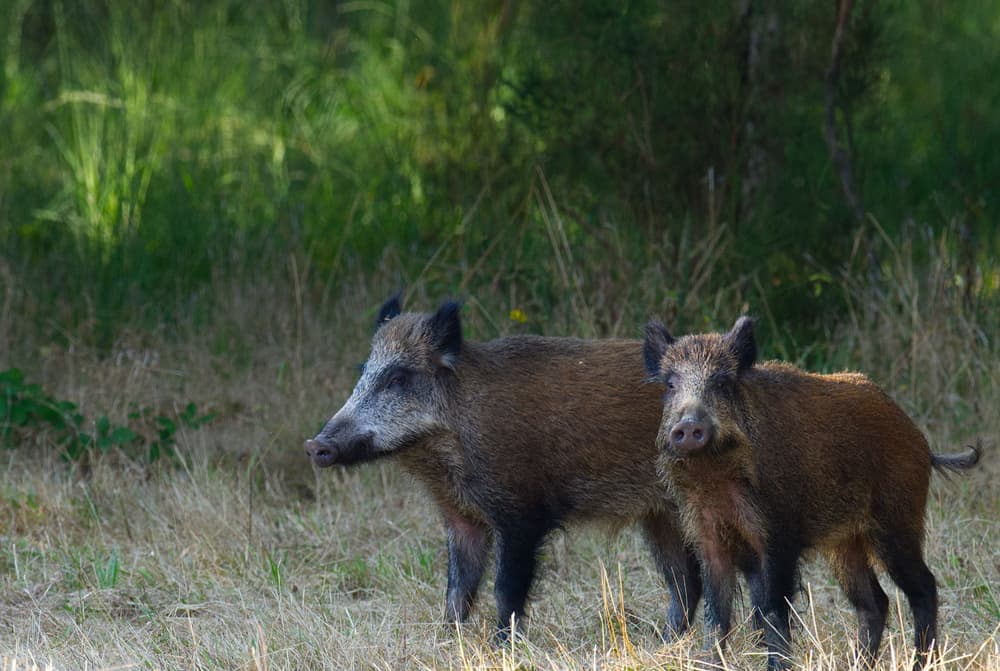
A hog problem starts with a question: where are they, how many, and when? A handheld thermal monocular answers that. You walk to the feeder or the field edge after dark, sweep the ground, and see every warm body out there without putting any light on it. ATN describes thermal as detecting "the heat energy that objects already radiate, which is why it works identically with or without any light present" (ATN, Thermal vs Infrared). Texas A&M AgriLife notes that in warmer conditions feral hogs "feed nocturnally" (Feral Hog Ecology), so night is when you'll find them.
A thermal riflescope can see the same heat, but using it as a scanner means sweeping a rifle across everything out there: cattle, deer, the neighbor's dog, a person walking a fence. Basic firearm safety says don't point a muzzle at anything you haven't identified and aren't willing to shoot. A monocular separates the two jobs. You scan and identify with the handheld, then bring the rifle up only on a hog you've already picked out.
That split changes how you shop:
- Scanning wants a wide view. Monoculars here use 10 to 19 mm lenses on the budget and compact units, which show a lot of ground at once.
- Identifying wants pixels on the animal. That's longer lenses (25 to 35 mm), the same trade-off as in riflescopes.
- Shooting wants a reticle and a zero. A monocular has neither. You'll still need a scope, a thermal clip-on or a light for the shot.
If you're deciding between buying a handheld first or going straight to a scope, our comparison of a thermal monocular vs a thermal scope works through it. The rest of the thermal and night vision hub covers scopes, clip-ons and budgets.
How we picked
We started from the thermal monoculars Amazon listed when we checked on September 19, 2026, and read each maker's spec page and warranty terms. Monoculars are scored on the same published thermal rubric as scopes and clip-ons: sensor and lens for identifying hogs (30%), usability at night (20%), battery and power (15%), durability (15%), warranty and support (10%) and value within the budget tier (10%). Detection and rangefinder distances are the maker's claims.
We haven't tested these units; scores come from published specs and the rubric on our How We Choose page. One more unit in our registry, the TOPDON TS004, didn't make the eight; it's covered in the under-$500 section below.
What each lens shows at hog distances
The same math that ranks riflescopes works for scanners. Pixel pitch (µm) divided by lens focal length (mm) gives the angle one pixel covers in milliradians; one milliradian spans 3.6 inches at 100 yards. So inches per pixel = distance (yd) × 0.036 × pitch ÷ lens, and pixels across a hog = hog length ÷ inches per pixel. We use a 60-inch hog, the top of the Missouri Department of Conservation's range for feral hogs ("length: to 5 feet," MDC). The width of the view is the sensor's pixel count across times the inches per pixel.
| Monocular (published pitch / lens) | Pixels across a 5 ft hog at 50 / 100 / 200 yd | Width of view at 100 yd |
|---|---|---|
| AGM Taipan V2 10-256 (12 µm / 10 mm) | 28 / 14 / 7 | About 92 ft |
| ATN BlazeSeeker 6 210 (12 µm / 10 mm, lens per its Amazon listing) | 28 / 14 / 7 | About 92 ft |
| Pulsar Axion Compact XQ19 (17 µm / 19 mm) | 37 / 19 / 9 | About 103 ft |
| RIX Pocket K3 (12 µm / 15 mm) | 42 / 21 / 10 | About 92 ft |
| AGM ReachIR LRF 25-384 (12 µm / 25 mm) | 69 / 35 / 17 | About 55 ft |
| Pulsar Oryx LRF XG35, 640 (12 µm / 35 mm) | 97 / 49 / 24 | About 66 ft |
This is illustrative math, not a test, and it's rounded. The ATN BlazeTrek 6 and TOPDON TS004 Pro are missing because their makers don't publish both a pixel pitch and a lens length. What the table shows: the compact scanners (Taipan, BlazeSeeker, Axion, Pocket K3) cover 90 to 100 feet of ground at 100 yards, so a sounder at a feeder is easy to count, but each hog is only 14 to 21 pixels long there. The ReachIR and Oryx show less ground and far more detail, which is what you want for telling a sow with piglets from a lone boar across a field.
TOPDON is one maker that publishes an identification distance as well as detection: 91 m for the TS004 and 145 yards for the TS004 Pro, against detection claims of 450 and 650 yards. That gap is why a detection claim shouldn't drive the purchase.
The picks side by side
The picks in context
1. Pulsar Oryx LRF XG35
The best scanner on paper by a clear margin (8.5). A 640x480, 12 µm sensor behind a 35 mm F1.0 lens puts about 49 pixels across a big hog at 100 yards and still shows about 66 feet of ground. The built-in rangefinder reaches up to 1,640 yards (the maker's claim) and has a continuous SCAN mode for moving animals, so you know the distance before you pick up the rifle. Pulsar rates it up to 12 hours with an external APS 5 option, IP67, and a warranty of three years, five with registration. Two cautions: at about 17.6 oz it's the heaviest here, and Pulsar lists standard NETD at <40 mK with the sensor's sNETD at <20 mK, so compare like with like. It sits in the top budget tier.
2. Pulsar Axion Compact XQ19
Our pick for most landowners. A 384x288 sensor with <18 mK NETD behind a 19 mm F1.0 lens in an 8.8 oz, IPX7 magnesium body. The removable APS3 pack is rated up to 8 hours, so a spare doubles the night. Storage is 64 GB with dual-band Wi-Fi. The wide view (about 103 feet at 100 yards by our math) suits walking a property and checking feeders; the trade-off is detail past a few hundred yards and a low-resolution 640x400 display. Pulsar's warranty is three years, five with registration.
3. RIX Pocket K3
The lightest 384 here at 0.47 lb, with electronic image stabilization to steady a handheld view, a swappable 18650, a sliding lens cover, IP67 and a five-year warranty. The 15 mm lens puts about 21 pixels on a big hog at 100 yards. RIX publishes NETD (<25 mK), refresh rate and runtime (up to 7 hours) for the Pocket series rather than the K3 alone.
4. ATN BlazeTrek 6 325
A 384x288 sensor with <18 mK NETD, 2.8x to 22x zoom and a five-year warranty in a 0.7 lb body. The 2.8x base suits field edges better than a 1x scanner. ATN's page doesn't list the lens focal length or an IP rating, and the battery is built in (up to 8 hours, with external power supported), so there's no swapping in the field.
5. AGM ReachIR LRF 25-384
A 384, <20 mK sensor behind a 25 mm F1.0 lens with a 1,000 m rangefinder (the maker's claim), 64 GB storage and IP67. By our math it puts about 35 pixels across a big hog at 100 yards, well ahead of the compact scanners. The weak point is power: up to 4.5 hours per 18650, the shortest here, though two come in the box. AGM's product page doesn't list the warranty terms.
6. AGM Taipan V2 10-256
The best scanner under $500. A 256, 12 µm sensor behind a 10 mm lens gives a very wide, close-range view, with a sharp 1280x960 display, IP67, up to 7 hours per replaceable 18650 (two included) and a five-year transferable warranty. A tilt sensor turns the display off when you lower it. At about 14 pixels on a big hog at 100 yards, it finds heat; it won't size a hog across a pasture.
7. TOPDON TS004 Pro
TOPDON's step up to a 384x288 sensor behind a 19 mm lens, rated up to 10 hours, IP67, with a published identification distance (145 yards) as well as a detection claim. NETD is <40 mK, the least sensitive of the 384s here, the warranty is one year, and TOPDON doesn't describe the battery as swappable.
8. ATN BlazeSeeker 6 210
A low-budget 256x192, 12 µm scanner with Wi-Fi, recording, up to 8 hours and a five-year warranty in a 0.6 lb pocket body. The battery is built in, there's no IP rating on ATN's page, and ATN's page lists NETD as <20 mK in one section and <35 mK in another. Good for "is anything at the feeder?"; thin on detail beyond it.
Best thermal monocular under $500
Three monoculars in our registry sat in the under-$500 tier when we checked Amazon: the AGM Taipan V2 10-256, the ATN BlazeSeeker 6 and the TOPDON TS004. All three are 256x192 scanners with short lenses (10 to 13 mm), which means a wide view and limited detail. Here's how they split:
- AGM Taipan V2 10-256 (7.1): the pick. Swappable batteries with a spare included, IP67 and a five-year transferable warranty.
- ATN BlazeSeeker 6 210 (6.5): the same five-year warranty and the most sensitive NETD claim of the three, but a built-in battery and no published IP rating.
- TOPDON TS004 (6.3): the longest runtime claim (about 11 hours), IP67 with a 2 m drop rating and a tripod socket; the <40 mK NETD and one-year warranty are the weakest here. TOPDON lists identification at 91 m.
Under $500, any of these tells you whether hogs are using the feeder and how many there are. None of them is a long-range identification tool. If you'd rather put that money toward the shot, a digital night vision scope is the other way to spend it; see our best night vision scope for hog hunting.
In detail
The picks, in full
Rank 01
Stock photoBest thermal monocular
Pulsar Oryx LRF XG35
The most capable scanner here: a 640x480, 12 µm sensor behind a 35 mm F1.0 lens with a built-in rangefinder and up to 12 hours rated. It's a top-tier purchase, and more than a feeder check needs.
Published specsResearched · not tested by us
| Sensor | 640x480 |
|---|---|
| Pixel pitch | 12 µm |
| NETD | <40 mK (sensor sNETD <20 mK) |
| Lens | 35 mm, F1.0 |
| Magnification | 2.5-20x |
| Refresh rate | 50 Hz |
| Detection range | 1,950+ ydMaker's claim |
| Rangefinder | Built in, up to 1,640 yd (1,500 m), with SCAN modeMaker's claim |
| Display | 1024x768 AMOLED |
| Battery | Up to 12 h; accepts an external APS 5 pack |
| Recording | Photo and video to 64 GB; dual-band Wi-Fi (Stream Vision 2) |
| IP rating | IP67 |
| Weight | 17.64 oz with battery |
| Warranty | 3 years; 5 years with registration |
How the 8.5 score breaks down
- Sensor & lens for hog ID (30%)
- 9.3
- Usability at night (20%)
- 8.5
- Battery & power (15%)
- 8.5
- Durability (15%)
- 8
- Warranty & support (10%)
- 8.5
- Value within its tier (10%)
- 6.5
What the specs support
- 640x480 sensor and a 35 mm F1.0 lens: the most published detail in this group for sizing hogs at distance
- Built-in laser rangefinder with a continuous SCAN mode for moving animals
- Up to 12 hours rated, plus an external battery pack option
- IP67 and a warranty that extends to 5 years with registration
Where it falls short
- Heaviest monocular here at about 17.6 oz
- Standard NETD is listed as <40 mK (sensor-level sNETD <20 mK), so compare sensitivity figures carefully
- Top budget tier; more than most landowners need for feeder checks
Skip this if…
…You only scan feeders and brush lines inside 200 yards; a compact 384 monocular does that job from a much lower budget tier.
#ad · Price set by Amazon · How we make money for the link to Pulsar Oryx LRF XG35
Rank 02
Stock photoBest for most landowners
Pulsar Axion Compact XQ19
A pocket-size 384x288 scanner with a removable battery, an IPX7 body and a warranty that runs to 5 years with registration: the monocular to carry on every walk to the feeder.
Published specsResearched · not tested by us
| Sensor | 384x288 |
|---|---|
| Pixel pitch | 17 µm |
| NETD | <18 mK |
| Lens | 19 mm, F1.0 |
| Magnification | 1.5-6x |
| Refresh rate | 50 Hz |
| Detection range | 820 ydMaker's claim |
| Display | 640x400 AMOLED |
| Battery | Up to 8 h on a removable APS3 pack; USB-C charging |
| Recording | Photo and video to 64 GB internal memory; dual-band Wi-Fi (Stream Vision 2) |
| IP rating | IPX7 |
| Weight | 8.8 oz with battery |
| Warranty | 3 years; 5 years with registration |
How the 7.6 score breaks down
- Sensor & lens for hog ID (30%)
- 7.5
- Usability at night (20%)
- 7.5
- Battery & power (15%)
- 8
- Durability (15%)
- 7.5
- Warranty & support (10%)
- 8.5
- Value within its tier (10%)
- 7
What the specs support
- 384x288 sensor with a published NETD under 18 mK in a body under 9 oz
- Removable APS3 battery rated up to 8 hours, so a spare pack stretches a long night
- IPX7 magnesium body rated from -13°F to 104°F
- Warranty extends to 5 years when you register the unit
Where it falls short
- The 19 mm lens and 1.5x base magnification favor wide scanning over long-range detail
- The 640x400 display is low resolution next to Pulsar's larger units
- Priced at the upper edge of its budget tier
Skip this if…
…You mostly glass open pasture well past 500 yards; the 19 mm lens runs short of detail there, and a 35 mm unit like the Oryx fits that job better.
#ad · Price set by Amazon · How we make money for the link to Pulsar Axion Compact XQ19
Rank 03
Stock photoLightest 384 scanner
RIX Pocket K3
A 0.47 lb, 384x288 pocket monocular with electronic image stabilization, a swappable 18650 and a 5-year warranty; the 15 mm lens keeps it a close-to-mid-range tool.
Published specsResearched · not tested by us
| Sensor | 384x288 |
|---|---|
| Pixel pitch | 12 µm |
| NETD | <25 mK (stated for the POCKET series) |
| Lens | 15 mm |
| Magnification | 2x base |
| Refresh rate | 50 Hz (stated for the POCKET series) |
| Battery | Replaceable 18650; up to 7 h (stated for the POCKET series) |
| Recording | Wi-Fi live streaming to the RIX+ app |
| IP rating | IP67 |
| Weight | 0.47 lb |
| Warranty | 5 years |
How the 7.5 score breaks down
- Sensor & lens for hog ID (30%)
- 6.8
- Usability at night (20%)
- 7.5
- Battery & power (15%)
- 8
- Durability (15%)
- 7.5
- Warranty & support (10%)
- 9
- Value within its tier (10%)
- 7.5
What the specs support
- Electronic image stabilization steadies a handheld view
- Swappable 18650 battery
- Sliding built-in lens cover, so there's no cap to lose
- 5-year warranty
Where it falls short
- NETD, refresh rate and runtime are published for the POCKET series, not the K3 alone
- The 15 mm lens limits detail at distance
Skip this if…
…You mainly glass wide-open fields at long range; the 15 mm lens is built for pocket carry, not reach.
#ad · Price set by Amazon · How we make money for the link to RIX Pocket K3
Rank 04
Stock photoBest 384 value
ATN BlazeTrek 6 325
A 384x288, sub-18 mK monocular with 2.8-22x zoom and a 5-year warranty in a 0.7 lb body; the built-in battery is the trade-off.
Published specsResearched · not tested by us
| Sensor | 384x288 |
|---|---|
| Pixel pitch | 12 µm |
| NETD | <18 mK |
| Magnification | 2.8-22x |
| Refresh rate | 50 Hz |
| Detection range | 1,300 mMaker's claim |
| Battery | Built in, up to 8 h; external power supported |
| Recording | Photo and video to 32 GB; Wi-Fi (ATN 6 Connect app) |
| Weight | 0.7 lb (320 g) |
| Warranty | 5 years |
How the 7.3 score breaks down
- Sensor & lens for hog ID (30%)
- 7.5
- Usability at night (20%)
- 7.5
- Battery & power (15%)
- 6.5
- Durability (15%)
- 5.5
- Warranty & support (10%)
- 9
- Value within its tier (10%)
- 8
What the specs support
- 384x288 sensor with a published NETD under 18 mK
- 2.8x base magnification suits field edges better than a wide 1x scanner
- 5-year warranty
- Wi-Fi app with live view and recording
Where it falls short
- Built-in battery; no swapping in the field
- ATN's page doesn't list the lens focal length or an IP rating
Skip this if…
…You scan thick brush at close range and want the widest possible view; the 2.8x base magnification narrows the field compared with a 1x scanner.
#ad · Price set by Amazon · How we make money for the link to ATN BlazeTrek 6 325
Rank 05
Stock photoBest 384 with a rangefinder
AGM ReachIR LRF 25-384
A 384x288, sub-20 mK scanner with a 25 mm lens and a 1,000 m laser rangefinder; strong detail and ranging, but the rated 4.5-hour runtime means carrying the second battery.
Published specsResearched · not tested by us
| Sensor | 384x288 |
|---|---|
| Pixel pitch | 12 µm |
| NETD | <20 mK |
| Lens | 25 mm, F1.0 |
| Magnification | 2.5x base; 2.5-20x digital |
| Refresh rate | 50 Hz |
| Detection range | 1,200 m/ydMaker's claim |
| Rangefinder | Built in, 1,000 mMaker's claim |
| Display | 1024x768 OLED |
| Battery | Up to 4.5 h per replaceable 18650; 2 included |
| Recording | 64 GB; Wi-Fi (AGM Connect app) |
| IP rating | IP67 |
| Weight | 0.85 lb |
How the 7.2 score breaks down
- Sensor & lens for hog ID (30%)
- 8
- Usability at night (20%)
- 7.5
- Battery & power (15%)
- 6
- Durability (15%)
- 7.5
- Warranty & support (10%)
- 5.5
- Value within its tier (10%)
- 7
What the specs support
- Sub-20 mK 384x288 sensor paired with a 25 mm F1.0 lens
- Built-in laser rangefinder
- Swappable 18650 batteries, two included
- 64 GB storage and Wi-Fi app control
Where it falls short
- Rated battery life is the shortest in this group (up to 4.5 hours per battery)
- Warranty terms aren't listed on the product page
Skip this if…
…You want one battery to last an all-night sit without swaps; the rated 4.5 hours won't cover it.
#ad · Price set by Amazon · How we make money for the link to AGM ReachIR LRF 25-384
Rank 06
Stock photoBest under $500
AGM Taipan V2 10-256
A budget 256x192 scanner with a swappable 18650, two batteries in the box and a 5-year transferable warranty; its 10 mm lens is built for close cover, not long fields.
Published specsResearched · not tested by us
| Sensor | 256x192 |
|---|---|
| Pixel pitch | 12 µm |
| NETD | Sub-35 mK |
| Lens | 10 mm, F1.0 |
| Magnification | 1x base; 1.5-12x digital |
| Refresh rate | 50 Hz |
| Detection range | 500 m/ydMaker's claim |
| Display | 1280x960 LCOS |
| Battery | Up to 7 h per replaceable 18650; 2 included; USB-C external power |
| Recording | 16 GB; Wi-Fi (AGM Connect app) |
| IP rating | IP67 |
| Weight | 0.60 lb |
| Warranty | 5 years, transferable |
How the 7.1 score breaks down
- Sensor & lens for hog ID (30%)
- 5
- Usability at night (20%)
- 7
- Battery & power (15%)
- 8.5
- Durability (15%)
- 7.5
- Warranty & support (10%)
- 9
- Value within its tier (10%)
- 8.5
What the specs support
- Replaceable 18650 battery with two in the box
- A 90° tilt sensor turns the display off when you lower it, saving battery
- IP67 with a 5-year transferable warranty
- 1280x960 display is sharp for the tier
Where it falls short
- The 10 mm lens and sub-35 mK NETD limit detail beyond close range
- 16 GB of storage is the smallest in this group
Skip this if…
…You need to judge hog size across an open field rather than inside the tree line; the 10 mm lens is built for wide, close scanning.
#ad · Price set by Amazon · How we make money for the link to AGM Taipan V2 10-256
Rank 07
Stock photo384 with a published ID distance
TOPDON TS004 Pro
TOPDON's 384x288 step-up with a 19 mm lens and a 145-yard identification rating; a clear image for the tier, held back by <40 mK NETD and a 1-year warranty.
Published specsResearched · not tested by us
| Sensor | 384x288 |
|---|---|
| NETD | <40 mK |
| Lens | 19 mm |
| Magnification | 1x/2x/4x/8x digital |
| Refresh rate | 50 Hz |
| Detection range | 650 yd (594 m); identification 145 yd (133 m)Maker's claim |
| Display | 0.32-inch 800x600 OLED |
| Battery | 5,000 mAh; up to 10 h |
| Recording | 32 GB; Wi-Fi |
| IP rating | IP67 |
| Weight | 310 g (0.68 lb) |
| Warranty | 1 year |
How the 6.6 score breaks down
- Sensor & lens for hog ID (30%)
- 6.8
- Usability at night (20%)
- 6.5
- Battery & power (15%)
- 7.5
- Durability (15%)
- 7
- Warranty & support (10%)
- 4
- Value within its tier (10%)
- 7
What the specs support
- 384x288 sensor behind a 19 mm lens
- TOPDON publishes an identification distance (145 yd), not just a detection claim
- Rated up to 10 hours per charge
- IP67
Where it falls short
- <40 mK NETD trails the other 384 units here
- 1-year warranty is short for its tier
- TOPDON doesn't describe the battery as swappable
Skip this if…
…You want long warranty coverage; the 1-year term is the shortest of any 384 monocular in this group.
#ad · Price set by Amazon · How we make money for the link to TOPDON TS004 Pro
Rank 08
Stock photoBudget scanner with a 5-year warranty
ATN BlazeSeeker 6 210 (10 mm)
A low-budget route to a 12-micron 256x192 scanner with Wi-Fi, recording and a 5-year warranty; fine for spotting heat at the feeder, thin on detail beyond it.
Published specsResearched · not tested by us
| Sensor | 256x192 |
|---|---|
| Pixel pitch | 12 µm |
| NETD | <20 mK |
| Lens | 10 mm |
| Magnification | 1.7-13.6x |
| Refresh rate | 50 Hz |
| Detection range | 460 mMaker's claim |
| Battery | Built in, up to 8 h; USB-C external power |
| Recording | Photo and video to 32 GB; Wi-Fi (ATN app) |
| Weight | 0.6 lb (270 g) |
| Warranty | 5 years |
How the 6.5 score breaks down
- Sensor & lens for hog ID (30%)
- 5
- Usability at night (20%)
- 7
- Battery & power (15%)
- 6.5
- Durability (15%)
- 5.5
- Warranty & support (10%)
- 9
- Value within its tier (10%)
- 8.5
What the specs support
- 12 µm 256x192 sensor at 50 Hz
- Rated up to 8 hours, with USB-C external power for longer sits
- 5-year warranty
- About 0.6 lb, easy to keep in a jacket pocket
Where it falls short
- The battery is built in, so you can't swap a spare in the field
- ATN's own page lists NETD as <20 mK in one section and <35 mK in another
- No IP rating on the product page
Skip this if…
…You need to tell a boar from a sow across a pasture; a 10 mm lens on a 256 sensor shows heat at distance, not detail.
#ad · Price set by Amazon · How we make money for the link to ATN BlazeSeeker 6 210 (10 mm)
What to look for in a thermal monocular
- A lens that matches your ground. 10 to 15 mm for brush and feeders you can walk close to; 19 to 25 mm for mixed ground; 35 mm for open pasture where you need to size a hog at a distance.
- 384 over 256 if you can. At the same pixel pitch and lens, a 384 shows 50% more ground across than a 256, which makes scanning faster.
- A battery you can swap. The Axion, Pocket K3, Taipan and ReachIR take removable packs or 18650s. The BlazeTrek and BlazeSeeker are built in; carry a USB power bank.
- Weight and one-hand use. You'll carry it every night. The picks run from 0.47 lb (Pocket K3) to about 17.6 oz (Oryx).
- A published waterproof rating. IP67 or IPX7 on the Oryx, Axion, Pocket K3, Taipan, ReachIR and TS004 Pro; none listed for the ATN units.
- A rangefinder, if you shoot open fields. The Oryx and ReachIR range the hog before you pick up the rifle.
- Warranty terms. Five years from AGM (Taipan), ATN and RIX; three or five with registration from Pulsar; one year from TOPDON.
What each budget tier buys in a monocular
| Budget tier | Typical spec in our picks | Best job |
|---|---|---|
| Under $500 | 256x192 with a 10 to 13 mm lens | Is anything at the feeder, and how many? |
| $500 to $1,000 | 384x288 with a 15 to 19 mm lens | Walking the property, counting a sounder, spotting at field edges |
| $1,000 to $2,000 | 384x288 with a 25 mm lens and a rangefinder | Identifying and ranging hogs across a field |
| $2,000 and up | 640x480 with a 35 mm lens and a rangefinder | Open country at long range |
For what the same money buys in a riflescope instead, see how much a thermal scope costs.
How to use a monocular on a hog problem
- Start with the evidence you have. Rooting, tracks, an emptied feeder or a trail-camera photo tells you where to look first and roughly when.
- Scan from the edge, not the middle. Glass the feeder, food plot or field from a fence line or high spot before you walk in, so you see the whole area at once.
- Sweep slowly, then stop on every heat source. Count animals and look for size differences. A sounder with young is a trapping job; a lone boar may be a shooting job.
- Note how they come and go. The gap in the fence or the brush line they use is where a trap, a stand or a camera goes next.
- Range before you decide. With the Oryx or ReachIR, range the animals. Otherwise, use landmarks you paced in daylight.
- Record it. Seven of the eight picks list photo or video recording (the RIX Pocket K3 lists Wi-Fi streaming to its app instead), which is handy for showing a neighbor, a trapper or yourself next week what came through.
What to pair a monocular with
- A way to take the shot. A thermal riflescope from our thermal scope rankings for hogs, or a hunting light on the rifle if you're shooting at a feeder. Our guide to hunting hogs without a thermal scope shows the light route.
- A cellular trail camera. It tells you when hogs hit the feeder, so you go out with the monocular at the right hour instead of every night. See our best cellular trail cameras.
- A trapping plan. Scanning tells you the size of the sounder. Removing a whole sounder usually takes a trap; start with how to get rid of feral hogs.
Monocular mistakes
- Buying on detection range. The claims here run from 460 m to more than 1,950 yards; identification distances, where makers publish them, are a fraction of that.
- Buying a scanner too narrow for your ground. A 35 mm lens in thick brush shows you a small slice at a time.
- Relying on digital zoom. It enlarges the pixels the lens already put on the hog. It doesn't add detail.
- Using the riflescope as a scanner. That's the job a monocular exists to take off the rifle.
- Skipping Pulsar's registration. The five-year warranty depends on it.
How we scored this
Units we claim to have tested: 0
Plenty of gear sites say they field-tested everything they list. We haven't, and we say so. Every pick here is labeled Researched: we read each maker's published specs, manuals and warranty terms, compare products only against others in the same budget tier, and score them on a public rubric. Every figure links to where it came from, and seller performance numbers are labeled “maker's claim.”
Scores are editorial judgments from that documented research, not test results. Commissions never set a score or decide a pick. The rubric and its weights are published.
What changed
- Published.
Questions
Frequently asked
What is the best thermal monocular for hog hunting?
Should I buy a thermal monocular or a thermal scope first?
What is the best thermal monocular under $500?
How far can a thermal monocular see?
Do I need a rangefinder in a thermal monocular?
Can you use a thermal monocular during the day?
Receipts
Sources
- Pulsar: Oryx LRF XG35 Thermal Monocular product page and spec table (checked 2026-09-19)
- Pulsar: Axion XQ19 Compact Thermal Monocular product page and spec table (checked 2026-09-19)
- RIX Optics: POCKET K3 / K2 thermal monocular product page (checked 2026-09-19)
- ATN: BlazeTrek 6 325 product page (checked 2026-09-19)
- ATN: BlazeSeeker 6 210 product page (checked 2026-09-19)
- AGM Global Vision: ReachIR LRF 25-384 product page and specifications (checked 2026-09-19)
- AGM Global Vision: Taipan V2 10-256 product page and specifications (checked 2026-09-19)
- TOPDON: TS004 Pro product page and spec table (checked 2026-09-19)
- TOPDON: TS004 product page and spec table (checked 2026-09-19)
- ATN: Thermal vs Infrared: What's the Difference? (checked 2026-09-19)
- Texas A&M AgriLife, Coping with Feral Hogs: Feral Hog Ecology (checked 2026-09-19)
- Missouri Department of Conservation: Feral Hog (Feral Swine) field guide, size (checked 2026-09-19)
- TPWD: Outdoor Annual, Nongame and Other Species, Feral Hogs and Coyotes (valid Sep 1 2026 – Aug 31 2027; checked 2026-09-19)
- Texas Parks & Wildlife Code §62.004, Hunting at Night (texas.public.law; checked 2026-09-19)
- Texas Parks & Wildlife Code §62.0031, Hunting on Public Roads (texas.public.law; checked 2026-09-19)
We haven't tested the gear on this page and we don't pretend to. Specs come from each maker's own pages or the product listing (linked on every product), hog biology and trapping advice from Texas A&M AgriLife, and rules from TPWD and Texas statute. Prices are set by Amazon and change often, so we don't print them. Where a figure isn't published, we say so. Read the full method.