Quick picks
The picks at a glance
| # | Product | Best for | Score | Price |
|---|---|---|---|---|
| 1 |  Pulsar Thermion 2 XQ50 Pro The best all-around balance for hogs at feeder-to-field distance: a 50 mm F/1.0 lens, up to 10 hours on internal plus swappable external power, IPX7, a 6000 J rating and standard 30 mm rings. It sits in the $1,000 to $2,000 tier. | Best thermal for hogs$1,000 to $2,000 | 8.6/10Researched | Check price · Amazon #ad · Disclosure |
| 2 | Pulsar Thermion 2 LRF XQ50 Pro The same sensor, lens and battery as our #1 with an 800 m rangefinder added. It ties our #1 on score; it ranks second because most hog shots don't need the ranging it costs a tier more to get. | Best pick at $2,000 and up$2,000 and up | 8.6/10Researched | Check price · Amazon #ad · Disclosure |
| 3 | ATN ThOR 6 Elite LRF 384 3.5-28x A 12 µm, ≤15 mK 384 with a built-in 1,000 m rangefinder, ballistic calculator, 1920x1080 OLED and five-year warranty: the fullest feature set in its tier. | Best rangefinder under $2,000$1,000 to $2,000 | 8.5/10Researched | Check price · Amazon #ad · Disclosure |
| 4 | AGM Clarion 384 Dual Focus Two lenses in one scope: flip from a wide 25 mm (2x) view for scanning a sounder to 50 mm (4.5x) to identify the boar, with up to 11 hours per battery and a spare included. | Best for scanning wide, then identifying far$2,000 and up | 8.1/10Researched | Check price · Amazon #ad · Disclosure |
| 5 | oneleaf.ai Mars MT1000LRF (35 mm) A 640x512 sensor with a laser rangefinder under $2,000, with a wide 2x base for hogs; the trade-off is about 5 hours per battery and a three-year warranty. | Best 640 sensor under $2,000$1,000 to $2,000 | 8.1/10Researched | Check price · Amazon #ad · Disclosure |
| 6 | RIX Storm S6R 640 (35 mm) A 640x512 sensor, 2x base, rangefinder and ballistic calculator in a 1 lb scope with a five-year warranty; the catch is about 4 hours per 18650. | Best lightweight 640$2,000 and up | 7.8/10Researched | Check price · Amazon #ad · Disclosure |
| 7 | GOYOJO GRL335 The cheapest route to a 384 sensor behind a 35 mm lens with a five-year warranty; the 4x base and 6.5° view are narrow for sweeping a feeder at close range. | Best under $1,000$500 to $1,000 | 7.5/10Researched | Check price · Amazon #ad · Disclosure |
| 8 | ATN ThOR 6 Mini 256 2-16x The toughest spec sheet under $1,000 (IP67, 6000 J recoil, five-year warranty, ≤20 mK) in a 1.1 lb scope; the 15 mm lens and small 800x600 screen make it a close-range tool. | Best rugged pick under $1,000$500 to $1,000 | 7.3/10Researched | Check price · Amazon #ad · Disclosure |
#ad · Prices are set by Amazon and change often, so we don't print them. Scores are ours, built from published specs, manuals and warranty terms, not hands-on tests. Photos are illustrative stock. Tap a row for the full write-up.
Why thermal is the night tool for hogs
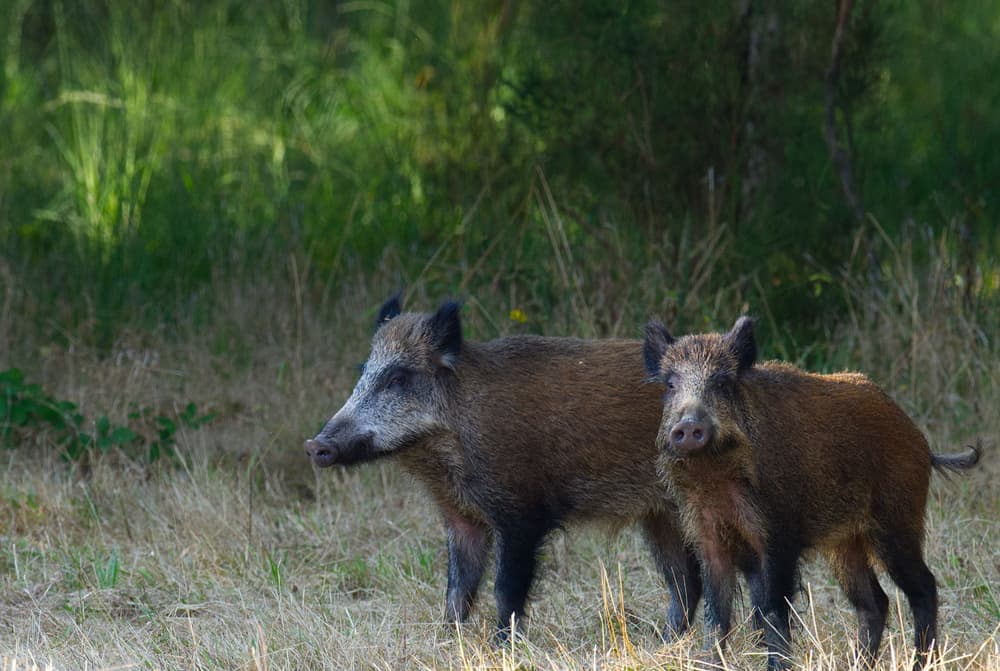
Hogs do a lot of their damage after dark. Texas A&M AgriLife notes that in warmer conditions feral hogs "feed nocturnally," use shade or wallow in mud to stay cool (Coping with Feral Hogs, Feral Hog Ecology). That's when the feeder empties and the pasture gets rooted, and it's when a scope that works without light earns its keep.
A thermal scope reads heat, not light. ATN puts it plainly: a thermal scope "does not emit or need any infrared light source. It passively detects the heat energy that objects already radiate, which is why it works identically with or without any light present" (ATN, Thermal vs Infrared). A hog stands out against cooler ground on a moonless night, with no light to put on it. Digital night vision is the other route, and it's cheaper, but it needs an infrared illuminator to see in the dark. Our thermal vs night vision comparison walks through that choice.
Seeing heat is only half the job. The other half is knowing what that heat is: a hog, a deer, a calf, a neighbor's dog. The scopes that rank highest here put more pixels on the animal at the distances hogs actually show up, so you can identify before you shoot. That matters for ethics and for the law, since deer and other protected game can't be hunted at night in Texas.
One more piece of honesty before the picks. A thermal scope removes hogs one or a few at a time. Texas A&M's Natural Resources Institute reports that "a sow can average 1.5 litters a year and each litter typically produces five to six piglets," and that eliminating about 66% of the population every year is needed just to stop growth (Texas A&M NRI, Nov. 2019). Shooting works best as one part of a plan that also traps whole sounders. Our guide on how to get rid of feral hogs lays out that system, and the rest of the thermal and night vision hub covers monoculars, clip-ons and budgets.
How we picked
We started from the thermal riflescopes Amazon listed when we checked on September 19, 2026, then read each maker's own spec page and warranty terms. Every scope is scored on our published thermal rubric: sensor and lens for identifying a hog at feeder-to-field distance (30%), usability at night (20%), battery and power (15%), durability (15%), warranty and support (10%) and value within its budget tier (10%). Seller performance numbers such as detection range are labeled as the maker's claim wherever they appear.
We haven't tested these units; scores come from published specs and the rubric on our How We Choose page. Budget tiers reflect the Amazon price we saw when we researched. Prices move, so each buy button checks the current price on Amazon.
This list ranks across all budgets, then breaks the picks into three tier sections below. If you already know your ceiling, the price-capped lists go deeper: our best thermal scopes under $1,000 and best thermal scope under $2,000 for the money.
Pixels on a hog: the worked math
Spec sheets lead with sensor resolution (256, 384, 640) and detection range. For putting detail on a hog, two quieter numbers matter more: pixel pitch (the size of each sensor pixel, in microns) and the lens focal length (in millimeters). Together they set how much of the hog each pixel covers. Here's the math, using only numbers the makers publish.
| Scope (published pitch / lens) | Inches per pixel at 100 yd | Pixels across a 5 ft hog at 50 / 100 / 150 yd | Horizontal view: our math (maker's figure) |
|---|---|---|---|
| ATN ThOR 6 Mini 256 (12 µm / 15 mm) | 2.9 | 42 / 21 / 14 | 11.7° (ATN: 11.7°) |
| AGM Rattler V2 19-256 (12 µm / 19 mm) | 2.3 | 53 / 26 / 18 | 9.3° (AGM: 9.3°) |
| Pulsar Talion XQ35 Pro (17 µm / 35 mm) | 1.7 | 69 / 34 / 23 | 10.7° (Pulsar: 10.7°) |
| AGM Clarion, 25 mm setting (12 µm / 25 mm) | 1.7 | 69 / 35 / 23 | 10.6° (AGM: 10.5°) |
| GOYOJO GRL335 (12 µm / 35 mm) | 1.2 | 97 / 49 / 32 | 7.5° (GOYOJO: 6.5°) |
| ATN ThOR 6 Elite LRF 384 (12 µm / 35 mm) | 1.2 | 97 / 49 / 32 | 7.5° (ATN: 7.53°) |
| oneleaf Mars MT1000LRF, 640 (12 µm / 35 mm) | 1.2 | 97 / 49 / 32 | 12.6° (oneleaf: 12.5°) |
| Pulsar Thermion 2 XQ50 Pro (17 µm / 50 mm) | 1.2 | 98 / 49 / 33 | 7.5° (Pulsar: 7.5°) |
| AGM Clarion, 50 mm setting (12 µm / 50 mm) | 0.9 | 139 / 69 / 46 | 5.3° (AGM: 5.3°) |
The view column is a check on the method: sensor width in pixels times the per-pixel angle gives the horizontal field of view, and it lands on the makers' own figures for every scope but one. GOYOJO publishes 6.5° for the GRL335 where the math gives 7.5°, so treat that scope's view as somewhere in that range. The RIX Storm S6R 640 shares the oneleaf's 12 µm pitch (per its Amazon listing title) and 35 mm lens, so its row is the same.
Four things fall out of the table:
- Lens and pitch put pixels on the hog; resolution buys the view around it. The 384 ThOR 6 Elite and the 640 oneleaf Mars put the same 49 pixels across the hog at 100 yards. The 640 shows a wider 12.6° scene, so you can watch the whole sounder and still see each animal at that detail.
- A bigger lens can make up for bigger pixels. The Thermion's 17 µm pixels behind a 50 mm lens land within a whisker of a 12 µm sensor behind 35 mm.
- Budget 256 scopes are close-range tools. With 15 to 19 mm lenses they put 21 to 26 pixels across a big hog at 100 yards, about half of what the 35 to 50 mm scopes manage. That's why their makers' wide views suit feeders, and why we say to step up if you shoot past 150 yards.
- Digital zoom doesn't add pixels. It enlarges the ones the lens already put on the animal. Compare scopes at their base magnification.
No maker publishes a pixel count for "identify a hog," so use these numbers to compare scopes, not as a pass mark. Real images also depend on sensitivity (NETD), lens quality, image processing, the display and conditions on the night. For the full resolution explainer, read 256 vs 384 vs 640 thermal.
The top picks side by side
Under $1,000: close-range scopes, one with reach
This tier is mostly 256x192 sensors behind short lenses, which suits a feeder or food plot inside about 100 yards. One scope breaks the pattern.
7. GOYOJO GRL335
The only 384 sensor in this list's under-$1,000 tier, with 12 µm pixels, a 35 mm lens and <25 mK NETD. By the math above it puts as many pixels on a hog as scopes a tier or two up. It also carries a five-year warranty, a published 1000 g recoil rating, 64 GB of storage and shot-activated recording. The trade-offs are a narrow view (GOYOJO lists 6.5° x 4.5° at a 4x base) that makes close, fast hogs slow to pick up, and IP65 splash resistance rather than the IP67 several rivals publish. It ranks seventh overall because its sensor score is strong but its usability and durability scores trail the premium scopes.
8. ATN ThOR 6 Mini 256 2-16x
The toughest spec sheet under $1,000: IP67, a 6000 J recoil rating, a -22°F to 131°F operating range and a five-year warranty in a 1.1 lb scope. Its ≤20 mK NETD is the most sensitive 256 in the tier on paper. The 15 mm lens gives one of the widest views in this list (11.7°), which is good at a feeder and weak at distance: about 21 pixels across a big hog at 100 yards. Two 18650s come in the box at about 4 hours each, plus USB-C power.
More budget options, including the AGM Rattler V2 and RIX Storm S2, are ranked on our under-$1,000 thermal list.
$1,000 to $2,000: where most hog hunters should land
This is the tier where lenses grow to 35 to 50 mm, batteries run 9 to 10 hours, and waterproof and recoil ratings get published as a matter of course. Three of our top five sit here.
1. Pulsar Thermion 2 XQ50 Pro
Our pick for hogs because it has no weak category. The 50 mm F/1.0 lens puts about 49 pixels across a big hog at 100 yards. Power is an internal APS5 plus a swappable external APS2 for up to 10 hours at 22°C, with USB-C (5 V/9 V) for more. It's IPX7, rated to 6000 J on rifles, works from -25°C to +50°C, and mounts in standard 30 mm rings with five zero profiles and 10 reticles. The costs: 31.7 oz of weight, 17 µm pixels where newer 384s use 12 µm, and a 3x base with a 7.5° view that's slower than a 2x scope on hogs inside 60 yards in brush. Pulsar's warranty is three years, or five with registration.
3. ATN ThOR 6 Elite LRF 384 3.5-28x
The fullest feature set under $2,000: a 12 µm, ≤15 mK sensor (the lowest NETD in this list), a 35 mm F/1.0 lens, a built-in 1,000 m rangefinder feeding a ballistic calculator, a 1920x1080 OLED, 64 GB with Recoil Activated Video, IP67, 6000 J and a five-year warranty. Runtime is about 9 hours from two 18650s, only one of which is field-replaceable, and rings aren't included. Like the Thermion, its 3.5x base is narrow up close. It scores 8.5 to the Thermion's 8.6; if you want to see that pair argued out, read Pulsar Thermion vs ATN ThOR.
5. oneleaf.ai Mars MT1000LRF (35 mm)
The only 640x512 sensor in this list's $1,000 to $2,000 tier, with <20 mK NETD, a built-in rangefinder (5.5 to 1,300 yd, the maker's claim), IP67 and a 6000 J rating. Its 2x base and 12.5° x 10.1° view are among the widest in the tier, so you can see the sounder and still resolve each hog at 35 mm detail. The catch is power: about 5 hours per removable 18650, so a full night means spares or USB-C. Warranty is three years.
$2,000 and up: rangefinders, dual lenses and light 640s
Above $2,000 you're paying for ranging, a second lens or a 640 sensor in a light body. None of these is necessary to kill hogs cleanly at feeder distance, but each solves a specific problem.
2. Pulsar Thermion 2 LRF XQ50 Pro
Everything our #1 does, plus an 800 m rangefinder (the maker's claim) and support for Pulsar's ballistics app. It ties the Thermion 2 XQ50 Pro at 8.6 and ranks just behind it because the rangefinder costs a full budget tier, and most hog shots at a feeder happen at a distance you already know. Buy it if you shoot across open fields at unknown ranges and want a traditional 30 mm-tube scope.
4. AGM Clarion 384 Dual Focus
Two lenses in one body: flip from 25 mm (2x base, 10.5° view) to scan a sounder, then to 50 mm (4.5x base, 5.3° view) to pick out the boar. By our math the 50 mm setting puts about 69 pixels across a big hog at 100 yards, the most of any setting here. It runs up to 11 hours per battery with a spare NE-4400 in the box, is IP67 and carries AGM's five-year US warranty. AGM doesn't publish a recoil rating for it.
6. RIX Storm S6R 640 (35 mm)
A 640x512, <20 mK sensor with a 2x base, a 1,312 yd rangefinder (the maker's claim) and a ballistic calculator in a scope of about 1 lb, with a 6000 J rating and a five-year warranty. The weak spots are about 4 hours per 18650 and no published IP rating.
In detail
The picks, in full
Rank 01
Stock photoBest thermal for hogs
Pulsar Thermion 2 XQ50 Pro
The best all-around balance for hogs at feeder-to-field distance: a 50 mm F/1.0 lens, up to 10 hours on internal plus swappable external power, IPX7, a 6000 J rating and standard 30 mm rings. It sits in the $1,000 to $2,000 tier.
Published specsResearched · not tested by us
| Sensor | 384x288 (uncooled) |
|---|---|
| Pixel pitch | 17 µm |
| NETD | <25 mK (sNETD <18 mK) |
| Lens | 50 mm, F/1.0 |
| Magnification | 3-12x |
| Refresh rate | 50 Hz |
| Field of view | 7.5° horizontal (13.1 m at 100 m) |
| Detection range | 1,800 m (about 1,969 yd)Maker's claim |
| Display | 1024x768 AMOLED |
| Battery | Internal APS5 plus external APS2, up to 10 h at 22°C; USB-C (5 V/9 V) external power |
| Recording | 16 GB internal; Wi-Fi (2.4/5 GHz) to Stream Vision 2 app |
| IP rating | IPX7 |
| Recoil rating | 6000 J on rifled weapons; 12 gauge on smoothbores |
| Operating temperature | -25°C to +50°C |
| Weight | 0.9 kg (31.7 oz) |
| Mount | Standard 30 mm rings |
| Warranty | 3 years; 5 years with registration |
How the 8.6 score breaks down
- Sensor & lens for hog ID (30%)
- 8.5
- Usability at night (20%)
- 8.5
- Battery & power (15%)
- 9
- Durability (15%)
- 9
- Warranty & support (10%)
- 8.5
- Value within its tier (10%)
- 7.5
What the specs support
- Big 50 mm F/1.0 lens with a 3x base: more detail on a hog at field distance than 25-35 mm scopes
- Swappable external APS2 pack on top of the internal battery, up to 10 h, plus USB-C power
- IPX7, 6000 J recoil rating and a -25°C to +50°C operating range, all published
- Mounts in standard 30 mm rings; five zero profiles and 10 reticles
Where it falls short
- 17 µm pixels versus 12 µm on newer 384 scopes; field of view at 3x is narrower than a 35 mm scope
- Heaviest scope in its tier at 31.7 oz
- No built-in rangefinder (that's the Thermion 2 LRF)
Skip this if…
…Your hogs come to a feeder inside 60 yards in thick brush; a 3x base on a 50 mm lens is slower to pick up close movement than a 2x, 25-35 mm scope.
#ad · Price set by Amazon · How we make money for the link to Pulsar Thermion 2 XQ50 Pro
Rank 02
Stock photoBest pick at $2,000 and up
Pulsar Thermion 2 LRF XQ50 Pro
The same sensor, lens and battery as our #1 with an 800 m rangefinder added. It ties our #1 on score; it ranks second because most hog shots don't need the ranging it costs a tier more to get.
Published specsResearched · not tested by us
| Sensor | 384x288 (uncooled) |
|---|---|
| Pixel pitch | 17 µm |
| NETD | <25 mK |
| Lens | 50 mm, F/1.0 |
| Magnification | 3-12x |
| Refresh rate | 50 Hz |
| Field of view | 7.5° x 5.6° (13.1 x 9.8 m at 100 m) |
| Detection range | 1,800 mMaker's claim |
| Display | 1024x768 AMOLED |
| Battery | 2 Ah changeable external plus 4.9 Ah internal, up to 10 h at 22°C; USB-C (5 V/9 V) external power |
| Recording | 16 GB internal; Wi-Fi (2.4/5 GHz) to Stream Vision 2 and Stream Vision Ballistics |
| Rangefinder | Built-in, 800 m max, ±1 m (905 nm, Class 1)Maker's claim |
| IP rating | IPX7 |
| Recoil rating | 6000 J on rifled weapons; 12 gauge on smoothbores |
| Operating temperature | -25°C to +50°C |
| Weight | 0.97 kg |
| Mount | Standard 30 mm rings |
| Warranty | 3 years; 5 years with registration |
How the 8.6 score breaks down
- Sensor & lens for hog ID (30%)
- 8.5
- Usability at night (20%)
- 9
- Battery & power (15%)
- 9
- Durability (15%)
- 9
- Warranty & support (10%)
- 8.5
- Value within its tier (10%)
- 6.5
What the specs support
- Built-in rangefinder on a traditional 30 mm-tube scope that fits standard rings
- Up to 10 h with a changeable external pack, plus USB-C power delivery
- IPX7, 6000 J and a -25°C to +50°C range, all published
Where it falls short
- 384 sensor at 17 µm, while the RIX Storm S6R and AGM Clarion 640 offer 640 or 12 µm sensors in this tier
- 800 m rangefinder is shorter than the 1,000 m ATN and 1,300 yd oneleaf units
- Heaviest scope in this list at 0.97 kg
Skip this if…
…You don't need ranging for hog-distance shots; the non-LRF Thermion 2 XQ50 Pro has the same sensor, lens and battery for a tier less.
#ad · Price set by Amazon · How we make money for the link to Pulsar Thermion 2 LRF XQ50 Pro
Rank 03
Stock photoBest rangefinder under $2,000
ATN ThOR 6 Elite LRF 384 3.5-28x
A 12 µm, ≤15 mK 384 with a built-in 1,000 m rangefinder, ballistic calculator, 1920x1080 OLED and five-year warranty: the fullest feature set in its tier.
Published specsResearched · not tested by us
| Sensor | 384x288 (12 µm VOx) |
|---|---|
| Pixel pitch | 12 µm |
| NETD | ≤15 mK |
| Lens | 35 mm germanium, F/1.0 |
| Magnification | 3.5-28x (1x, 2x, 4x, 8x digital zoom) |
| Refresh rate | 50 Hz |
| Field of view | 7.53° x 5.65° |
| Detection range | 2,750 mMaker's claim |
| Display | 0.49 in OLED, 1920x1080 |
| Battery | Two 18650s (one internal, one replaceable), about 9 h; USB-C external power |
| Recording | 64 GB internal; Recoil Activated Video; Wi-Fi to ATN Connect 6 app |
| Rangefinder | Built-in, 1,000 m, ±1 m (905 nm, Class 1); ballistic calculatorMaker's claim |
| IP rating | IP67 |
| Recoil rating | 6000 J (1000 g over 0.4 ms) |
| Operating temperature | -22°F to 131°F (-30°C to 55°C) |
| Weight | 830 g (1.83 lb) |
| Mount | 30 mm rings (not included) |
| Warranty | 5 years |
How the 8.5 score breaks down
- Sensor & lens for hog ID (30%)
- 8.5
- Usability at night (20%)
- 8
- Battery & power (15%)
- 8
- Durability (15%)
- 9
- Warranty & support (10%)
- 9
- Value within its tier (10%)
- 8.5
What the specs support
- Lowest published NETD in this list (≤15 mK) on a 12 µm 384 sensor
- Built-in laser rangefinder feeds the ballistic calculator; six ballistic profiles
- Full HD 1920x1080 OLED, 64 GB storage and Recoil Activated Video
- IP67, 6000 J and a five-year warranty, all published
Where it falls short
- 3.5x base on a 35 mm lens is a narrow 7.5° view for close feeder work
- Rings aren't included
- Only one of the two 18650s is replaceable in the field
Skip this if…
…You mostly shoot hogs inside 75 yards; the 3.5x base is tight up close, and the ThOR 6 384 2.5-20x gives a wider 10.5° view.
#ad · Price set by Amazon · How we make money for the link to ATN ThOR 6 Elite LRF 384 3.5-28x
Rank 04
Stock photoBest for scanning wide, then identifying far
AGM Clarion 384 Dual Focus
Two lenses in one scope: flip from a wide 25 mm (2x) view for scanning a sounder to 50 mm (4.5x) to identify the boar, with up to 11 hours per battery and a spare included.
Published specsResearched · not tested by us
| Sensor | 384x288 |
|---|---|
| Pixel pitch | 12 µm |
| NETD | <20 mK |
| Lens | Switchable 25 mm / 50 mm |
| Magnification | 2x / 4.5x base; 2-16x / 4.5-36x digital |
| Refresh rate | 50 Hz |
| Field of view | 10.5° x 7.9° (25 mm) / 5.3° x 4.0° (50 mm) |
| Detection range | 1,200 (25 mm) / 2,600 (50 mm), listed as m/ydMaker's claim |
| Display | 1024x768 OLED |
| Battery | Up to 11 h; one replaceable NE-4400 Li-ion, two included |
| Recording | 16 GB video/photo storage |
| IP rating | IP67 |
| Weight | 1.65 lb |
| Warranty | 5 years (US purchases, per AGM warranty terms) |
How the 8.1 score breaks down
- Sensor & lens for hog ID (30%)
- 8.5
- Usability at night (20%)
- 8.5
- Battery & power (15%)
- 9
- Durability (15%)
- 6.5
- Warranty & support (10%)
- 8.5
- Value within its tier (10%)
- 7
What the specs support
- Mechanical switch between 25 mm and 50 mm lenses without changing sensor resolution
- 12 µm sensor with <20 mK NETD
- Up to 11 h per battery with a second NE-4400 in the box
- IP67 and a five-year warranty for US buyers
Where it falls short
- AGM doesn't publish a recoil rating for it
- 384 sensor in a tier where the RIX Storm S6R offers 640
Skip this if…
…You hunt one kind of ground at one distance; a single-lens 640 like the RIX Storm S6R puts the money into resolution instead.
#ad · Price set by Amazon · How we make money for the link to AGM Clarion 384 Dual Focus
Rank 05
Stock photoBest 640 sensor under $2,000
oneleaf.ai Mars MT1000LRF (35 mm)
A 640x512 sensor with a laser rangefinder under $2,000, with a wide 2x base for hogs; the trade-off is about 5 hours per battery and a three-year warranty.
Published specsResearched · not tested by us
| Sensor | 640x512 |
|---|---|
| Pixel pitch | 12 µm |
| NETD | <20 mK |
| Lens | 35 mm, F1.0 (50 mm and 75 mm lenses optional) |
| Magnification | 2x base; 1-8x digital |
| Refresh rate | 60/50/30 Hz selectable |
| Field of view | 12.5° x 10.1° |
| Detection range | 1,800 m / 1,969 ydMaker's claim |
| Display | 1024x768 OLED |
| Battery | Removable 18650 (3200 mAh), up to 5 h; USB-C 5 V/2 A external power |
| Recording | Photo and video with microphone; 32-256 GB storage |
| Rangefinder | Built-in, 5.5-1,300 yd; ballistic calculator with 7 data profilesMaker's claim |
| IP rating | IP67 |
| Recoil rating | 6000 J (1000 g over 0.4 ms) |
| Operating temperature | -4°F to 122°F |
| Weight | 549 g (19.37 oz) |
| Mount | Picatinny |
| Warranty | 3 years |
How the 8.1 score breaks down
- Sensor & lens for hog ID (30%)
- 9
- Usability at night (20%)
- 8
- Battery & power (15%)
- 6
- Durability (15%)
- 8.5
- Warranty & support (10%)
- 7.5
- Value within its tier (10%)
- 9
What the specs support
- The only 640x512 sensor in this list's $1,000 to $2,000 tier, with <20 mK NETD
- 2x base and a 12.5° x 10.1° view: wide for sounders, with 640 detail for zooming in
- Built-in rangefinder and ballistic calculator, IP67 and a 6000 J rating
- Swappable lenses (50 mm, 75 mm) if you later need more reach
Where it falls short
- About 5 h per 18650, so a full night needs spares or USB-C power
- Three-year warranty versus five on the ATN ThOR 6 Elite and RIX Storm S3
Skip this if…
…You won't carry spare batteries; at about 5 hours per 18650 it won't last a long sit on one cell.
#ad · Price set by Amazon · How we make money for the link to oneleaf.ai Mars MT1000LRF (35 mm)
Rank 06
Stock photoBest lightweight 640
RIX Storm S6R 640 (35 mm)
A 640x512 sensor, 2x base, rangefinder and ballistic calculator in a 1 lb scope with a five-year warranty; the catch is about 4 hours per 18650.
Published specsResearched · not tested by us
| Sensor | 640x512 |
|---|---|
| Pixel pitch | 12 µm (listing title) |
| NETD | <20 mK |
| Lens | 35 mm |
| Magnification | 2x base; 1-4x digital |
| Refresh rate | 50 Hz |
| Detection range | About 1,969 ydMaker's claim |
| Display | 1024x768 AMOLED |
| Battery | Swappable 18650, about 4 h at 72°F; 5 V USB-C external power |
| Recording | 32 GB built-in; Recoil-Activated Video; Wi-Fi to RIX+ app |
| Rangefinder | Built-in, 1,312 yd, ±1.09 yd; ballistic calculatorMaker's claim |
| Recoil rating | 1000 g / 6000 J |
| Weight | About 1 lb |
| Mount | Picatinny QD mount included |
| Warranty | 5 years |
How the 7.8 score breaks down
- Sensor & lens for hog ID (30%)
- 9
- Usability at night (20%)
- 8
- Battery & power (15%)
- 5.5
- Durability (15%)
- 6
- Warranty & support (10%)
- 9
- Value within its tier (10%)
- 8.5
What the specs support
- 640x512 with <20 mK NETD at a wide 2x base: a big view for sounders with detail to zoom into
- Built-in 1,312 yd rangefinder and ballistic calculator
- About 1 lb with a 6000 J rating and a five-year warranty
Where it falls short
- About 4 h per 18650 is the shortest runtime among the 640s here
- No IP rating on RIX's S6R page
Skip this if…
…You won't manage spare batteries on a long sit; the AGM Clarion's up-to-11-hour claim or a Pulsar's 10 h fits better.
#ad · Price set by Amazon · How we make money for the link to RIX Storm S6R 640 (35 mm)
Rank 07
Stock photoBest under $1,000
GOYOJO GRL335
The cheapest route to a 384 sensor behind a 35 mm lens with a five-year warranty; the 4x base and 6.5° view are narrow for sweeping a feeder at close range.
Published specsResearched · not tested by us
| Sensor | 384x288 (VOx) |
|---|---|
| Pixel pitch | 12 µm |
| NETD | <25 mK |
| Lens | 35 mm |
| Magnification | 4x optical; 1x, 2x, 3x, 4x digital |
| Refresh rate | 55 Hz |
| Field of view | 6.5° x 4.5° |
| Detection range | 2,647 m (human-size target)Maker's claim |
| Display | 0.39 in OLED, 1024x768 |
| Battery | 18650 rechargeable (2600 mAh), 6-8 h; 5 V/2 A charging |
| Recording | 64 GB SD card; shot-activated recording; Wi-Fi app |
| IP rating | IP65 |
| Recoil rating | 1000 g / 0.4 ms |
| Operating temperature | -20°C to 50°C (-4°F to 122°F) |
| Weight | 553 g (1.22 lb) without battery |
| Mount | Picatinny mount |
| Warranty | 5 years |
How the 7.5 score breaks down
- Sensor & lens for hog ID (30%)
- 8
- Usability at night (20%)
- 6.5
- Battery & power (15%)
- 7
- Durability (15%)
- 6.5
- Warranty & support (10%)
- 8.5
- Value within its tier (10%)
- 9
What the specs support
- The only 384 sensor in this list's $500 to $1,000 tier: 12 µm, 35 mm lens, <25 mK NETD
- Five-year warranty and a published 1000 g recoil rating
- 64 GB storage, shot-activated recording and thermal one-shot zero
Where it falls short
- 4x base and a 6.5° x 4.5° field of view are tight for close, fast-moving hogs
- IP65 is splash resistance, a step below the IP67 on several rivals
Skip this if…
…Most of your shots are inside 75 yards at a feeder; the narrow 4x base view makes it slow to pick up a sounder that close.
#ad · Price set by Amazon · How we make money for the link to GOYOJO GRL335
Rank 08
Stock photoBest rugged pick under $1,000
ATN ThOR 6 Mini 256 2-16x
The toughest spec sheet under $1,000 (IP67, 6000 J recoil, five-year warranty, ≤20 mK) in a 1.1 lb scope; the 15 mm lens and small 800x600 screen make it a close-range tool.
Published specsResearched · not tested by us
| Sensor | 256x192 (12 µm VOx) |
|---|---|
| Pixel pitch | 12 µm |
| NETD | ≤20 mK |
| Lens | 15 mm germanium, F/1.0 |
| Magnification | 2-16x (1x, 2x, 4x, 8x digital zoom) |
| Refresh rate | 50 Hz |
| Field of view | 11.7° x 8.8° |
| Detection range | 1,200 mMaker's claim |
| Display | 0.32 in OLED, 800x600 |
| Battery | About 8 h total from two included 18650s (about 4 h each); USB-C external power |
| Recording | 64 GB internal; Recoil Activated Video; Wi-Fi to ATN Connect 6 app |
| IP rating | IP67 |
| Recoil rating | 6000 J (1000 g over 0.4 ms) |
| Operating temperature | -22°F to 131°F (-30°C to +55°C) |
| Weight | 500 g (1.10 lb) |
| Mount | Picatinny rail mount (included) |
| Warranty | 5 years |
How the 7.3 score breaks down
- Sensor & lens for hog ID (30%)
- 5.5
- Usability at night (20%)
- 7
- Battery & power (15%)
- 8
- Durability (15%)
- 9
- Warranty & support (10%)
- 9
- Value within its tier (10%)
- 8
What the specs support
- Most sensitive 256 sensor in its tier on paper (≤20 mK NETD)
- Published 6000 J recoil rating, IP67 and a -22°F to 131°F operating range
- Swappable 18650 batteries (two included) plus USB-C external power
- 64 GB internal storage with Recoil Activated Video, zeroing freeze and picture-in-picture
Where it falls short
- 15 mm lens is the shortest here, so animals look small beyond close range
- 256 model gets a smaller 0.32 in 800x600 display; the 384 and 640 Minis get 1920x1080
- About 4 h per battery means carrying the spare on a full night
Skip this if…
…Your shots are regularly past 150 yards across open fields; the 15 mm lens trades reach for field of view, so look at a 35 mm 384 instead.
#ad · Price set by Amazon · How we make money for the link to ATN ThOR 6 Mini 256 2-16x
What to look for in a thermal scope for hogs
- Lens focal length and pixel pitch first. They set how many pixels land on the hog (see the math above). For shots past 100 yards, look for 35 mm or longer with 12 µm pixels, or 50 mm with 17 µm.
- Sensor resolution second. At the same pitch and lens, a 640 gives a wider view than a 384, and a 384 wider than a 256. Wider helps you follow a sounder that's moving.
- Base magnification that matches your distances. A 2x to 2.5x base (oneleaf Mars, RIX S6R, Clarion at 25 mm, Talion) is quicker on close hogs in brush. A 3x to 4x base (Thermion, ThOR 6 Elite, GRL335) is narrower up close but fills the view at field distance.
- NETD. Lower is more sensitive. The picks here run from ≤15 mK (ThOR 6 Elite) to <25 mK (Thermion, GRL335). Check whether a maker quotes a sensor-level figure (Pulsar lists sNETD separately) before comparing.
- Batteries you can swap in the dark. Runtime claims here run from about 4 hours per cell (RIX S6R) to up to 11 hours (Clarion). A swappable pack or USB-C power matters more than the headline number on an all-night sit.
- Published waterproof and recoil ratings. IP67 or IPX7 and a stated recoil rating (6000 J, or a named caliber) are what you want. A blank field isn't a pass; RIX publishes no IP rating for the S6R, and AGM no recoil rating for the Clarion.
- Warranty you can read. Terms here run from three years (oneleaf) to five (ATN, RIX, GOYOJO GRL335, AGM for US purchases), with Pulsar at three years or five with registration.
- Zero profiles and one-shot zero. Useful if the scope moves between rifles. Our guide on how to zero a thermal scope covers the process.
What each budget tier buys at hog distances
| Budget tier | What you typically get (from the picks' published specs) | Realistic hog job |
|---|---|---|
| Under $1,000 | 256x192 sensors behind 15 to 25 mm lenses; one 384 with a 35 mm lens (GOYOJO GRL335) | Feeders and food plots inside about 100 yards; the GRL335 reaches further but is slow up close |
| $1,000 to $2,000 | 384 sensors behind 35 to 50 mm lenses, one 640; 9 to 10 hour batteries on the leaders; rangefinders on some | Feeder to open field; the tier most hog hunters should aim for |
| $2,000 and up | Rangefinders on 30 mm-tube scopes, dual-lens bodies, light 640s | Open country at unknown ranges, or one scope for every setup |
The jump that changes the most at hog distances is from a short-lens 256 to a 35 mm-plus scope, which roughly doubles the pixels on the animal. Going from $2,000 to well past it mostly buys features, not detail. Our guide to how much a thermal scope costs goes tier by tier.
Texas night-hunting rules in one paragraph
On private land with the landowner's authorization, TPWD says no hunting license is required for feral hogs, though Hunter Education requirements apply; public land still requires a license, and paid hunting access requires a hunting lease license (TPWD Outdoor Annual). Texas A&M NRI's 2026 summary notes that thermal rifle scopes and night-vision scopes can be used when removing feral pigs, and recommends telling local game wardens you'll be hunting pigs at night (Texas A&M NRI, April 2026). Don't shoot across a property line without written permission. The details, with every rule cited, are in Texas hog hunting laws.
Thermal-buying mistakes
- Buying on detection range. It's the maker's claim, and it measures seeing a heat spot, not telling a hog from a deer. TOPDON publishes both numbers for its TS004 monocular: 450 yards to detect, 91 m to identify. The gap is the point.
- Comparing magnification at the top of the digital zoom. Digital zoom doesn't add pixels. Compare lens size and base magnification.
- Buying a narrow scope for a close feeder. A 3.5x to 4x base is hard work on hogs at 40 yards. Match the base to your shots.
- Ignoring the battery design. A built-in battery or a 4-hour cell means planning a swap or a power bank before the hogs come in.
- Forgetting the mount. The ThOR 6 Elite and Thermion need 30 mm rings (ATN's aren't included); others ship with a Picatinny mount. Check what's in the box.
- Treating the scope as the whole plan. Pair it with a steady shooting rest and a trapping plan for the rest of the sounder.
How we scored this
Units we claim to have tested: 0
Plenty of gear sites say they field-tested everything they list. We haven't, and we say so. Every pick here is labeled Researched: we read each maker's published specs, manuals and warranty terms, compare products only against others in the same budget tier, and score them on a public rubric. Every figure links to where it came from, and seller performance numbers are labeled “maker's claim.”
Scores are editorial judgments from that documented research, not test results. Commissions never set a score or decide a pick. The rubric and its weights are published.
What changed
- Published.
Questions
Frequently asked
What is the best thermal scope for hog hunting?
Are thermal scopes worth it for hogs?
What resolution thermal scope do I need for hogs?
How far can a thermal scope see a hog?
How long will a thermal scope last?
Is it legal to hunt hogs at night with a thermal scope in Texas?
Receipts
Sources
- Pulsar: Thermion 2 XQ50 PRO product page and full specification (checked 2026-09-19)
- Pulsar: Thermion 2 LRF XQ50 PRO product page and full specification (checked 2026-09-19)
- Pulsar: Talion XQ35 PRO product page and full specification (checked 2026-09-19)
- ATN: ThOR 6 LRF 384x288 3.5-28x product page and spec table (checked 2026-09-19)
- ATN: ThOR 6 Mini 256x192 2-16x product page and spec table (checked 2026-09-19)
- AGM Global Vision: Clarion 384 Dual Focus product page and spec table (checked 2026-09-19)
- AGM Global Vision: Rattler V2 19-256 product page and spec table (checked 2026-09-19)
- AGM Global Vision: warranty terms (checked 2026-09-19)
- oneleaf.ai: Mars MT1000LRF product page and spec table (checked 2026-09-19)
- RIX Optics: STORM S6R product page and FAQ (checked 2026-09-19)
- GOYOJO Optics: GRL Series (GRL335) product page and spec table (checked 2026-09-19)
- ATN: Thermal vs Infrared: What's the Difference? (checked 2026-09-19)
- Texas A&M AgriLife, Coping with Feral Hogs: Feral Hog Ecology (checked 2026-09-19)
- Missouri Department of Conservation: Feral Hog (Feral Swine) field guide, size (checked 2026-09-19)
- Texas A&M NRI: Startling statistics everyone needs to know about wild pigs (Nov. 2, 2019; checked 2026-09-19)
- Texas A&M NRI: An update on feral pig laws and regulations in Texas (April 1, 2026; checked 2026-09-19)
- TPWD: Outdoor Annual, Nongame and Other Species: Feral Hogs and Coyotes (valid Sep 1 2026 – Aug 31 2027; checked 2026-09-19)
- TPWD: Outdoor Annual, Means and Methods (valid Sep 1 2026 – Aug 31 2027; checked 2026-09-19)
- TOPDON: TS004 product page and spec table (checked 2026-09-19)
- Texas Parks & Wildlife Code §62.004, Hunting at Night (texas.public.law; checked 2026-09-19)
- Texas Parks & Wildlife Code §62.005, Hunting with Light (texas.public.law; checked 2026-09-19)
- Texas Parks & Wildlife Code §62.0031, Hunting on Public Roads (texas.public.law; checked 2026-09-19)
We haven't tested the gear on this page and we don't pretend to. Specs come from each maker's own pages or the product listing (linked on every product), hog biology and trapping advice from Texas A&M AgriLife, and rules from TPWD and Texas statute. Prices are set by Amazon and change often, so we don't print them. Where a figure isn't published, we say so. Read the full method.