The contenders
Side by side
 Stock photo
The spin feeder: corn on your schedule
Moultrie 250 lb Pro Hunter III Tripod Feeder
Under $5006.5/1010 feed times, sunrise and sunset sync and adjustable throw. You decide when corn hits the ground and how far it goes, which is the whole argument for a spinner in hog country.
Check price · Amazon#ad · Price set by Amazon · How we make money for the link to Moultrie 250 lb Pro Hunter III Tripod Feeder
- Stock photo
The gravity feeder: same frame, no timer
Moultrie Gravity Deer Feeder (tripod)
Under $5004.5/10Moultrie's no-battery gravity tripod, with a Quick-Lock head that converts to a spinner later. Feed sits in the ports 24 hours a day.
Check price · Amazon#ad · Price set by Amazon · How we make money for the link to Moultrie Gravity Deer Feeder (tripod)
- Stock photo
The big protein gravity feeder
Boss Buck 350 lb Gravity Protein Feeder (3 feed tubes)
Under $5005.2/10Three angled ports with drain holes and a UV-protected HDPE hopper for about 350 lb of corn or 300 lb of pellets. Built for a protein program, and it belongs inside a pen.
Check price · Amazon#ad · Price set by Amazon · How we make money for the link to Boss Buck 350 lb Gravity Protein Feeder (3 feed tubes)
We haven't tested these units; scores come from published specs and the rubric on our How We Choose page. The three feeders compared here are all sold on Amazon, and every spec below links to the maker's page.
How each one works
A spin feeder (also called a broadcast feeder) holds feed in a hopper over a motor and a spin plate. At the times you program, the motor runs for a set number of seconds and the plate throws feed out in a circle. The Moultrie Pro Hunter III does this across 360 degrees off a metal spin plate, up to 10 times a day at 1 to 60 seconds each, with high, medium or low throw. It needs a battery, and it only puts feed out when the timer says so.
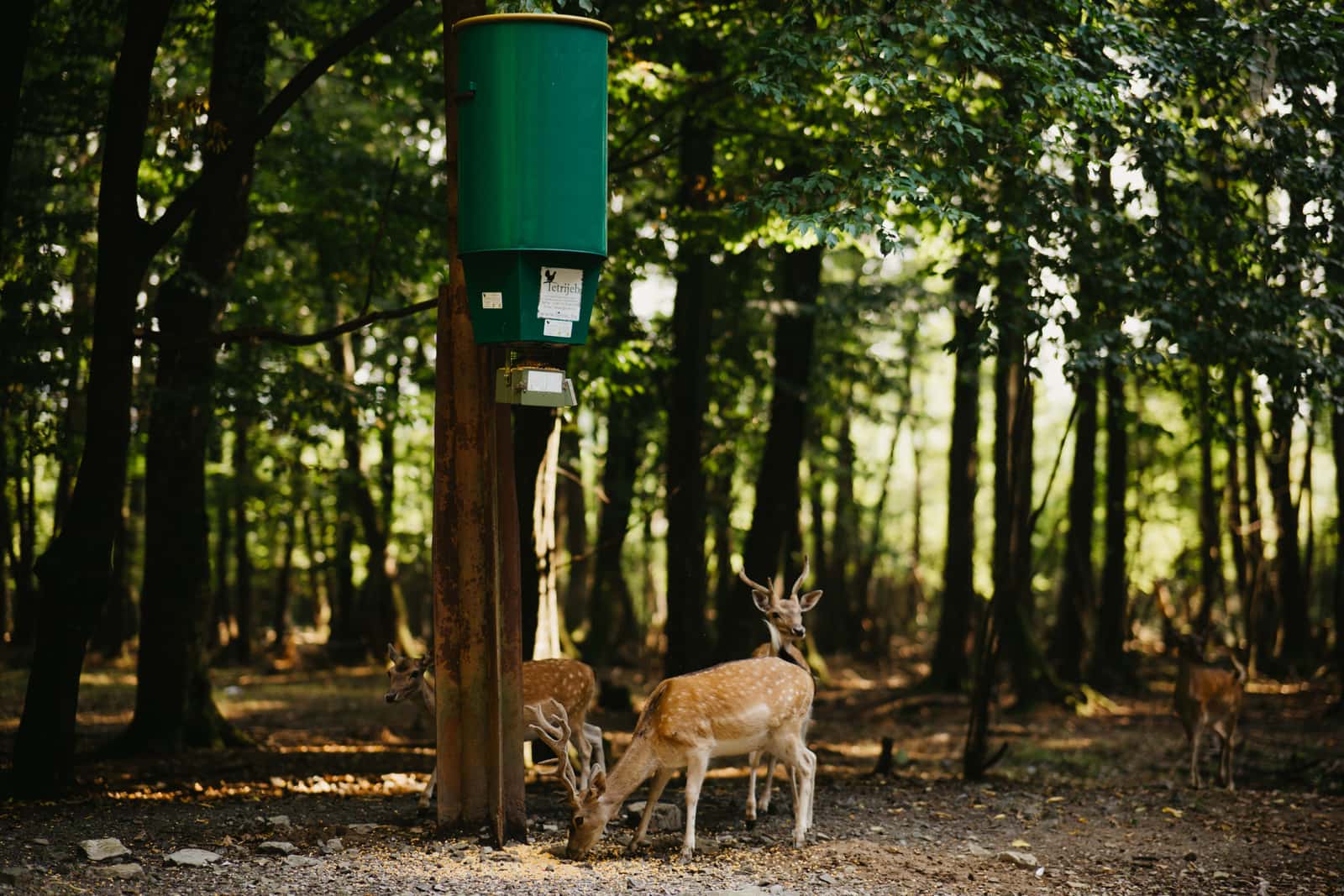
A gravity feeder has no motor. Feed flows down into ports or tubes, and animals eat it from there; as they eat, more feed drops in. It's "free-choice": available any hour an animal shows up. The Moultrie Gravity has no electronics or batteries at all, and the Boss Buck 350 feeds through three 10 in tubes set at a 10-degree angle, each with a drain hole.
That one difference, scheduled versus always available, drives almost everything else on this page. For the broader feeder picture, see the Feeders & Trail Cameras hub.
Spin feeder vs gravity feeder at a glance
| Spin (broadcast) feeder | Gravity feeder | |
|---|---|---|
| When feed is out | Only when the timer runs; you set the times | All day and all night, until the hopper is empty |
| Where the feed sits | On the ground, in a circle around the feeder | In the ports, off the ground |
| Hog exposure | Any corn on the ground is open to hogs; short daylight runs limit it | Open to any animal that can reach the ports, around the clock |
| Power | Battery (6V tab-top on the Pro Hunter III, sold separately); solar compatible | None |
| Programmability | Feed times, duration, throw; app on some models | None |
| Typical feed | Corn | Protein pellets or corn |
| Pen size in the research | 28 ft circle around a broadcast corn feeder | 80 by 80 ft or larger suggested for protein feeders |
| Upkeep | Battery, timer, motor and refills | Refills and keeping ports dry and clear |
Pen sizes are from Texas A&M AgriLife Extension publication L-5533, which reports the 28-foot exclosures its researchers built around broadcast corn feeders and a Caesar Kleberg Wildlife Research Institute suggestion for protein feeders (L-5533).
The three feeders side by side
| Published spec | Moultrie 250 lb Pro Hunter III Tripod Feeder | Moultrie Gravity Deer Feeder (tripod) | Boss Buck 350 lb Gravity Protein Feeder (3 feed tubes) |
|---|---|---|---|
| Type | Tripod broadcast (spin) feeder, 360° coverage, metal spin plate | Tripod gravity feeder; no electronics or batteries | Gravity (free-choice protein) feeder, 3 feed tubes |
| Capacity | 250 lb | 250 lb on Moultrie's tripod gravity model (the Amazon title doesn't state capacity) | About 350 lb corn or 300 lb large protein pellets |
| Fill height | 6 ft | 6 ft | — |
| Feed times | Up to 10 per day, 1 to 60 seconds each | — | None (gravity); converts to an automatic 12V spinner timer |
| Throw control | High / medium / low RPM | — | — |
| Power | 6V tab-top rechargeable battery (sold separately); solar compatible | — | — |
| Construction | Plastic hopper; powder-coated steel legs, 6 sections | Plastic hopper; twist-lock detachable lid; powder-coated steel legs, 6 sections | Thick-wall UV-protected HDPE hopper; galvanized hardware |
| Warranty | 1 year | 1 year | — |
| Score | 6.5/10 | 4.5/10 | 5.2/10 |
The two Moultrie feeders are close to a controlled experiment: same maker, 250 lb class, 6 ft fill height, powder-coated steel legs, plastic hopper, 1-year warranty. The difference is the head: one has a motor and a Bluetooth timer, the other has ports. The Boss Buck is the heavier-duty gravity option, with a thick-wall HDPE hopper that Boss Buck says won't rot, rust or leak.
Which one feeds more hogs?
Both feed hogs. Texas A&M's Natural Resources Institute says feral pigs "have become accustomed to utilizing feeders as an easily accessible food source," that they "often dominate other species and push them away from feed," and that this "also occurs at feeding stations, which provide pelleted feed and other high-protein food sources" ( Texas A&M NRI, Dec. 2025). So the question isn't which design hogs ignore. It's which one gives you more control.
The spin feeder gives you two levers. First, timing: AgriLife notes that in warmer conditions feral hogs can "feed nocturnally" (AgriLife, Feral Hog Ecology), so daylight-only feedings leave less corn waiting after dark in the warm months. Second, amount: short runs put less corn on the ground at once. Neither lever stops a sounder that comes in by day or cleans up what the deer left.
The gravity feeder gives you none. Feed is there at 2 a.m. the same as at noon. Neither Moultrie nor Boss Buck publishes how high the ports sit or claims they're out of a hog's reach, so plan as if hogs can eat from them. A gravity feeder that hogs find will be emptied on their schedule, not yours.
That's why the spin feeder wins this matchup in hog country, narrowly. But notice what both paragraphs have in common: the feeder only manages the problem. The fix is a pen, and our best hog-proof deer feeders guide walks through the research and the build.
Pens: why a gravity feeder needs a bigger one
AgriLife's guidance for a deer feeder is a short fence "28 inches to 34 inches in height" around the area where food is spread; hogs stay out and deer "can easily jump a fence of that height" ( AgriLife, Preventative Options). How big the pen needs to be is where the two designs split.
- Spin feeder: the L-5533 researchers used 28-foot circles around broadcast corn feeders, and the 28 and 34 inch fences "kept them out completely." The pen has to contain the throw, so turn the throw down until the corn lands inside a 14-foot radius.
- Gravity feeder: there's no throw to contain, but deer crowd at ports. The Caesar Kleberg researchers "suggested that fences be 80 by 80 feet or larger to prevent deer from crowding while feeding" around protein feeders (L-5533). The NRI's 2025 article calls a 30 by 30 foot circle "reasonable and consistent with published studies" for feeders generally.
Run the fence math with 16-foot panels:
| Pen | Fence length | 16 ft panels (before overlaps) |
|---|---|---|
| 28 ft circle (spin feeder, L-5533) | About 88 ft (28 x 3.14) | 6 |
| 30 ft circle (NRI 2025) | About 94 ft | 6, with little to spare for overlaps |
| 80 x 80 ft square (protein feeder, CKWRI) | 320 ft | 20 |
A protein pen at the suggested size takes more than three times the panel and T-posts of a corn pen. That's the hidden cost of a gravity protein program in hog country, and it belongs in the budget before you buy the feeder.
Setting up a spin feeder inside a pen
A spin feeder and a pen can work against each other if the throw is wrong. A 28-foot pen has a 14-foot radius, so any corn thrown past 14 feet lands outside the fence, where hogs can reach it. Moultrie publishes high, medium and low throw settings for the Pro Hunter III but not the distance each one reaches, so you have to check it yourself:
- Set the feeder where the pen will go, and set the throw to low.
- Run one short feeding and pace off where the farthest corn landed.
- Build the pen a little outside that line, or turn the throw down until the corn lands inside your planned circle.
- Follow AgriLife's build: T-posts on the outside of the circle, panels clipped to them and set flush to the ground, with no gaps hogs might dig under (L-5533).
- Schedule short daylight feedings, and put a camera on it for the first few weeks to confirm deer are using it and hogs aren't.
A gravity feeder skips steps 1 to 3 entirely: there's no throw, so the pen only has to be big enough for the deer. That's the one setup advantage gravity has inside a fence.
Corn or protein
AgriLife's L-5533 describes both uses: hunters use corn "as feed and as bait to attract them into hunting areas," and supplemental feed such as protein pellets "to increase antler scores, body weights, survival and fawn production." A spin feeder is built to throw corn on a schedule, which suits the hunting and baiting side. A gravity feeder suits free-choice protein: the Moultrie listing calls its gravity model "Protein Pellet Ready," and the Boss Buck holds about 300 lb of large protein pellets.
If you're baiting hogs on purpose, into a trap or a shooting lane, corn on a timer is the tool. AgriLife's trapping page lists deer corn and soured corn among common baits and wants bait there "every single day" ( AgriLife, Trapping). Our sour corn guide covers that bait.
Power, fill and upkeep
- Power. The Pro Hunter III needs a 6V tab-top rechargeable battery (sold separately) and is solar compatible. Both gravity feeders need nothing.
- Fill. The Moultrie pair both fill at 6 ft. The Boss Buck stands on 78 in legs and holds about 350 lb of corn, the most here.
- How fast it empties. A spin feeder empties at the rate you program, which you can budget (our feeder timer guide works the math on a published dispense rate). A gravity feeder empties at the rate animals eat, hogs included, and you can't schedule that.
- Weather. Boss Buck puts a drain hole in each port; Moultrie uses a twist-lock lid. The spinner's timer and motor are one more thing to fail, and the Moultrie spec lists a 14 to 140 °F operating range.
Converting later
Both gravity feeders here can become spin feeders. The Moultrie Gravity has a Quick-Lock head that swaps to a Moultrie spinner kit without tools, and Boss Buck says its 350 lb gravity feeder converts to an automatic 12V spinner. So if you start with gravity for protein and the hogs find it before you can build a big pen, you have a way to put the feed back on a schedule.
Which to buy
- Hogs are already on your corn and there's no pen yet: a spin feeder with short daylight feedings, then build a 28 to 34 inch pen. See how to keep hogs away from a deer feeder.
- You run summer protein for deer: a gravity feeder inside a large pen, sized for crowding.
- You want to shoot or trap the hogs: a spin feeder on a consistent daily schedule, with a camera on it so you know when the sounder comes.
- You can't get out to change batteries: gravity avoids the battery, but in hog country only with a pen. Otherwise you'll be refilling it for the hogs.
In detail
The contenders, in full
Stock photoThe spin feeder: corn on your schedule
Moultrie 250 lb Pro Hunter III Tripod Feeder
10 feed times, sunrise and sunset sync and adjustable throw. You decide when corn hits the ground and how far it goes, which is the whole argument for a spinner in hog country.
Published specsResearched · not tested by us
How the 6.5 score breaks down
- Hog resistance (30%)
- 4
- Programmability (20%)
- 9
- Capacity & fill (20%)
- 7
- Build & weather durability (20%)
- 6.5
- Value (10%)
- 8
What the specs support
- Up to 10 feed times a day, 1 to 60 seconds each, set on the timer or over Bluetooth
- Sunrise and sunset sync and day-by-day schedules make daylight-only feeding easy to set
- Adjustable throw (high, medium or low RPM) off a metal spin plate
- Pairs with an Edge 3 Series camera for cellular feeder control
Where it falls short
- No varmint guard or hog-exclusion feature is listed; the spinner and the corn it throws are open to hogs
- The 6V tab-top battery is sold separately
- Plastic hopper and a 1-year warranty
Skip this if…
…You want feed that hogs can't reach at all: a broadcast tripod puts every pound on the ground.
#ad · Price set by Amazon · How we make money for the link to Moultrie 250 lb Pro Hunter III Tripod Feeder
Stock photoThe gravity feeder: same frame, no timer
Moultrie Gravity Deer Feeder (tripod)
Moultrie's no-battery gravity tripod, with a Quick-Lock head that converts to a spinner later. Feed sits in the ports 24 hours a day.
Published specsResearched · not tested by us
How the 4.5 score breaks down
- Hog resistance (30%)
- 3
- Programmability (20%)
- 1
- Capacity & fill (20%)
- 7
- Build & weather durability (20%)
- 6
- Value (10%)
- 8
What the specs support
- No electronics or batteries to maintain
- Quick-Lock head lets you swap to a Moultrie spinner kit later without tools
- Twist-lock lid and powder-coated steel legs
Where it falls short
- The Amazon title doesn't state capacity; Moultrie's own tripod gravity model is 250 lb, so confirm it on the listing
- Feed sits at the ports 24 hours a day, open to hogs as much as deer
- Plastic hopper and a 1-year warranty
Skip this if…
…Hogs are already on the property and you don't plan to fence the feeder.
#ad · Price set by Amazon · How we make money for the link to Moultrie Gravity Deer Feeder (tripod)
Stock photoThe big protein gravity feeder
Boss Buck 350 lb Gravity Protein Feeder (3 feed tubes)
Three angled ports with drain holes and a UV-protected HDPE hopper for about 350 lb of corn or 300 lb of pellets. Built for a protein program, and it belongs inside a pen.
Published specsResearched · not tested by us
How the 5.2 score breaks down
- Hog resistance (30%)
- 3
- Programmability (20%)
- 1.5
- Capacity & fill (20%)
- 9
- Build & weather durability (20%)
- 8
- Value (10%)
- 6
What the specs support
- Thick-wall UV-protected HDPE that the maker says won't rot, rust or leak
- Three angled feed tubes with drain holes to keep water out of the feed
- Holds about 350 lb of corn or 300 lb of large protein pellets
- Converts from gravity to an automatic 12V spinner later
Where it falls short
- Gravity feed is always on: there's no schedule to keep feed away from hogs at night
- No hog-exclusion feature is published, and Boss Buck sells the varmint cage for its spinner version separately
- No programmability at all until you buy the spinner conversion
Skip this if…
…Hogs already visit the spot: an always-open gravity feeder will feed the sounder around the clock.
#ad · Price set by Amazon · How we make money for the link to Boss Buck 350 lb Gravity Protein Feeder (3 feed tubes)
How we scored this
Units we claim to have tested: 0
Plenty of gear sites say they field-tested everything they list. We haven't, and we say so. Every pick here is labeled Researched: we read each maker's published specs, manuals and warranty terms, compare products only against others in the same budget tier, and score them on a public rubric. Every figure links to where it came from, and seller performance numbers are labeled “maker's claim.”
Scores are editorial judgments from that documented research, not test results. Commissions never set a score or decide a pick. The rubric and its weights are published.
What changed
- Published. Maker spec pages and the Texas A&M feeder-fence research checked for all three feeders.
Questions
Frequently asked
What is a gravity feeder?
Is a spin feeder or a gravity feeder better for keeping hogs away?
Do gravity feeders attract hogs?
Can you convert a gravity feeder to a spin feeder?
How big should a pen around a protein feeder be?
Does a spin feeder waste more feed than a gravity feeder?
Receipts
Sources
- Texas A&M AgriLife Extension: L-5533, Using Fences to Exclude Feral Hogs from Wildlife Feeding Stations (checked 2026-09-19)
- Texas A&M Natural Resources Institute: Using exclusion fencing to prevent feral hog access at feeding stations (Dec. 16, 2025) (checked 2026-09-19)
- Texas A&M AgriLife, Coping with Feral Hogs: Preventative Options (checked 2026-09-19)
- Texas A&M AgriLife, Coping with Feral Hogs: Feral Hog Ecology (checked 2026-09-19)
- Texas A&M AgriLife, Coping with Feral Hogs: Trapping (checked 2026-09-19)
- Moultrie: 250LB Deer Feeder Pro III product page and spec table (checked 2026-09-19)
- Moultrie: 250LB Deer Feeder Gravity product page and spec table (checked 2026-09-19)
- Boss Buck: 350 lb Feeders product page, features and tube specs (checked 2026-09-19)
We haven't tested the gear on this page and we don't pretend to. Specs come from each maker's own pages or the product listing (linked on every product), hog biology and trapping advice from Texas A&M AgriLife, and rules from TPWD and Texas statute. Prices are set by Amazon and change often, so we don't print them. Where a figure isn't published, we say so. Read the full method.