A thermal scope shows you emitted heat, not reflected light. That one difference changes how you focus it, how you search with it, what it can tell you about an animal, and how much it can see on a given night. None of it is difficult; all of it is different from a day scope.
Before the first night
Do three things in daylight, at home, before you take it out. They take twenty minutes and save a wasted sit.
- Charge and count your batteries. Rated runtimes on this class of optic run from about 4 to 11 hours, and they fall in the cold. Know your number and carry spares.
- Zero it, properly. A thermal has no turrets; the reticle moves in a menu, usually against a frozen image. Our step-by-step zeroing guide covers heated targets and the one-shot freeze method.
- Learn the menu with the lights on. Palette, calibration, zoom step, recording and brightness. Find each one now, because you will be reaching for them in the dark with a rifle in your hands.
The two focus rings, in order
Nearly every "my thermal is blurry" problem is these two being set in the wrong order.
- Eyepiece diopter first. Point at a blank, uniform surface, ignore the scene, and turn the eyepiece until the reticle and the menu text are razor sharp. This sets the scope to your eye. Set it once and leave it.
- Objective focus second. Now focus the scene at about the distance you expect to shoot — your feeder, your fence line. On a thermal this ring matters more than on glass: a slightly out-of-focus thermal picture loses edge detail, which is exactly the information you identify an animal with.
Refocus the objective when the distance changes a lot. If you focused on a feeder at 80 yards and a sounder appears at 250, the far group will look mushier than it needs to.
How to scan with it
Scanning is most of what you actually do with a thermal, and the rule is simple: find wide, identify zoomed.
- Stay at base magnification to search. A 2x or 2.5x base gives a 10 to 12 degree window; a 3.5x base gives about 7 degrees. Searching at 8x through a narrow window is how people walk past hogs.
- Work in overlapping sweeps. Pan slowly left to right along a tree line or a field edge, then step your eye back along the next band of ground. Hot spots pop out of a moving picture better than a static one.
- Watch the edges, not the middle. Hogs hold on cover edges — brush lines, creek banks, the shadow side of a fence row.
- Scan from a rest. At anything past base magnification, your own pulse is the limiting factor. A tripod or shooting sticks fixes it; so does a truck window or a fence post.
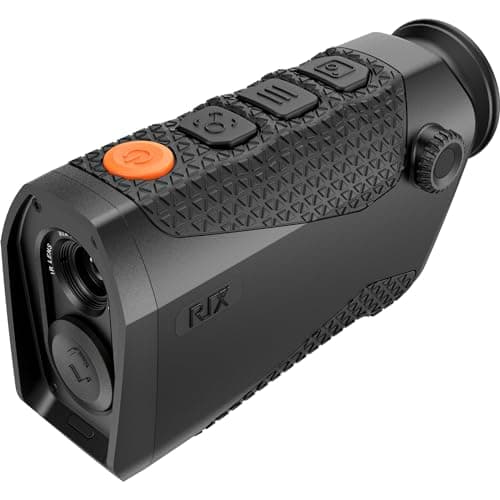
If you expect to walk and glass a lot, a handheld scanner is far better at this than a rifle-mounted optic — see monocular vs scope.
Calibration: the grainy-picture fix
Every uncooled thermal drifts as its own electronics warm up. The picture slowly gains fixed noise — faint vertical banding, a grainy haze, sometimes a ghost of whatever was in frame a minute ago. The fix is a sensor calibration, which most makers label NUC or shutter calibration, and it takes a fraction of a second.
- Automatic is fine most of the time. Leave it on auto and let the scope handle it.
- Learn the manual trigger. If an animal is standing there and the picture degrades, you want to recalibrate deliberately rather than wait. On most scopes it is one button.
- Expect one soon after switch-on. A thermal settles for several minutes from cold. Turn it on before you need it, not when the hogs arrive.
Palettes, and which one to leave it on
Palettes are just color maps over the same data. They change nothing about what the sensor detects, and they change a lot about what your eye picks out.
- White hot. The default and the right answer most nights: hot shows bright, and edge detail reads cleanly for identification.
- Black hot. Often better over warm ground or on a humid night, because the background clutter stops glowing at you. Worth a try when white hot looks washed out.
- Red or color overlays. Good for spotting a weak signature fast at distance, poor for reading what an animal actually is. Use them to find, switch back to identify.
Pick one as your default, learn how your ground looks in it, and change only for a reason. Switching palettes constantly means you never learn what "normal" looks like.
Identifying what you are looking at
This is the skill that takes a season. A thermal strips out color, texture and most depth cues, so you identify from shape, gait and size relative to known objects.
- Hogs move head-down and blocky, in groups, with short legs and a low straight back. Deer are taller, lighter on their feet, with a visible neck and a different tail.
- Judge size against something you know. A feeder leg, a gate, a round bale. A hog at 60 yards and a hog at 200 look similar through digital zoom.
- Do not zoom to identify when you can walk closer. Digital zoom enlarges pixels; it does not add any.
- Count before you shoot into a group. One signature can be two animals overlapping, and a sow with piglets behind her reads as one mass.
The pixel arithmetic behind all of this — how many pixels actually land on a 5 ft hog at a given distance — is on our detection range page.
Our picks for this job
What makes this easier in the field
A wide base magnification for scanning, a bright 384 for identifying, and something to rest on so your pulse is not the limit.
Best compact thermal for close brush hogs
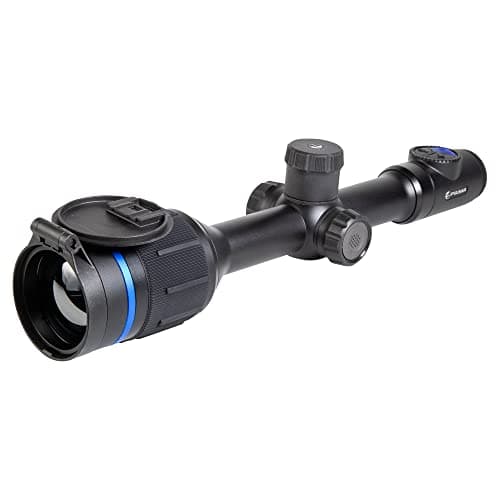
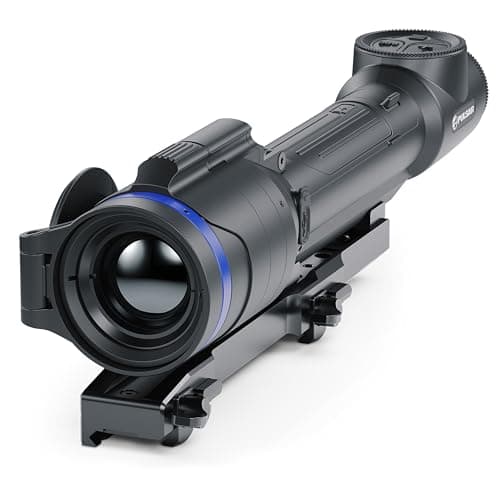
Pulsar Talion XQ35 Pro
$1,000 to $2,0007.9/10ResearchedA 2.5x base and a 10.7 degree view make searching and following moving hogs far easier than a 3.5x scope. IPX7, 6000 J, up to 9 hours.
$1,767.55Amazon#ad · Price as of November 3, 2026 · How we make money for the link to Pulsar Talion XQ35 Pro
Best lightweight 384 under $2,000
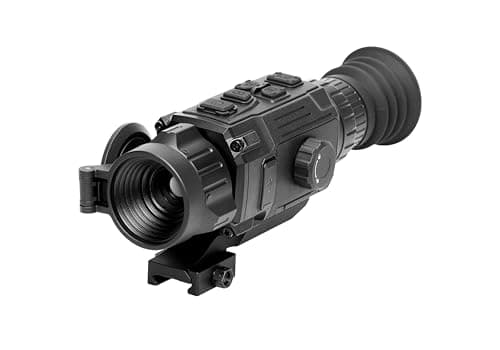
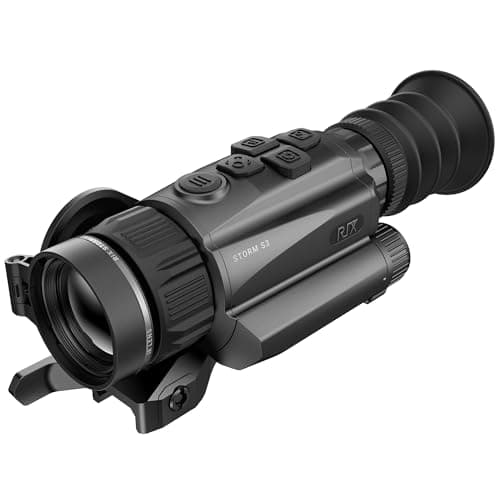
RIX Storm S3 384 (35 mm)
$1,000 to $2,0007.4/10ResearchedA 12 micron 384 behind a 35 mm F1.0 lens: the detail that makes identification a decision rather than a guess. About 4.5 hours per cell.
$1,299.00Amazon#ad · Price as of November 3, 2026 · How we make money for the link to RIX Storm S3 384 (35 mm)
Best one-hand shooting stick for stalking
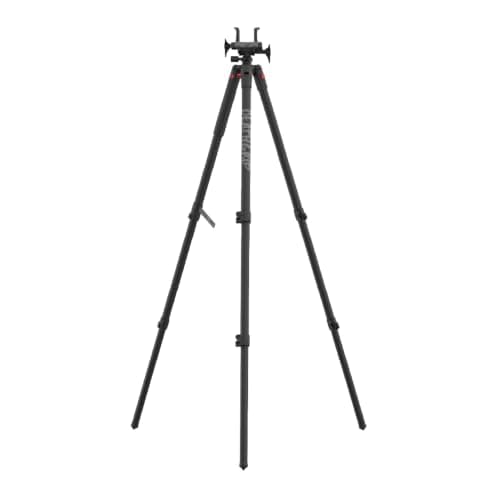
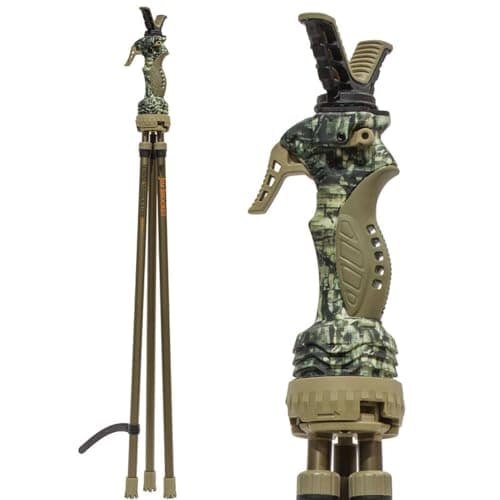
Primos Trigger Stick Gen3 Tall Tripod
Under $5007.5/10ResearchedTrigger-release height change while you are glassing, so you can scan standing and settle for the shot without rebuilding your position.
$159.99Amazon#ad · Price as of November 3, 2026 · How we make money for the link to Primos Trigger Stick Gen3 Tall Tripod
Reading the weather
Thermal performance is not constant, and knowing why saves you from thinking the scope is faulty.
- Cold, dry, still nights are best. Big temperature difference between animal and ground, and clear air between you and it.
- Humidity cuts range hard. Water vapour absorbs infrared. A muggy Gulf Coast night will show you less than a dry front at the same temperature.
- Rain and fog cut it further, and a published IP rating is about survival in the wet, not seeing through it.
- A sun-baked pasture stays hot for hours. On a summer evening the ground can read as warm as an animal, which flattens contrast. Black hot often helps; waiting two hours helps more.
- Wet animals read cooler. A hog that just came out of a wallow shows up poorly.
Using one in daylight
You can, and it will not hurt the scope as long as you never point it at the sun. But the image is poor: once sunlight has warmed rocks, roads, tin and soil, the contrast a thermal depends on largely disappears, and a hog in the shade can be harder to see at noon than at midnight.
Two practical uses for daytime thermal: confirming a zero against a heat-visible target, and finding a wounded animal in brush, where body heat still beats shaded ground. If you need a rifle that genuinely works in both light conditions, digital night vision is the better tool, and we compare them on thermal vs night vision.
What makes a thermal easy to use
- A wide base magnification. 2x to 2.5x searches; 3.5x and up hunts a narrow window.
- A manual calibration button you can find in the dark. Not buried three menus deep.
- A 50 Hz or faster refresh. Everything on this site's registry publishes 50 Hz or better; slower than that smears on a moving hog.
- A swappable battery and USB-C power. So a long sit is a pocket problem, not a hunt-ending one.
- A published operating temperature range. Winter sits below freezing are normal in Texas; some optics are rated from 32°F up.
- Simple zero profiles. If the scope moves between rifles, saved profiles save a range trip.
Mistakes new owners make
- Searching at full zoom. The single most common one. Zoom adds no detail and costs you the field of view you find animals with.
- Never setting the diopter. Then blaming the objective focus, or the scope, for a soft picture.
- Treating the detection claim as a working range. Identification is roughly a fifth of it.
- Switching it on when the hogs show up. Turn it on early and let it settle.
- Expecting the same reach every night. Humidity and warm ground change it dramatically.
- Shooting at a signature you have not identified. Shape, gait and a known size reference, every time.
How we scored this
Every score, built from the published record
Every pick here is labeled Researched: we read each maker's published specs, manuals and warranty terms, compare products only against others in the same budget tier, and score them on a public rubric. Every figure links to where it came from, and seller performance numbers are labeled “maker's claim,” so you can see exactly what you are buying.
Scores are our editorial read of that documented evidence. Commissions never set a score or decide a pick. The rubric and its weights are published.
What changed
- Published.
Questions
Frequently asked
How do you focus a thermal scope?
Why does my thermal scope picture look grainy?
Can you use a thermal scope during the day?
White hot or black hot for hogs?
How far should I zoom in to identify a hog?
Do I need to re-zero a thermal scope every season?
Receipts
Sources
- Pulsar: Talion XQ35 Pro product page and full specification, including field of view and refresh rate (checked 2026-10-17)
- RIX Optics: Storm S3 thermal imaging riflescope product page (checked 2026-10-17)
- Primos: Gen 3 Tall Tripod Trigger Stick product page (checked 2026-10-17)
- TPWD: Hunter education shooting safety rules (checked 2026-10-17)
- TPWD: Outdoor Annual, Nongame and Other Species, feral hogs (checked 2026-10-17)
- Texas Parks & Wildlife Code §62.005, Hunting with Light (texas.public.law; checked 2026-10-17)
Specs come from each maker's own pages or the product listing (linked on every product), hog biology and trapping advice from Texas A&M AgriLife, and rules from TPWD and Texas statute. Prices are set by Amazon and change often, so we don't print them. Where a figure isn't published, we say so. Read the full method.