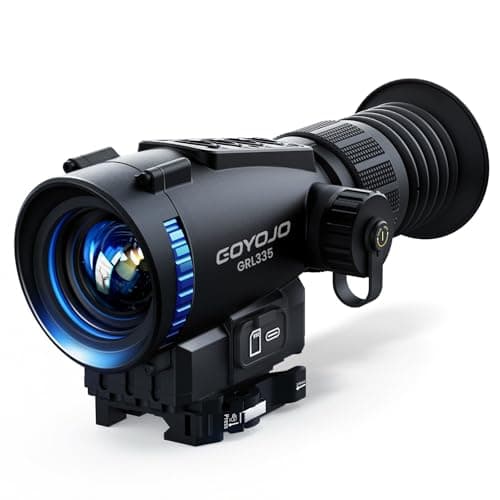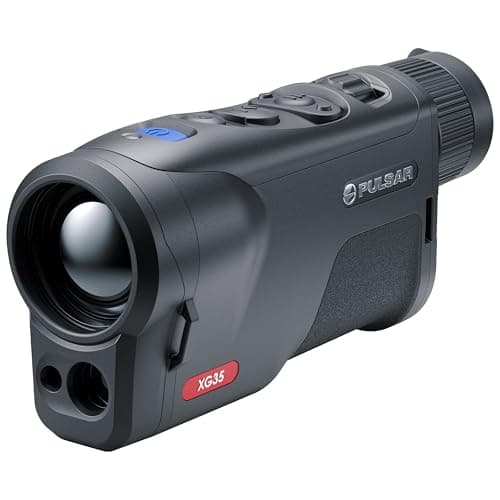
"Is it worth it" is really two questions — does a thermal do something nothing else does, and is that thing the thing you are stuck on. The first has a clear answer. The second depends entirely on your ground.
What a thermal actually changes
A thermal reads emitted heat, so it needs no light at all and does not care about cover the way your eye does. Four things change the night you put one on a rifle:
- You find animals you would never have seen. A sounder in standing sorghum, in cedar, in a creek bottom. This is the whole product.
- Nothing has to be lit. No white light, no red light, no glow at the emitter. Hogs that have been shot over a lit feeder learn the light; they cannot learn a thermal.
- You can tell occupied from empty fast. Thirty seconds of scanning answers whether the field is worth a stalk, which is most of what a long night actually consists of.
- You can follow a hit animal. A wounded hog in brush is a heat signature, and finding it is the difference between recovering it and not.
None of that is available from a light, at any price. If you have spent a season driving pasture roads with a spotlight and come home empty, that is the gap a thermal closes.
What it does not change
Thermal buyers are consistently disappointed by the same three things, and all three are knowable in advance.
- It does not identify at the distance it detects. Makers publish detection ranges from 950 to 1,900 yards. Identification — hog, that big, the one you meant — is roughly a fifth of that. Our detection range page runs the pixel math.
- It does not work like a day scope in daylight. A thermal picture at noon is a flat gray field with hot rocks in it. If your rifle needs to work in daylight too, you are looking at digital night vision, not thermal.
- It does not read through rain, fog or a sun-baked pasture. Thermal reaches furthest on a cold, dry, still night. Humidity and warm ground both cut it, and Texas supplies both.
What it costs, by tier
We do not quote prices in copy — they move weekly — but the tier structure is stable, and it is the honest answer to "how much do I need to spend."
- Under $1,000. A 256-class sensor behind a 19 to 25 mm lens. Real capability inside about 150 yards; a hog-sized blob past that. Our under-$1,000 ranking covers this tier.
- $1,000 to $2,000. A 384 behind a 35 mm lens, often with a rangefinder. This is where identification across a pasture starts working, and where most landowners should be looking. See under $2,000.
- $2,000 and up. A 640 sensor, a wider frame and better glass. Mostly it buys scanning width rather than reach — the cheapest 640 page explains why.
The full market view, with what each band actually includes, is on how much a thermal scope costs.
The two cheaper routes that solve most of it
Before you spend thermal money on a scope, check whether either of these is your actual answer. Both are a tier or two cheaper and both are the right call more often than the forums suggest.
- A light on a rifle you already own. If hogs come to a feeder, a dimmable red or green light and a rest solves the whole problem for a fraction of a thermal. Our hog hunting light ranking and how to hunt hogs at night without thermal cover that setup end to end.
- A thermal monocular to find with, and a lit rifle to shoot with. A handheld scanner gives you the finding half of a thermal's value without paying for a recoil-rated, zeroed, mounted optic. For many landowners this is the best dollar on the page — see monocular vs scope.
Our picks for this job
Three ways to answer the question
The cheapest scope that works at feeder distance, the handheld that buys the finding half for less, and the scope that fixes identification across a pasture.
Best entry thermal for feeder distances
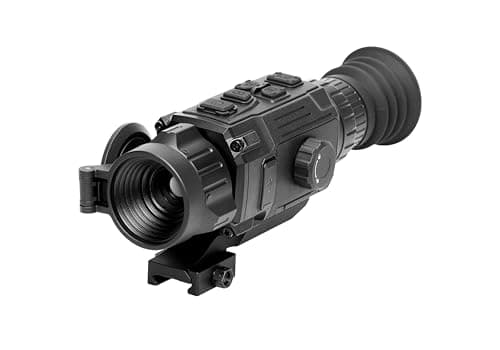
AGM Rattler V2 19-256
$500 to $1,0007.1/10ResearchedThe easiest entry thermal to live with: up to 11.5 rated hours with a spare cell included, a wide 9.3 degree view and IP67. Good to about 150 yards.
Check price · Amazon#ad · Price as of November 3, 2026 · How we make money for the link to AGM Rattler V2 19-256
Best compact 384 scanner
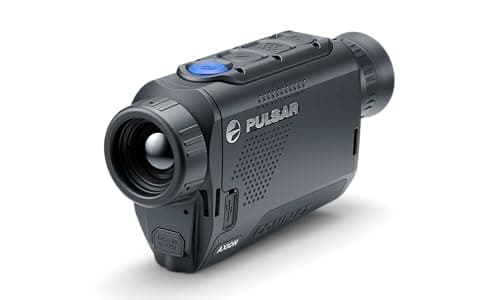
Pulsar Axion Compact XQ19
$500 to $1,0007.6/10ResearchedBuy this instead of a scope if finding is the problem and you already have a light: a 384 at <18 mK, 8.8 oz, IPX7, up to 8 hours.
$999.97Amazon#ad · Price as of November 3, 2026 · How we make money for the link to Pulsar Axion Compact XQ19
Best lightweight 384 under $2,000
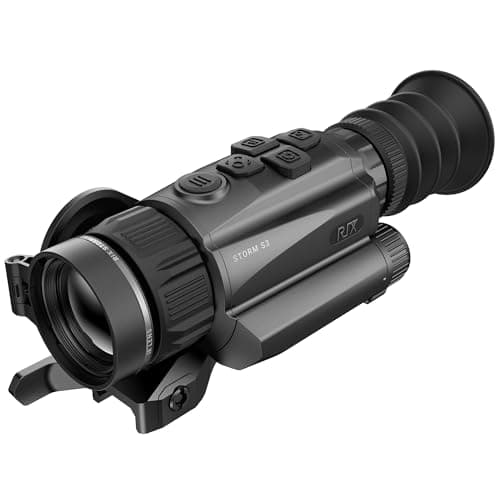
RIX Storm S3 384 (35 mm)
$1,000 to $2,0007.4/10ResearchedThe step that changes identification: a 12 micron 384 behind a 35 mm F1.0 lens, 6000 J, five-year warranty, at under a pound.
$1,299.00Amazon#ad · Price as of November 3, 2026 · How we make money for the link to RIX Storm S3 384 (35 mm)
What to look for if you do buy
- Lens focal length, published. It sets detail on the animal more than the sensor does. 35 mm is the practical step up from 19 mm.
- NETD under 25 mK. Sensitivity is what reads humid air and a hog in cedar. Under $1,000 you can get ≤20 mK; do not settle for 40.
- Rated runtime and a swappable cell. Four hours and a six-hour sit do not meet. Two spares or USB-C power.
- A recoil rating in joules. 6000 J is the figure to look for on an AR. No rating is an unknown.
- An IP rating. IP67 or IPX7, published. Dew alone will find a scope that has neither.
- Warranty in writing. Three to five years is normal. You cannot repair a microbolometer in a shop.
Who should skip one
Honestly: a lot of people asking the question.
- You hunt one lit feeder inside 100 yards. A light and a rest are the better spend, and you will shoot more hogs with them this season.
- The rifle also needs to work in daylight. Thermal is poor in sun. Digital night vision does both.
- Your real problem is that hogs are not on the property yet. No optic fixes that. A feeder, bait and patterning do — start with how to attract hogs.
- You are trapping rather than shooting. Whole-sounder removal happens in a trap, not down a barrel. See how to trap feral hogs.
- The budget stops under about $700. At that point you are buying a 256 behind a short lens, and a good light plus a handheld scanner is more capability for the same money.
The damage side of the arithmetic
If you are a landowner rather than a recreational hunter, the number on the other side of the ledger is damage. Texas A&M AgriLife wrote in August 2023 that feral hogs cause more than $500 million in damage to agriculture and private property in Texas each year; a 2004 AgriLife survey of agricultural damage alone, quoted by Texas A&M's Natural Resources Institute, put the figure at $52 million. Those two numbers measure different things nearly twenty years apart, which is why we keep them separate — our feral hog damage page lays out each estimate with its date. Against a pasture being rooted every spring, a mid-tier thermal is a single-season expense rather than a luxury, which is a different calculation from the one a hunter who shoots four hogs a year is making.
That is the real test. Price the optic against what the hogs are costing you, not against what it would be fun to own. If the damage number is small, so is the case for the scope.
How we scored this
Every score, built from the published record
Every pick here is labeled Researched: we read each maker's published specs, manuals and warranty terms, compare products only against others in the same budget tier, and score them on a public rubric. Every figure links to where it came from, and seller performance numbers are labeled “maker's claim,” so you can see exactly what you are buying.
Scores are our editorial read of that documented evidence. Commissions never set a score or decide a pick. The rubric and its weights are published.
What changed
- Published.
Questions
Frequently asked
Are thermal scopes worth it for hog hunting?
How much do I need to spend on a thermal scope?
Is a thermal monocular a better buy than a thermal scope?
Can you use a thermal scope during the day?
How long does a thermal scope last?
Receipts
Sources
- Texas A&M Natural Resources Institute, Nov. 2019: startling statistics about wild pigs, quoting the 2004 AgriLife $52 million agricultural damage survey (checked 2026-10-17)
- Texas A&M AgriLife Today, Aug. 31, 2023: feral hogs cause more than $500 million in Texas damage each year (checked 2026-10-17)
- AGM Global Vision: Rattler V2 19-256 product page and spec table (checked 2026-10-17)
- RIX Optics: Storm S3 thermal imaging riflescope product page (checked 2026-10-17)
- Pulsar: Axion XQ19 Compact thermal monocular product page and spec table (checked 2026-10-17)
- TPWD: Outdoor Annual, Nongame and Other Species, feral hogs (checked 2026-10-17)
Specs come from each maker's own pages or the product listing (linked on every product), hog biology and trapping advice from Texas A&M AgriLife, and rules from TPWD and Texas statute. Prices are set by Amazon and change often, so we don't print them. Where a figure isn't published, we say so. Read the full method.