Not legal advice. This page summarizes Texas rules from the official sources linked in the text (TPWD Outdoor Annual, valid Sep 1, 2026 through Aug 31, 2027). Rules checked . Laws change: confirm the current rules with Texas Parks and Wildlife and your local game warden before you rely on them.
A hog is not a small deer, and that is the whole problem
Nearly every poor shot on a hog comes from a hunter using a deer hold. On a whitetail you learn to put the bullet a little behind the shoulder, roughly halfway up the body, and it works beautifully. Do that on a hog and you have shot a stomach.
Three differences drive it:
- The vitals sit lower and further forward. A hog's heart and lungs are tucked low in the chest and well forward, tight behind and above the front leg — not in the middle of the body where the deer hold puts them.
- The body shape hides the landmarks. There is no clear shoulder line, no obvious waist. A hog is a wedge with a huge head, and the hair and fat make the body look larger and more uniform than the skeleton underneath. The MDC field guide puts a feral hog at a length to about five feet — a lot of animal with very few reference points on it.
- Mature boars grow armor. A thick plate of scar tissue and cartilage builds up over the shoulders from fighting. It is real, it is tough, and it absorbs energy from a soft-tissue hit.
Add to that the fact that hogs are usually shot in the dark, often in a group, frequently moving, and often by people shooting from a less steady position than they would on a deer stand, and you can see why the margin for a bad hold is small.
The broadside shot: two references that work
Broadside is the shot to take, and there are two conventional aiming references. Either is good; which you prefer depends on your cartridge and on whether you want the meat.
1. The crease behind the front leg, about a third of the way up. Follow the back edge of the front leg up from the elbow and hold low — not halfway up the body. This is the heart-lung hold. It wastes the least meat and drops animals cleanly when it connects, and it is the one that most often gets held too high and too far back by deer hunters.
2. On the shoulder, level with the base of the ear. Higher and slightly further forward, through the shoulder structure and spine. It is a more forgiving window vertically, anchors animals on the spot, and is the right call when you need the hog down right there — in front of a trap, near a fence line, or when a running group means a tracked animal is not going to be found. The cost is shoulder meat and, on a mature boar, the shield.
A third reference worth knowing: the ear-base/neck shot for a stationary animal at close range with a known backstop. Small target, very decisive, and not a shot to take with any doubt about your rest or the animal's position.
The shoulder shield, and what to do about it
The shield is the reason "it should have dropped" gets said about hogs more than about any other animal. On a mature boar, built-up gristle over the shoulder can turn an adequately placed soft-point into a shallow wound.
Three practical answers:
- Choose a bullet that holds together. This is a cartridge and projectile question rather than a placement one, and we treat it properly on best caliber for hogs and 300 Blackout vs 5.56 for hogs.
- Go higher. The high shoulder / spine window sits above the heaviest part of the shield.
- Wait for broadside. The shield is thickest over the shoulder from the side-front. A true broadside presentation gives you the crease, which goes under it.
Sows and young hogs have no meaningful shield. If the animal in your scope is a 90 lb shoat, this section does not apply to it.
Angles, and which to refuse
| Presentation | Take it? | Hold |
|---|---|---|
| Broadside, standing | Yes — the shot | Crease behind the front leg, a third up; or shoulder level with the ear base |
| Quartering away | Yes | Slightly further back, angling forward through the off shoulder |
| Quartering toward you | Only with a cartridge you trust | The near shoulder point; you are driving through the shield |
| Facing straight on | Close range only, with a solid rest | Centre of the chest, low; or the base of the neck |
| Straight away | No | No vitals available; a wounded hog in the dark |
| Moving or running | No | Wait. A sounder stops before it leaves — see thermal hog hunting tips |
| Bedded or partly obscured | No | You cannot see the landmarks you need |
One more that belongs in the refuse column: any shot where you cannot account for what is behind the animal. Texas hog country is flat, hogs are shot at night, and a miss or a pass-through keeps going. That is the hardest safety constraint in this sport and it is non-negotiable.
At night, identification comes before placement
Everything above assumes you know what you are looking at. On a thermal image at 4x, a shoat behind a sow looks like one animal, and a calf looks like a hog to anyone in a hurry. Mississippi State Extension's wild hog hunting advice and Texas A&M AgriLife's guidance on selective shooting both treat identification as part of the shot, not a step before it.
Practically: turn the magnification up to identify and back down to shoot, flip the palette to check body shape, count the animals twice, and make sure you can see the whole outline of the one you intend to shoot. Our sensor resolution guide explains why a 256 gives you less to work with here than a 384 or a 640.
What makes the shot possible
Our picks for this job
Something to see the landmarks with, and something to hold still on
Placement is an optic problem and a rest problem before it is a marksmanship problem. These are the entry-tier picks for each; every spec is the maker's published figure, and scores come from our published rubrics.
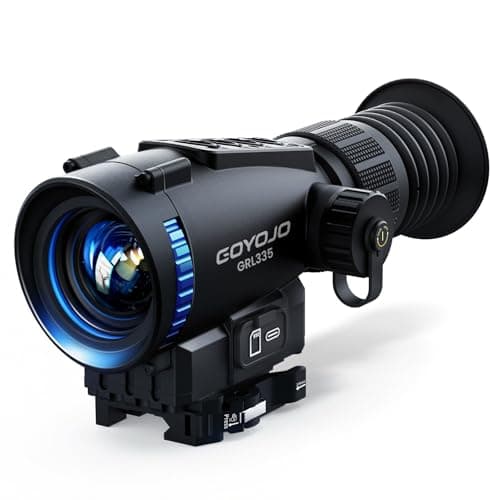
Best entry thermal for feeder distances
AGM Rattler V2 19-256
$500 to $1,0007.1/10ResearchedAn entry thermal scope with a published recoil rating: enough picture to find the crease behind the leg at feeder distance.
$695.00Amazon#ad · Price as of October 11, 2026 · How we make money for the link to AGM Rattler V2 19-256
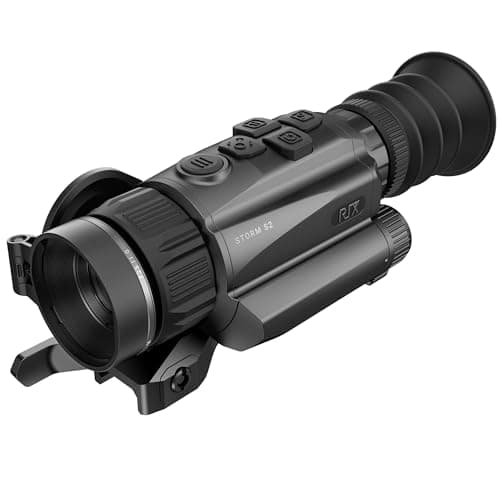
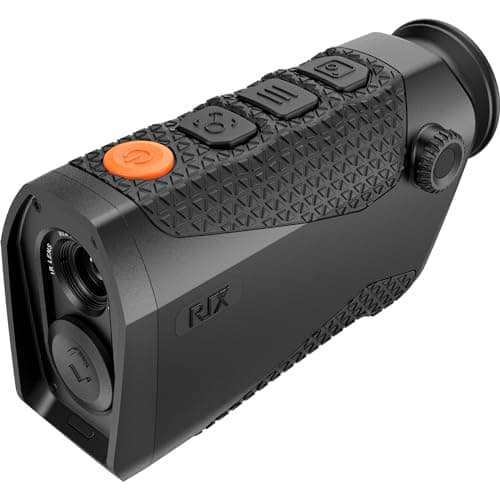
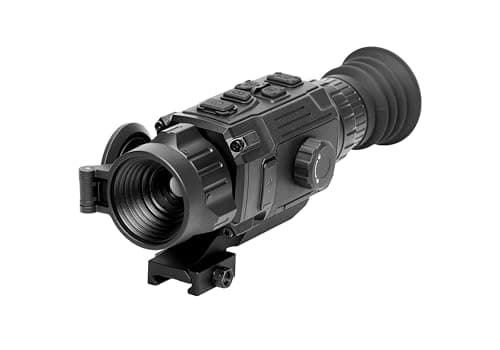
Best 256 scope for a little more reach
RIX Storm S2 (256x192, 25 mm)
$500 to $1,0006.8/10ResearchedThe 25 mm alternative, with a longer lens for the same sensor - more detail on the animal at the cost of field of view.
$799.00Amazon#ad · Price as of October 11, 2026 · How we make money for the link to RIX Storm S2 (256x192, 25 mm)
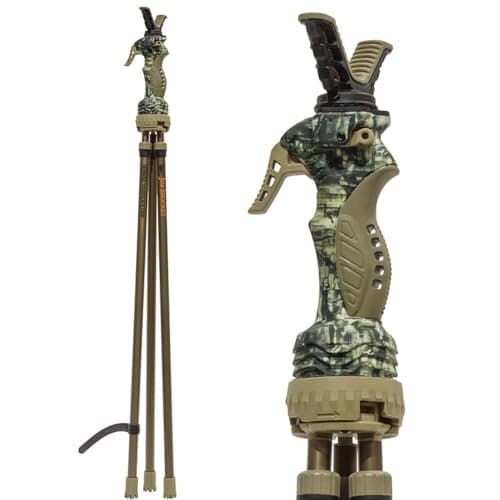
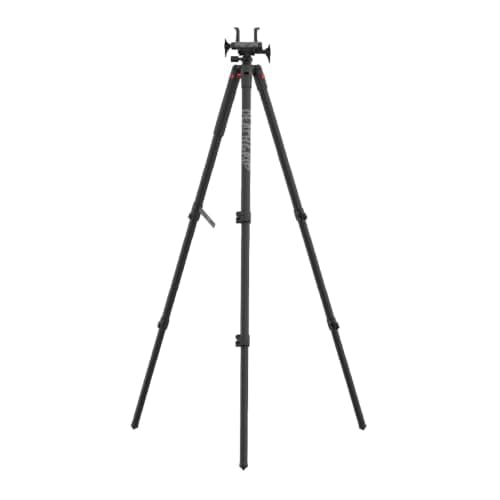
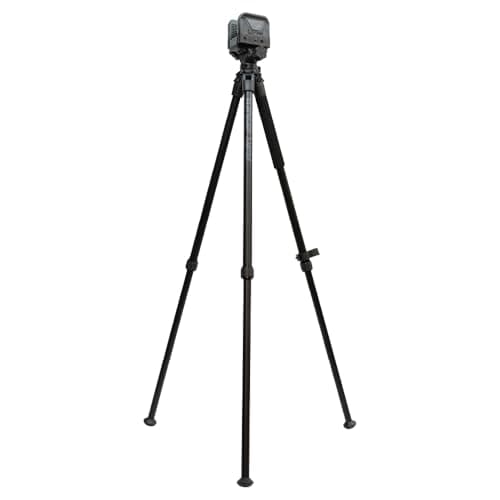
Best one-hand shooting stick for stalking
Primos Trigger Stick Gen3 Tall Tripod
Under $5007.5/10ResearchedA tall tripod rest you can adjust one-handed, which is what you want when a group walks in and you need height now.
$162.87Amazon#ad · Price as of October 11, 2026 · How we make money for the link to Primos Trigger Stick Gen3 Tall Tripod
Best clamping rest for ground blinds
BOG DeathGrip Bantam Tripod
Under $5007.5/10ResearchedThe clamping rest: it holds the rifle for you, which is the difference between an aimed shot and a hopeful one.
$116.99Amazon#ad · Price as of October 11, 2026 · How we make money for the link to BOG DeathGrip Bantam Tripod
Full rankings on best thermal scopes for hog hunting and best shooting sticks and rests.
After the shot
Stay in the optic for a full minute. Hogs that run a short distance and pile up are easy to find through thermal and very hard to find without it, and an animal that has not been pushed usually does not go far. Mark where it was standing and where you last saw it before you move.
If you are keeping the meat, speed is everything in Texas heat — get it opened, cooled and on ice. The handling rules are on feral hog diseases and meat safety, the technique is on how to field dress a hog, and extension field-care guidance from Oregon State and Penn State covers the general-purpose version well.
An honest note on sources
We looked for an extension or agency publication with a labeled feral-hog shot-placement diagram we could cite line by line, and we did not find one. The agencies publish extensively on hog biology, control methods and meat handling, and are noticeably quiet on aiming points.
So the aiming references on this page are conventional practice, explained with the reasoning behind them, backed by the published biology (body size and shape) and by the agency guidance on selective, clean shooting. We would rather say that plainly than dress up received wisdom as research. If you want the underlying argument about why shooting alone does not reduce hog numbers, that is on how to get rid of feral hogs — and it is the reason this site treats trapping as the main event.
How we scored this
Every score, built from the published record
Every pick here is labeled Researched: we read each maker's published specs, manuals and warranty terms, compare products only against others in the same budget tier, and score them on a public rubric. Every figure links to where it came from, and seller performance numbers are labeled “maker's claim,” so you can see exactly what you are buying.
Scores are our editorial read of that documented evidence. Commissions never set a score or decide a pick. The rubric and its weights are published.
What changed
- Published.
Questions
Frequently asked
Where do you shoot a hog?
Why is hog shot placement different from deer?
What is a hog's shoulder shield?
Should you take a running shot at a hog?
Is a head shot a good idea on hogs?
Receipts
Sources
- Missouri Department of Conservation: Feral Hog (Feral Swine) field guide, body size and description (checked 2026-10-11)
- Missouri Department of Conservation: feral hogs in Missouri, state program position (checked 2026-10-11)
- Texas A&M AgriLife: selective shooting as a feral hog control method (checked 2026-10-11)
- Mississippi State University Extension: top tips for hunting wild hogs (checked 2026-10-11)
- Oregon State University Extension: PNW 517, big game from hunt to home field care (checked 2026-10-11)
- Penn State Extension: proper field dressing and handling of wild game and fish (checked 2026-10-11)
- TPWD: Outdoor Annual, Nongame and Other Species, feral hogs (checked 2026-10-11)
- Texas Parks & Wildlife Code §62.005, Hunting with Light (texas.public.law; checked 2026-10-11)
Specs come from each maker's own pages or the product listing (linked on every product), hog biology and trapping advice from Texas A&M AgriLife, and rules from TPWD and Texas statute. Prices are set by Amazon and change often, so we don't print them. Where a figure isn't published, we say so. Read the full method.