The contenders
Side by side
 Stock photo
Pick for ranging and features
ATN ThOR 6 Elite LRF 384 3.5-28x
$1,000 to $2,0008.5/1012 µm sensor, ≤15 mK NETD, a built-in 1,000 m rangefinder feeding a ballistic calculator, a 1920x1080 display and a five-year warranty.
Check price · Amazon#ad · Price set by Amazon · How we make money for the link to ATN ThOR 6 Elite LRF 384 3.5-28x
- Stock photo
Pick for runtime and a classic build
Pulsar Thermion 2 XQ50 Pro
$1,000 to $2,0008.6/1050 mm F/1.0 lens, up to 10 hours with a swappable external pack, IPX7, a magnesium-alloy body and standard 30 mm rings. No rangefinder on this version.
Check price · Amazon#ad · Price set by Amazon · How we make money for the link to Pulsar Thermion 2 XQ50 Pro
We haven't tested these units; scores come from published specs and the rubric on our How We Choose page. Every spec below links to the maker's page, and our scores for the two are one tenth of a point apart, which on our rubric is a near tie.
Which ThOR and which Thermion?
Both names cover whole families, so it matters which models you line up. We compare the two that sit in the same budget tier ($1,000 to $2,000 by the Amazon prices we recorded) with the same 384x288 sensor class: the ATN ThOR 6 LRF 384 3.5-28x (listed on Amazon as the ThOR 6 Elite) and the Pulsar Thermion 2 XQ50 Pro. That's the matchup most people searching "ATN ThOR vs Pulsar Thermion" are weighing: ATN's feature-packed digital approach against Pulsar's traditional-tube thermal.
Two family members sit outside this matchup. Pulsar's Thermion 2 LRF XQ50 Pro adds an 800 m rangefinder to the same sensor and lens, but it sits a tier up, at $2,000 and up. And ATN's ThOR 6 Mini 256 is a much smaller, cheaper scope with a 15 mm lens; if that's your budget, our AGM Rattler vs ATN ThOR comparison is the better match.
The spec sheets side by side
Detail on a hog: nearly a tie
Here's the number that surprises people. The Pulsar has the bigger lens (50 mm against 35 mm), but it also has bigger pixels (17 µm against 12 µm). What decides how much of a hog each pixel covers is the ratio of the two, and the ratios come out almost identical:
- ATN ThOR 6 Elite LRF 384: 12 µm ÷ 35 mm = 0.343 milliradians per pixel, about 1.23 inches at 100 yards.
- Pulsar Thermion 2 XQ50 Pro: 17 µm ÷ 50 mm = 0.340 milliradians per pixel, about 1.22 inches at 100 yards.
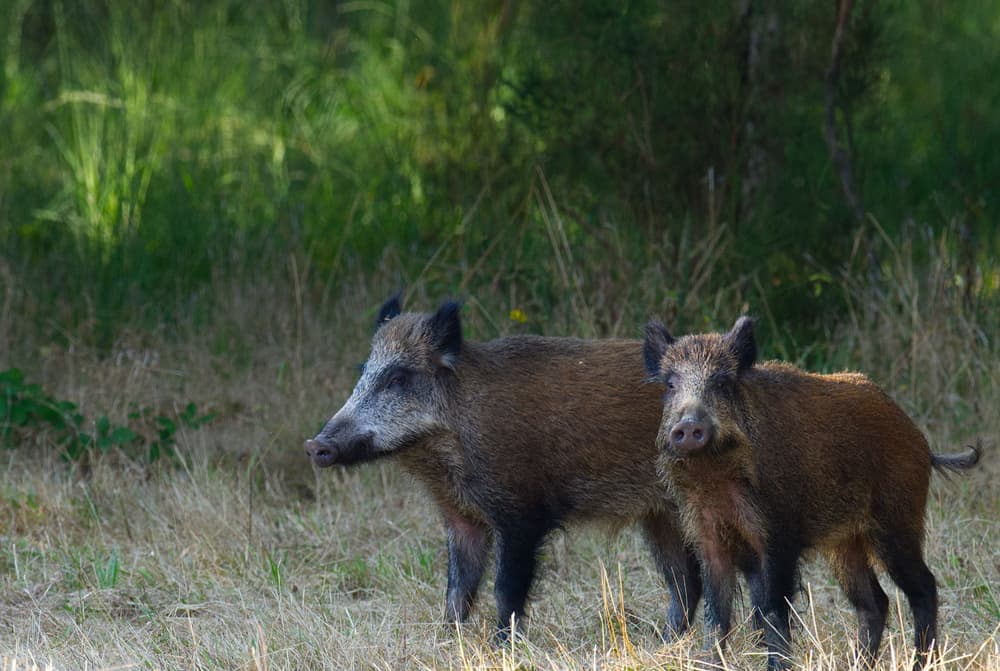
On a 5-foot hog (Texas A&M AgriLife says the largest adults can top 5 feet long; Feral Hogs in Texas), that's about 49 pixels across the body at 100 yards and about 24 to 25 at 200 yards on either scope. Because both sensors are 384 pixels wide, the field of view matches too: ATN publishes 7.53° and Pulsar 7.5°, and the geometry (sensor width ÷ focal length) reproduces both figures. This is illustrative math from published specs, not a field test. The full method is in our 256 vs 384 vs 640 resolution guide.
So neither scope shows a hog in more detail by sensor and lens alone. Pulsar's own comparison guide explains the trade-off behind the two designs: "A 12-micron detector can pack more pixels into a given area and support smaller optics for a chosen field of view. A larger-pitch element presents more surface area to incoming radiation and can favor raw sensitivity" ( Pulsar). In plain terms, ATN got the same view from a smaller lens, and Pulsar used bigger pixels behind a bigger lens.
Sensitivity and display
ATN lists NETD as ≤15 mK; Pulsar lists <25 mK, with a sensor-level figure (sNETD) under 18 mK. NETD is the smallest temperature difference the sensor separates from noise, and lower is better. ATN's own page sums it up as "Lower NETD = finer temperature differentiation." It matters most on nights when the ground stays warm and a hog doesn't stand out as sharply. These are the makers' stated figures, and we can't tell you how differently each company measures them, so treat a few millikelvin as a tiebreaker, not a verdict.
The displays differ more clearly: a 1920x1080 OLED on the ATN, a 1024x768 AMOLED on the Pulsar. Both are larger than the 384x288 sensor image, and Pulsar's guide notes that a high-resolution display "prevents the eyepiece screen from discarding detail captured by the sensor." The extra screen resolution helps menus, the reticle and overlays look crisp; it doesn't add sensor pixels to the hog. Both run at 50 Hz.
Rangefinder and ballistics
This is the ThOR's clearest advantage. ATN builds in a 905 nm laser rangefinder with a stated 1,000 m range and ±1 m accuracy (maker's claim), and the reading feeds a built-in ballistic calculator with six profiles, so the reticle adjusts for the distance you just ranged. The Thermion 2 XQ50 Pro has no rangefinder. Pulsar sells that as a separate model, the Thermion 2 LRF XQ50 Pro (800 m, maker's claim), a tier higher.
How much the rangefinder is worth depends on your ground. If you shoot one feeder from one stand, you can pace or range the distance once in daylight and zero for it. If you walk field edges and take hogs wherever they show, knowing the distance in the dark is a real help for holdover, and it's built in on the ATN.
Battery and power
Pulsar rates the Thermion 2 XQ50 Pro at up to 10 hours at 22°C from an internal APS5 pack plus a changeable external APS2 pack, with USB-C power at 5 V or 9 V. ATN rates the ThOR 6 LRF 384 at about 9 hours from two 18650 cells, one internal and one replaceable, plus USB-C external power. Either will cover most sits. The practical difference is in the field: on the Pulsar you swap a proprietary pack, and on the ATN you swap a standard 18650 cell, which is easy to find and carry spares of.
One warranty detail belongs here: Pulsar covers rechargeable battery packs for one year, separate from the device warranty (Pulsar warranty terms).
Build, weight and mounting
Both publish a 6000 J recoil rating on rifled weapons; Pulsar adds a 12-gauge rating for smoothbores. Pulsar lists IPX7 and ATN lists IP67. Operating ranges are -25°C to +50°C for the Pulsar and -30°C to 55°C for the ATN.
Pulsar's spec sheet lists a magnesium-alloy body and a weight of 31.7 oz (0.9 kg); ATN lists 830 g (1.83 lb, about 29 oz). Both mount in 30 mm rings. ATN notes the rings aren't included, so budget for a set; Pulsar describes the Thermion as compatible with standard 30 mm rings. For anyone used to mounting day scopes, the familiar ring mount is one of the Thermion's selling points.
Zeroing, profiles and recording
Both zero digitally, without turrets. Pulsar stores up to 5 zeroing profiles with 10 distances each and lists a click value of 13 mm at 100 m at 3x, getting finer as you zoom (3.25 mm at 12x). ATN offers a Zeroing Freeze function that holds the image after the shot while you move the reticle, and its ThOR 6 manual lists a heated zeroing target in the box (ATN ThOR 6 manual). Our step-by-step thermal zeroing guide covers both makers' methods.
Both offer picture-in-picture. For recording, ATN lists 64 GB internal storage and Recoil Activated Video, which starts recording when the rifle fires; Pulsar lists 16 GB internal storage and dual-band Wi-Fi to its Stream Vision 2 app. Pulsar lists 50 mm of eye relief; ATN describes its eye relief as adjustable.
Warranty terms
ATN lists a five-year warranty on the ThOR 6 LRF 384. Its limited warranty terms say coverage is "extended only to the original purchaser" and that ATN must receive a completed registration to validate it (ATN Limited Warranty).
Pulsar gives three years from the factory and adds two more when you register, for five in total. The extra two years apply to US purchases made on or after January 1, 2024, on devices manufactured after January 1, 2023, and Pulsar says its warranty "is transferable with proof of purchase or a serial number." If you might sell the scope later, that transferability is worth something. Register either scope the day it arrives.
What about the ThOR 5?
Many searches still ask about "Pulsar Thermion vs ATN ThOR 5." The ThOR 5 is ATN's previous generation. The ThOR 5 640 we track sits in the $2,000 and up tier and offers a 640x480, 12 µm sensor at 60 fps, but ATN's ThOR 5 640 page doesn't publish NETD, lens size, battery life, an IP rating or a recoil rating, all of which the ThOR 6 pages do. If you're choosing between ATN and Pulsar today, compare the ThOR 6 against the Thermion 2, as we have here.
Which one to buy
- You hunt changing distances in open country: the ATN ThOR 6 Elite LRF 384. The rangefinder and ballistic calculator are built in, and the published NETD is lower.
- You sit one feeder or field edge all night: the Pulsar Thermion 2 XQ50 Pro. Up to 10 hours, a swappable external pack, IPX7 and a classic 30 mm tube.
- You may sell or pass the scope on: Pulsar's transferable warranty is the difference.
- Your hogs come in close through brush: neither. At about 7.5°, both are narrow up close; the Pulsar Talion XQ35 Pro in our best thermal scopes for hog hunting list publishes a 10.7° view.
Before your first night out with either, read our summary of whether you can hunt hogs at night in Texas: what's legal on private land, the courtesy call TPWD asks for, and the rules on protected game and public roads. For more head-to-heads and tiers, see the thermal and night vision hub.
In detail
The contenders, in full
Stock photoPick for ranging and features
ATN ThOR 6 Elite LRF 384 3.5-28x
12 µm sensor, ≤15 mK NETD, a built-in 1,000 m rangefinder feeding a ballistic calculator, a 1920x1080 display and a five-year warranty.
Published specsResearched · not tested by us
| Sensor | 384x288 (12 µm VOx) |
|---|---|
| Pixel pitch | 12 µm |
| NETD | ≤15 mK |
| Lens | 35 mm germanium, F/1.0 |
| Magnification | 3.5-28x (1x, 2x, 4x, 8x digital zoom) |
| Refresh rate | 50 Hz |
| Field of view | 7.53° x 5.65° |
| Detection range | 2,750 mMaker's claim |
| Display | 0.49 in OLED, 1920x1080 |
| Battery | Two 18650s (one internal, one replaceable), about 9 h; USB-C external power |
| Recording | 64 GB internal; Recoil Activated Video; Wi-Fi to ATN Connect 6 app |
| Rangefinder | Built-in, 1,000 m, ±1 m (905 nm, Class 1); ballistic calculatorMaker's claim |
| IP rating | IP67 |
| Recoil rating | 6000 J (1000 g over 0.4 ms) |
| Operating temperature | -22°F to 131°F (-30°C to 55°C) |
| Weight | 830 g (1.83 lb) |
| Mount | 30 mm rings (not included) |
| Warranty | 5 years |
How the 8.5 score breaks down
- Sensor & lens for hog ID (30%)
- 8.5
- Usability at night (20%)
- 8
- Battery & power (15%)
- 8
- Durability (15%)
- 9
- Warranty & support (10%)
- 9
- Value within its tier (10%)
- 8.5
What the specs support
- Lowest published NETD in this list (≤15 mK) on a 12 µm 384 sensor
- Built-in laser rangefinder feeds the ballistic calculator; six ballistic profiles
- Full HD 1920x1080 OLED, 64 GB storage and Recoil Activated Video
- IP67, 6000 J and a five-year warranty, all published
Where it falls short
- 3.5x base on a 35 mm lens is a narrow 7.5° view for close feeder work
- Rings aren't included
- Only one of the two 18650s is replaceable in the field
Skip this if…
…You mostly shoot hogs inside 75 yards; the 3.5x base is tight up close, and the ThOR 6 384 2.5-20x gives a wider 10.5° view.
#ad · Price set by Amazon · How we make money for the link to ATN ThOR 6 Elite LRF 384 3.5-28x
Stock photoPick for runtime and a classic build
Pulsar Thermion 2 XQ50 Pro
50 mm F/1.0 lens, up to 10 hours with a swappable external pack, IPX7, a magnesium-alloy body and standard 30 mm rings. No rangefinder on this version.
Published specsResearched · not tested by us
| Sensor | 384x288 (uncooled) |
|---|---|
| Pixel pitch | 17 µm |
| NETD | <25 mK (sNETD <18 mK) |
| Lens | 50 mm, F/1.0 |
| Magnification | 3-12x |
| Refresh rate | 50 Hz |
| Field of view | 7.5° horizontal (13.1 m at 100 m) |
| Detection range | 1,800 m (about 1,969 yd)Maker's claim |
| Display | 1024x768 AMOLED |
| Battery | Internal APS5 plus external APS2, up to 10 h at 22°C; USB-C (5 V/9 V) external power |
| Recording | 16 GB internal; Wi-Fi (2.4/5 GHz) to Stream Vision 2 app |
| IP rating | IPX7 |
| Recoil rating | 6000 J on rifled weapons; 12 gauge on smoothbores |
| Operating temperature | -25°C to +50°C |
| Weight | 0.9 kg (31.7 oz) |
| Mount | Standard 30 mm rings |
| Warranty | 3 years; 5 years with registration |
How the 8.6 score breaks down
- Sensor & lens for hog ID (30%)
- 8.5
- Usability at night (20%)
- 8.5
- Battery & power (15%)
- 9
- Durability (15%)
- 9
- Warranty & support (10%)
- 8.5
- Value within its tier (10%)
- 7.5
What the specs support
- Big 50 mm F/1.0 lens with a 3x base: more detail on a hog at field distance than 25-35 mm scopes
- Swappable external APS2 pack on top of the internal battery, up to 10 h, plus USB-C power
- IPX7, 6000 J recoil rating and a -25°C to +50°C operating range, all published
- Mounts in standard 30 mm rings; five zero profiles and 10 reticles
Where it falls short
- 17 µm pixels versus 12 µm on newer 384 scopes; field of view at 3x is narrower than a 35 mm scope
- Heaviest scope in its tier at 31.7 oz
- No built-in rangefinder (that's the Thermion 2 LRF)
Skip this if…
…Your hogs come to a feeder inside 60 yards in thick brush; a 3x base on a 50 mm lens is slower to pick up close movement than a 2x, 25-35 mm scope.
#ad · Price set by Amazon · How we make money for the link to Pulsar Thermion 2 XQ50 Pro
How we scored this
Units we claim to have tested: 0
Plenty of gear sites say they field-tested everything they list. We haven't, and we say so. Every pick here is labeled Researched: we read each maker's published specs, manuals and warranty terms, compare products only against others in the same budget tier, and score them on a public rubric. Every figure links to where it came from, and seller performance numbers are labeled “maker's claim.”
Scores are editorial judgments from that documented research, not test results. Commissions never set a score or decide a pick. The rubric and its weights are published.
What changed
- Published.
Questions
Frequently asked
Is ATN or Pulsar better for hog hunting?
Does the Pulsar Thermion 2 XQ50 Pro have a rangefinder?
Which has better battery life, the ThOR 6 or the Thermion 2?
Is the ATN ThOR 5 still worth buying?
Do the ATN ThOR 6 and Pulsar Thermion 2 fit standard scope rings?
Receipts
Sources
- Pulsar: Thermion 2 XQ50 PRO product page and full specification (checked 2026-09-19)
- Pulsar: Thermion 2 LRF XQ50 PRO product page and full specification (checked 2026-09-19)
- ATN: ThOR 6 LRF 384x288 3.5-28x (Elite series) product page and spec table (checked 2026-09-19)
- ATN: ThOR 6 manual, zeroing and package contents (checked 2026-09-19)
- ATN: ThOR 6 Mini 256x192 2-16x product page (checked 2026-09-19)
- ATN: ThOR 5 640 product page (checked 2026-09-19)
- ATN: Limited Warranty terms (checked 2026-09-19)
- Pulsar USA: 5-Year Product Warranty terms (checked 2026-09-19)
- Pulsar: Thermal vs Night Vision: Full Comparison Guide (updated July 23, 2026; checked 2026-09-19)
- Texas A&M AgriLife Extension: Feral Hogs in Texas, B-6149 (2004; PDF, checked 2026-09-19)
We haven't tested the gear on this page and we don't pretend to. Specs come from each maker's own pages or the product listing (linked on every product), hog biology and trapping advice from Texas A&M AgriLife, and rules from TPWD and Texas statute. Prices are set by Amazon and change often, so we don't print them. Where a figure isn't published, we say so. Read the full method.