The verdict up front
The Thermion 2 XQ50 Pro is the thermal for the hunter who has decided the problem is distance. Almost everything Pulsar spent money on here serves that one job: the biggest lens in the tier, a 3x optical base, a 1024x768 AMOLED to show what the lens gathers, and a battery arrangement that lets you sit until the sounder finally walks out. On our rubric it scores 8.6/10, and the lens and durability scores are what put it there.
What you are paying for in weight and in sensor generation is real. At 31.7 oz it is the heaviest scope in its tier in our registry, and its 17 µm pixel pitch is the older of the two pitches now sold at this price — the ATN ThOR 6 Elite and the RIX Storm S3 both put 12 µm sensors in the same band. Pixel pitch is not marketing: finer pixels put more of them across a hog behind the same lens.
The honest summary is that Pulsar wins this tier on optics and ownership and loses it on sensor generation. Whether that trade is right for you comes down to how far away your hogs are, which is the whole of the next two sections.
What it actually is
Pulsar publishes a standalone thermal riflescope on a traditional 30 mm tube with:
- A 384x288 uncooled sensor at 17 µm, NETD <25 mK (Pulsar also lists sNETD <18 mK)
- A 50 mm F/1.0 lens, 3-12x magnification
- 50 Hz refresh and a 1024x768 AMOLED display
- A 7.5° horizontal field of view — 13.1 m of ground at 100 m
- A detection claim of 1,800 m (a maker's claim, with no stated target size)
- An internal APS5 plus an external APS2 pack, up to 10 hours at 22°C, and USB-C power delivery at 5 V or 9 V
- 16 GB internal storage with Wi-Fi (2.4 and 5 GHz) to Stream Vision 2
- IPX7, a 6000 J recoil rating on rifled weapons (12 gauge on smoothbores), and -25°C to +50°C operating temperature
- 0.9 kg / 31.7 oz, mounting in standard 30 mm rings
- Three years of warranty, five with registration
Two of those lines are unusual and worth flagging now, because they are the reasons people who own one keep it: the lens is a full 50 mm at F/1.0, and the durability block has no blanks in it.
The 50 mm lens is the product
Detail on an animal comes from pixel pitch and lens focal length, and of the two, the lens is the lever you can buy. Inches covered by one pixel equals distance in yards × 0.036 × pitch in microns ÷ lens in millimeters — so doubling the lens halves the ground each pixel has to cover.
That is the entire argument for this scope. Sixteen pixels across a hog at 300 yards is enough to say "hog-sized animal, moving, four legs". Eleven is not reliably enough to separate a shoat from a coyote. If your shots happen at 60 yards over corn, you will never notice the difference and you are carrying a pound of lens for nothing. If they happen at 200-plus across a field, the 50 mm is the reason to buy Pulsar rather than something lighter.
The flip side is close-in handling. A 3x base through a 7.5° window is a narrow picture when a sounder breaks at 40 yards; Pulsar's own guidance effectively concedes this, and the registry entry lists it as the condition to skip the scope on. A 2 to 2.5x base on a shorter lens — the Talion below, or the scopes on our under-$1,000 ranking — finds close movement faster.
The 17-micron question
This is the clearest knock against the Thermion 2 Pro line in 2026, and it deserves to be stated plainly rather than buried: its 384 sensor is a 17 µm part, and two scopes in the same budget tier now use 12 µm. The ATN ThOR 6 Elite LRF 384 publishes 12 µm at ≤15 mK; the RIX Storm S3 publishes 12 µm at <25 mK. Finer pixels behind the same lens mean more pixels on the hog.
What keeps the Thermion competitive despite that is the lens length. A 17 µm sensor behind 50 mm and a 12 µm sensor behind 35 mm land in the same place arithmetically — which is exactly the trade Pulsar has made, and it is a defensible one. Where the Thermion falls behind is on frame width at that detail: the 12 µm scopes see more ground at the same pixels-per-hog. We work the whole relationship through on thermal scope resolution: 256 vs 384 vs 640.
On sensitivity Pulsar is mid-pack and honest about it: <25 mK is better than the AGM Rattler's <35 mK and behind the ThOR 6 Elite's ≤15 mK. The sNETD figure of <18 mK that Pulsar also prints is measured differently from the standard NETD number, so the two cannot be compared across brands — read the <25 mK.
Battery: two cells, ten hours, and a USB-C port that matters
Pulsar runs an internal APS5 and a swappable external APS2 together for up to 10 hours at 22°C. The external pack is the clever part: you change it without breaking your cheek weld or losing the scope's state, and the internal cell carries you while you do.
Against the tier, ten hours is at or near the top. The ThOR 6 Elite publishes about nine, the RIX Storm S3 about 4.5 per 18650, and the Talion up to nine. Add USB-C power delivery at 5 V or 9 V and a long November sit stops being a battery-management exercise. For how this plays out over years rather than nights, see how long a thermal scope lasts — proprietary packs like the APS series are a middle case: excellent while the maker sells them.
The durability sheet, in full — which is rarer than it should be
It mounts in 30 mm rings, and that is a feature
The Thermion line is built on a conventional 30 mm tube. You mount it with whatever quality rings you already trust, at whatever height suits your stock and cheek weld, on a bolt gun or an AR without adapter hunting. Pulsar's own Talion — same brand, same sensor class — instead uses Weaver-style Talion mounts, and several competitors ship proprietary bases.
For anyone moving a thermal between rifles, or anyone who has already solved mount height on a rifle they like, this is a genuine convenience. Budget for the rings: unlike the AGM Rattler V2, no mount is included. Our AR setup guide covers how mount height interacts with a tall thermal body and your comb.
Who this scope is for
| If this is you… | Thermion 2 XQ50 Pro? | Why |
|---|---|---|
| Pasture shots at 150-300 yd | Yes — this is the pick | The 50 mm F/1.0 lens is the longest in the tier |
| You sit from last light to 2 a.m. | Yes | Up to 10 h across two cells, plus USB-C power |
| You want to use rings you already own | Yes | Standard 30 mm tube; no proprietary base |
| Hogs break at 40 yd in thick brush | No | A 3x base through 7.5° is slow to pick up close movement |
| Every ounce on the rifle counts | No | 31.7 oz, the heaviest in its tier here |
| You want the newest sensor at this money | No | 17 µm; the ThOR 6 Elite and RIX Storm S3 are 12 µm |
| You need a rangefinder in the scope | Step up to the LRF | This model has none; the LRF adds an 800 m laser |
| You hunt in genuine rain and cold | Yes | IPX7, 6000 J and -25°C to +50°C all published |
Alternatives and how they differ
Three ways to spend around this money differently:
- Pulsar Thermion 2 LRF XQ50 Pro — the same scope with an 800 m laser rangefinder and Stream Vision Ballistics support, in the tier above. Same sensor, same lens, same 10 hours. Worth it only if you actually shoot far enough that range estimation is your error source; at 800 m the laser is also shorter than ATN's 1,000 m unit.
- ATN ThOR 6 Elite LRF 384 — the specification answer to this scope: 12 µm at ≤15 mK behind a 35 mm F/1.0 lens, a built-in 1,000 m rangefinder feeding a ballistic calculator, a 1920x1080 OLED, IP67, 6000 J and a five-year warranty, at 1.83 lb. You give up the 50 mm lens, the standard rings (it takes 30 mm rings too, but they are not included either) and Pulsar's external swappable pack — only one of its two 18650s is field-replaceable.
- Pulsar Talion XQ35 Pro — the close-range Pulsar: a 2.5x base and a 10.7° view on a 35 mm lens, IPX7, 6000 J, up to 9 hours and a magnesium body, for less. If your hogs arrive close and moving, this is the better-handling scope of the two, and we compare them directly on Thermion vs Talion.
Our picks for this job
The Thermion 2 and the three scopes to weigh against it
All four were confirmed currently sold with a live price in our price data on October 19, 2026. Scores come from our published thermal rubric, not from testing.
Best all-around thermal for hogs at field distance
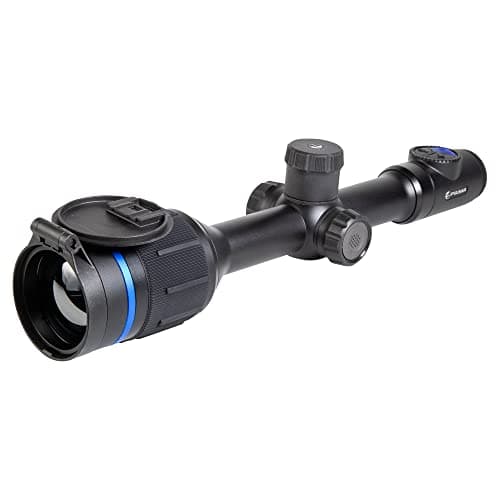
Pulsar Thermion 2 XQ50 Pro
$1,000 to $2,0008.6/10ResearchedThe subject of this review: the longest lens and the most complete durability sheet in its tier, on a 17 micron sensor and 31.7 oz.
$1,999.97Amazon#ad · Price as of November 3, 2026 · How we make money for the link to Pulsar Thermion 2 XQ50 Pro
Best rangefinding thermal on a 30 mm tube
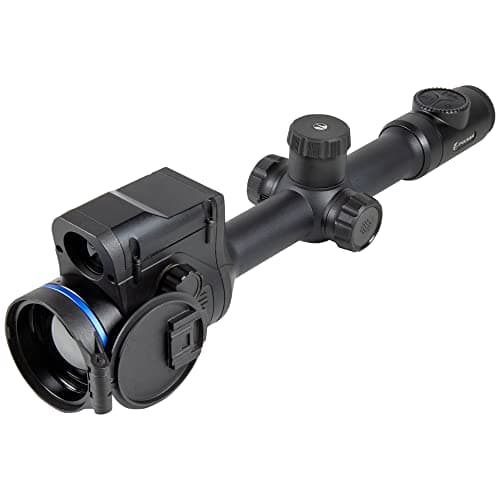
Pulsar Thermion 2 LRF XQ50 Pro
$2,000 and up8.6/10ResearchedThe same scope plus an 800 m laser and ballistics app support, a tier up. Buy it only if range estimation is genuinely your error source.
$2,999.97Amazon#ad · Price as of November 3, 2026 · How we make money for the link to Pulsar Thermion 2 LRF XQ50 Pro
Best rangefinding thermal under $2,000
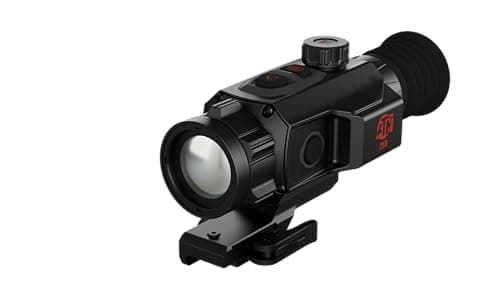
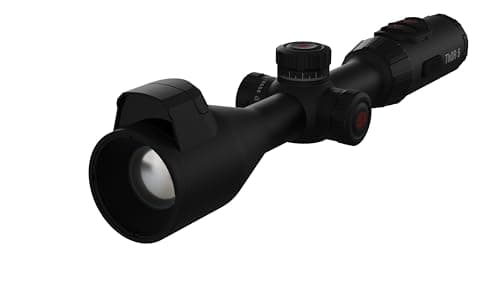
ATN ThOR 6 Elite LRF 384 3.5-28x
$1,000 to $2,0008.5/10ResearchedThe specification answer: 12 micron at 15 mK, a 1,000 m rangefinder, Full HD display, IP67 and 6000 J - behind a shorter 35 mm lens.
$1,890.00Amazon#ad · Price as of November 3, 2026 · How we make money for the link to ATN ThOR 6 Elite LRF 384 3.5-28x
Best compact thermal for close brush hogs
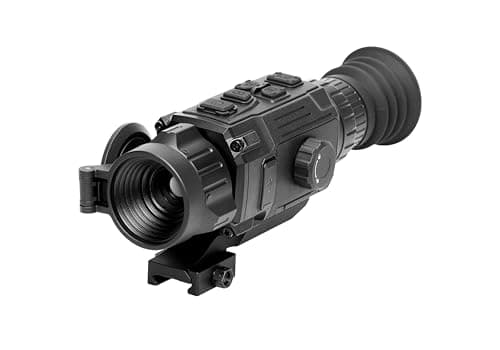
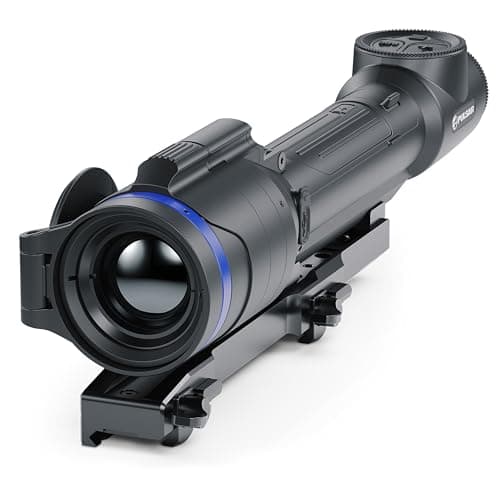
Pulsar Talion XQ35 Pro
$1,000 to $2,0007.9/10ResearchedThe close-range Pulsar: a 2.5x base and a 10.7 degree view for hogs that arrive at 50 yards and move, for less money.
$1,767.55Amazon#ad · Price as of November 3, 2026 · How we make money for the link to Pulsar Talion XQ35 Pro
If you are not yet sure this tier is the right spend at all, start with are thermal scopes worth it — for hunters whose hogs already come to a lit feeder, a light and a handheld scanner buy more capability per dollar. The full ranking of this band is on best thermal scope under $2,000.
How we reviewed this
Plainly: we have not shot this scope. This is a specification review. Every figure above comes from Pulsar's own product page for the Thermion 2 XQ50 Pro, re-read on October 19, 2026, and from the competing makers' pages for the comparisons. We confirmed the Thermion 2 and all three alternatives were currently sold with a live price the same day through our daily price check. Scores come from the published thermal rubric on how we choose: sensor and lens for hog identification (30%), usability at night (20%), battery and power (15%), durability (15%), warranty and support (10%) and value within tier (10%).
Our network standard is "tested when I can, researched when I can't, labeled either way", and this page is labeled. The pixels-per-hog figures in this review are arithmetic from the published pitch and lens numbers, not measurements. For what a scope like this is like to run once it is mounted, see how to use a thermal scope and how to zero a thermal scope.
If this tier is above where you want to be, the entry scope with the most complete spec sheet is reviewed on ATN ThOR 6 Mini 256 review, and the compact day-night alternative to thermal altogether is on Sightmark Wraith 4K Mini review.
How we scored this
Every score, built from the published record
Every pick here is labeled Researched: we read each maker's published specs, manuals and warranty terms, compare products only against others in the same budget tier, and score them on a public rubric. Every figure links to where it came from, and seller performance numbers are labeled “maker's claim,” so you can see exactly what you are buying.
Scores are our editorial read of that documented evidence. Commissions never set a score or decide a pick. The rubric and its weights are published.
What changed
- Published.
Questions
Frequently asked
Is the Pulsar Thermion 2 XQ50 Pro worth it?
What is the difference between the Thermion 2 XQ50 Pro and the LRF version?
Does the Thermion 2 come with a mount?
Is 17 microns a problem on the Thermion 2?
How long does the Thermion 2 battery last?
Thermion 2 or Talion for hog hunting?
Receipts
Sources
- Pulsar: Thermion 2 XQ50 Pro product page and full specification (checked 2026-10-19)
- Pulsar: Thermion 2 LRF XQ50 Pro product page, including the 800 m rangefinder specification (checked 2026-10-19)
- Pulsar: Talion XQ35 Pro product page and specification (checked 2026-10-19)
- ATN: ThOR 6 Elite LRF 384 3.5-28x product page and spec table (checked 2026-10-19)
- Missouri Department of Conservation: Feral Hog (Feral Swine) field guide, size (checked 2026-10-19)
- TPWD: Outdoor Annual, Nongame and Other Species, feral hogs (checked 2026-10-19)
Specs come from each maker's own pages or the product listing (linked on every product), hog biology and trapping advice from Texas A&M AgriLife, and rules from TPWD and Texas statute. Prices are set by Amazon and change often, so we don't print them. Where a figure isn't published, we say so. Read the full method.