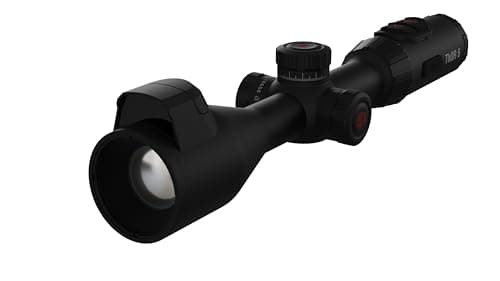
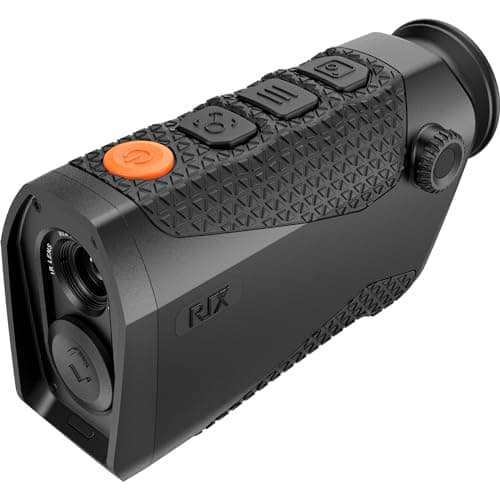
The contenders
Side by side
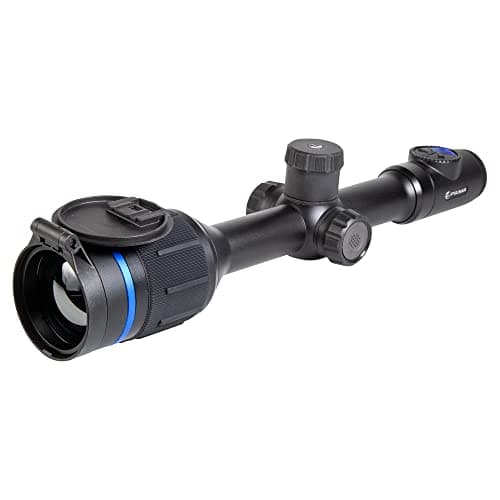
Buy the Thermion for reach
Pulsar Thermion 2 XQ50 Pro
$1,000 to $2,0008.6/10A 50 mm F/1.0 lens and a 3x base, up to 10 hours on two batteries, and it drops into standard 30 mm rings. The reach answer, and the heavier one.
$1,999.97Amazon#ad · Price as of October 11, 2026 · How we make money for the link to Pulsar Thermion 2 XQ50 Pro
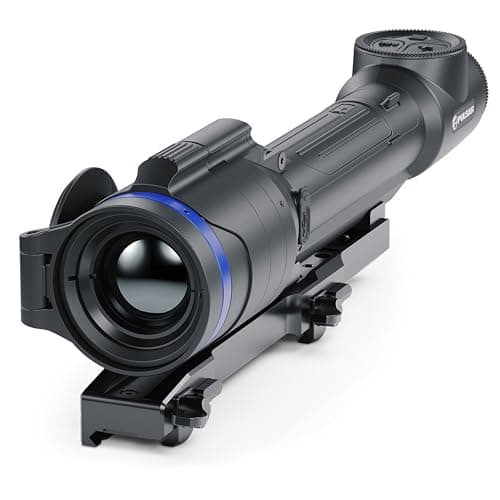
Buy the Talion for close brush
Pulsar Talion XQ35 Pro
$1,000 to $2,0007.9/1035 mm lens, 2.5x base and a 10.7-degree view: easier to find and follow a moving hog inside 100 yards, in a magnesium body that weighs a third less.
$1,799.97Amazon#ad · Price as of October 11, 2026 · How we make money for the link to Pulsar Talion XQ35 Pro
If you want the laser too
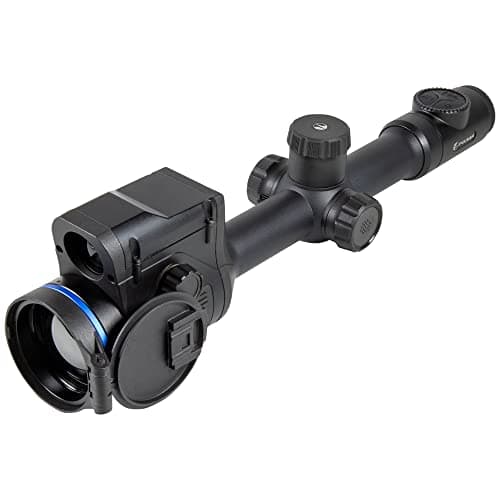
Pulsar Thermion 2 LRF XQ50 Pro
$2,000 and up8.6/10The same scope as the Thermion 2 XQ50 Pro with an 800 m rangefinder and ballistics app support, one budget tier up.
$2,999.97Amazon#ad · Price as of October 11, 2026 · How we make money for the link to Pulsar Thermion 2 LRF XQ50 Pro
What these two scopes share, which is most of it
People put the Thermion and the Talion against each other expecting a good-better-best answer, and that is not what this is. Pulsar publishes the same core numbers for both: a 384x288 uncooled sensor at 17 µm, a NETD figure of <25 mK, a 50 Hz refresh rate, a 1024x768 AMOLED display, 16 GB of internal recording with Wi-Fi to the Stream Vision 2 app, IPX7 and a 6000 J recoil rating on rifled weapons. Both carry Pulsar's three-year warranty, five with registration (Pulsar warranty terms).
So the picture quality, the sensitivity, the durability and the support are a wash. If you were hoping one of them resolves a hog better at the same distance because it costs more, it does not. What differs is the glass in front of the sensor, how the scope attaches to the rifle, and what the whole thing weighs on the end of a barrel. Those three things change how the scope behaves in the dark more than any spec on the box.
The lens is the whole argument
The Thermion 2 XQ50 Pro runs a 50 mm F/1.0 lens; the Talion XQ35 Pro runs a 35 mm F/1.0. On a fixed sensor, a longer lens buys magnification and reach and spends field of view to get it. Pulsar's own figures show exactly that trade:
- Thermion 2 XQ50 Pro: 3-12x, a 7.5° horizontal field (13.1 m of ground at 100 m), and a detection claim of 1,800 m.
- Talion XQ35 Pro: 2.5-10x, a 10.7° x 8° field (18.2 x 13.7 m at 100 m), and a detection claim of 1,350 m.
Read the field-of-view numbers rather than the detection claims, because the field of view is the figure you will feel. At 100 metres the Talion shows you 18.2 metres of ground and the Thermion shows you 13.1 — that is roughly five extra metres of width at the exact distance most hogs get shot. When a sounder breaks and runs, the width is what keeps an animal in your picture instead of making you hunt for it at 3x.
Those detection claims, meanwhile, are both maker's claims with no stated target size and no stated conditions. We work through why they are not comparable across brands, or even useful across one brand, on thermal scope detection range. Neither 1,800 m nor 1,350 m has anything to do with the distance at which you can tell a sow from a shoat. A feral hog is an animal the MDC field guide puts at a length "to 5 feet", and on a 384 sensor you are identifying one at a small fraction of either figure.
Specs side by side
Rings versus Weaver mounts, which matters more than it sounds
The Thermion 2 is built on a 30 mm tube and mounts in ordinary 30 mm scope rings. If you already own rings, a one-piece mount or a cantilever you like, the Thermion goes straight into them, and the scope sits at whatever height and eye relief you have already worked out on a day optic.
The Talion does not have a tube. Pulsar specifies it for Weaver U, USQD or LQD mounts — the Talion-family mounts — so you are buying into Pulsar's mounting system rather than your own. The upside is the quick-detach options and a lower, more compact package. The downside is that a mount you already trust does not transfer, and if you swap the optic between rifles you are swapping Pulsar hardware.
Battery and weight: the Thermion wins one, the Talion the other
The Thermion 2 XQ50 Pro carries an internal APS5 battery plus an external APS2 pack, which Pulsar rates at up to 10 hours at 22°C, and takes USB-C external power at 5 V or 9 V. The Talion runs a single APS 5T pack rated up to 9 hours, also with USB-C power delivery. Both will run a full night with a bank in your pocket; the Thermion's two-battery arrangement means you can hot-swap the external pack without the picture going out, which is a real thing at 2 a.m.
Weight goes the other way, decisively. Pulsar lists the Thermion 2 XQ50 Pro at 0.9 kg (31.7 oz) and the Talion at 0.7 kg without the APS 5T battery. On a rifle you carry, or one you swing off a tripod at a running sounder, that difference is obvious within an hour. The Talion's magnesium-alloy body is most of why.
One more published difference worth knowing if you hunt a Texas summer: the Thermion's operating range runs to +50°C, the Talion's to +40°C. Neither is likely to matter on a night hunt, but the Talion's is the lower ceiling if the scope lives in a truck.
Where the Thermion 2 LRF fits
The third scope on this page is the same Thermion with a laser in it. Pulsar publishes an 800 m, ±1 m rangefinder (905 nm, Class 1) plus Stream Vision Ballistics support, on the same 384/17 µm sensor, the same 50 mm F/1.0 lens, the same 10-hour battery arrangement and the same 6000 J rating, at 0.97 kg. It sits a full budget tier above the non-LRF version.
Be honest with yourself about whether you need it. For hogs inside 150 yards over a feeder, a rangefinder is a convenience, not a capability — and Pulsar's own 800 m laser reaches less than half of the 1,800 m detection figure printed on the same spec sheet. If you want ranging because you shoot across a long pasture, it earns its tier. We rank the whole category on best thermal scopes with a ballistic calculator, and lay out what each price band buys on how much a thermal scope costs.
Which one to buy
| If this is your hunting… | Buy | Because |
|---|---|---|
| Hogs on a feeder, 40 to 100 yards, brush close in | Talion XQ35 Pro | 2.5x base and 18.2 m of view at 100 m: you find the animal instead of searching for it |
| Open pasture, shots out past 150 yards | Thermion 2 XQ50 Pro | 50 mm lens and 3x base put more pixels on the hog at distance |
| You already own 30 mm rings or a one-piece mount | Thermion 2 XQ50 Pro | It uses them; the Talion needs Pulsar's own Weaver-style mounts |
| You carry the rifle a long way | Talion XQ35 Pro | 0.7 kg versus 0.9 kg, in a magnesium body |
| You want a laser range on the target | Thermion 2 LRF XQ50 Pro | The only one of the three with a built-in 800 m rangefinder |
Our own ranking puts the Thermion 2 XQ50 Pro ahead on the published rubric, mostly on battery, durability and reach — but the Talion is the scope we would hand someone whose hogs show up at 50 yards in cedar. That is not a contradiction; it is what happens when a rubric scores reach and your problem is width. The full rubric is on how we choose.
Mistakes people make choosing between these
- Buying on the detection claim. 1,800 m versus 1,350 m decides nothing. Neither number is a target-size-stated, condition-stated figure, and you identify hogs at a fraction of either.
- Assuming the pricier scope sees better. Same sensor, same pixel pitch, same NETD. The Thermion sees further; it does not see more clearly.
- Ignoring the mount. People order a Talion, then discover the mount they wanted to use is a 30 mm ring set. Check the rifle first.
- Overlooking the base magnification. 3x versus 2.5x sounds trivial on paper and is the single most noticeable difference in the field at close range.
- Paying the LRF tier for feeder distance. If every shot is inside 150 yards, put the difference into a second battery, a better mount and a handheld scanner.
In detail
The contenders, in full
Buy the Thermion for reach
Pulsar Thermion 2 XQ50 Pro
A 50 mm F/1.0 lens and a 3x base, up to 10 hours on two batteries, and it drops into standard 30 mm rings. The reach answer, and the heavier one.
Published specsResearched · every spec sourced
| Sensor | 384x288 (uncooled) |
|---|---|
| Pixel pitch | 17 µm |
| NETD | <25 mK (sNETD <18 mK) |
| Lens | 50 mm, F/1.0 |
| Magnification | 3-12x |
| Refresh rate | 50 Hz |
| Field of view | 7.5° horizontal (13.1 m at 100 m) |
| Detection range | 1,800 m (about 1,969 yd)Maker's claim |
| Display | 1024x768 AMOLED |
| Battery | Internal APS5 plus external APS2, up to 10 h at 22°C; USB-C (5 V/9 V) external power |
| Recording | 16 GB internal; Wi-Fi (2.4/5 GHz) to Stream Vision 2 app |
| IP rating | IPX7 |
| Recoil rating | 6000 J on rifled weapons; 12 gauge on smoothbores |
| Operating temperature | -25°C to +50°C |
| Weight | 0.9 kg (31.7 oz) |
| Mount | Standard 30 mm rings |
| Warranty | 3 years; 5 years with registration |
How the 8.6 score breaks down
- Sensor & lens for hog ID (30%)
- 8.5
- Usability at night (20%)
- 8.5
- Battery & power (15%)
- 9
- Durability (15%)
- 9
- Warranty & support (10%)
- 8.5
- Value within its tier (10%)
- 7.5
What the specs support
- Big 50 mm F/1.0 lens with a 3x base: more detail on a hog at field distance than 25-35 mm scopes
- Swappable external APS2 pack on top of the internal battery, up to 10 h, plus USB-C power
- IPX7, 6000 J recoil rating and a -25°C to +50°C operating range, all published
- Mounts in standard 30 mm rings; five zero profiles and 10 reticles
Where it falls short
- 17 µm pixels versus 12 µm on newer 384 scopes; field of view at 3x is narrower than a 35 mm scope
- Heaviest scope in its tier at 31.7 oz
- No built-in rangefinder (that's the Thermion 2 LRF)
Skip this if…
…Your hogs come to a feeder inside 60 yards in thick brush; a 3x base on a 50 mm lens is slower to pick up close movement than a 2x, 25-35 mm scope.
#ad · Price as of October 11, 2026 · How we make money for the link to Pulsar Thermion 2 XQ50 Pro
Buy the Talion for close brush
Pulsar Talion XQ35 Pro
35 mm lens, 2.5x base and a 10.7-degree view: easier to find and follow a moving hog inside 100 yards, in a magnesium body that weighs a third less.
Published specsResearched · every spec sourced
| Sensor | 384x288 (uncooled) |
|---|---|
| Pixel pitch | 17 µm |
| NETD | <25 mK (sNETD <15 mK) |
| Lens | 35 mm, F/1.0 |
| Magnification | 2.5-10x |
| Refresh rate | 50 Hz |
| Field of view | 10.7° x 8° (18.2 x 13.7 m at 100 m) |
| Detection range | 1,350 m (about 1,475 yd)Maker's claim |
| Display | 1024x768 AMOLED HD |
| Battery | APS 5T pack, up to 9 h at 22°C; USB-C (5 V/9 V) external power |
| Recording | 16 GB internal; Wi-Fi (2.4/5 GHz) to Stream Vision 2 app |
| IP rating | IPX7 |
| Recoil rating | 6000 J on rifled weapons; 12 gauge on smoothbores |
| Operating temperature | -25°C to +40°C |
| Weight | 0.7 kg without APS 5T battery |
| Mount | Weaver U, USQD or LQD mounts |
| Warranty | 3 years; 5 years with registration |
How the 7.9 score breaks down
- Sensor & lens for hog ID (30%)
- 7.5
- Usability at night (20%)
- 8
- Battery & power (15%)
- 8
- Durability (15%)
- 8.5
- Warranty & support (10%)
- 8.5
- Value within its tier (10%)
- 7
What the specs support
- 2.5x base and a 10.7° view make close, moving hogs easier to follow than on 3x-plus scopes
- IPX7, 6000 J recoil rating and magnesium-alloy body
- Up to 9 h on the APS 5T pack plus USB-C power delivery
Where it falls short
- 17 µm pixels on a 384 sensor; the ATN ThOR 6 Elite offers 12 µm and ≤15 mK in the same tier
- Mounts through Weaver-style Talion mounts rather than standard scope rings
- Upper operating limit of +40°C is lower than the Thermion's +50°C
Skip this if…
…You want a rangefinder or regularly identify hogs past 200 yards; the ATN ThOR 6 Elite LRF or Thermion 2 XQ50 Pro reach further.
#ad · Price as of October 11, 2026 · How we make money for the link to Pulsar Talion XQ35 Pro
If you want the laser too
Pulsar Thermion 2 LRF XQ50 Pro
The same scope as the Thermion 2 XQ50 Pro with an 800 m rangefinder and ballistics app support, one budget tier up.
Published specsResearched · every spec sourced
| Sensor | 384x288 (uncooled) |
|---|---|
| Pixel pitch | 17 µm |
| NETD | <25 mK |
| Lens | 50 mm, F/1.0 |
| Magnification | 3-12x |
| Refresh rate | 50 Hz |
| Field of view | 7.5° x 5.6° (13.1 x 9.8 m at 100 m) |
| Detection range | 1,800 mMaker's claim |
| Display | 1024x768 AMOLED |
| Battery | 2 Ah changeable external plus 4.9 Ah internal, up to 10 h at 22°C; USB-C (5 V/9 V) external power |
| Recording | 16 GB internal; Wi-Fi (2.4/5 GHz) to Stream Vision 2 and Stream Vision Ballistics |
| Rangefinder | Built-in, 800 m max, ±1 m (905 nm, Class 1)Maker's claim |
| IP rating | IPX7 |
| Recoil rating | 6000 J on rifled weapons; 12 gauge on smoothbores |
| Operating temperature | -25°C to +50°C |
| Weight | 0.97 kg |
| Mount | Standard 30 mm rings |
| Warranty | 3 years; 5 years with registration |
How the 8.6 score breaks down
- Sensor & lens for hog ID (30%)
- 8.5
- Usability at night (20%)
- 9
- Battery & power (15%)
- 9
- Durability (15%)
- 9
- Warranty & support (10%)
- 8.5
- Value within its tier (10%)
- 6.5
What the specs support
- Built-in rangefinder on a traditional 30 mm-tube scope that fits standard rings
- Up to 10 h with a changeable external pack, plus USB-C power delivery
- IPX7, 6000 J and a -25°C to +50°C range, all published
Where it falls short
- 384 sensor at 17 µm, while the RIX Storm S6R and AGM Clarion 640 offer 640 or 12 µm sensors in this tier
- 800 m rangefinder is shorter than the 1,000 m ATN and 1,300 yd oneleaf units
- Heaviest scope in this list at 0.97 kg
Skip this if…
…You don't need ranging for hog-distance shots; the non-LRF Thermion 2 XQ50 Pro has the same sensor, lens and battery for a tier less.
#ad · Price as of October 11, 2026 · How we make money for the link to Pulsar Thermion 2 LRF XQ50 Pro
How we scored this
Every score, built from the published record
Every pick here is labeled Researched: we read each maker's published specs, manuals and warranty terms, compare products only against others in the same budget tier, and score them on a public rubric. Every figure links to where it came from, and seller performance numbers are labeled “maker's claim,” so you can see exactly what you are buying.
Scores are our editorial read of that documented evidence. Commissions never set a score or decide a pick. The rubric and its weights are published.
What changed
- Published.
Questions
Frequently asked
Is the Pulsar Thermion better than the Talion?
Do the Thermion and the Talion use the same sensor?
Can the Pulsar Talion use standard scope rings?
Which Pulsar thermal is best for hogs at a feeder?
Is the Thermion 2 LRF worth the extra over the non-LRF?
Receipts
Sources
- Pulsar: Thermion 2 XQ50 Pro product page and specification table (checked 2026-10-11)
- Pulsar: Thermion 2 LRF XQ50 Pro product page and specification table (checked 2026-10-11)
- Pulsar: Talion XQ35 Pro product page and specification table (checked 2026-10-11)
- Pulsar: warranty terms (three years, five with registration), checked 2026-10-11
- Missouri Department of Conservation: Feral Hog (Feral Swine) field guide, body size (checked 2026-10-11)
- TPWD: Outdoor Annual, Nongame and Other Species, feral hogs (checked 2026-10-11)
Specs come from each maker's own pages or the product listing (linked on every product), hog biology and trapping advice from Texas A&M AgriLife, and rules from TPWD and Texas statute. Prices are set by Amazon and change often, so we don't print them. Where a figure isn't published, we say so. Read the full method.