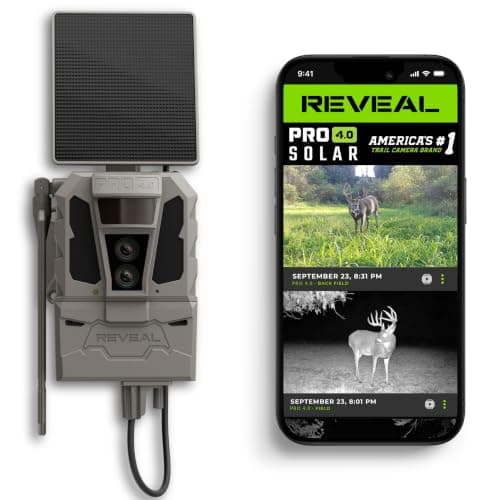
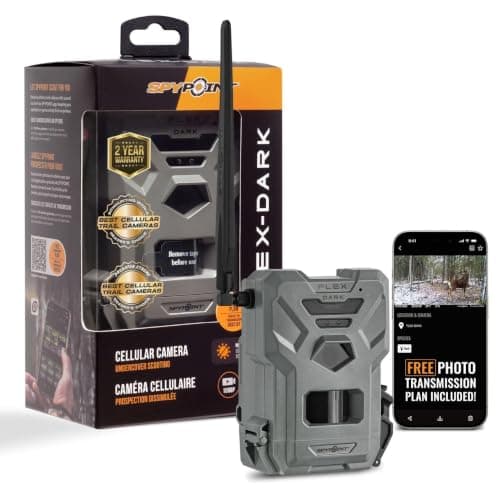
The contenders
Side by side
Cellular: cheapest big-network option
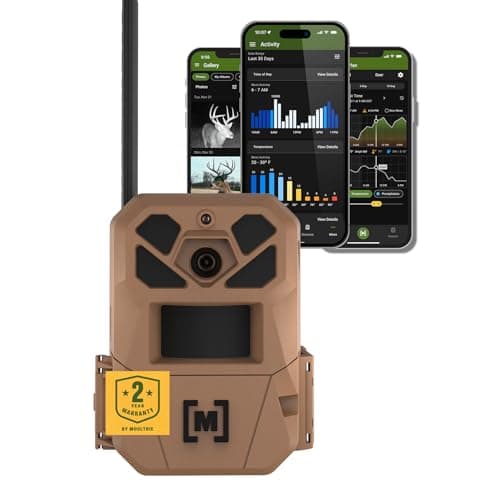
Moultrie Edge 3
Under $5007.4/10Auto-connects to all four major networks with built-in memory and GPS. Low-glow flash, and every Moultrie cellular device needs a paid plan.
$55.73Amazon#ad · Price as of October 5, 2026 · How we make money for the link to Moultrie Edge 3
Cellular: the one you can pause
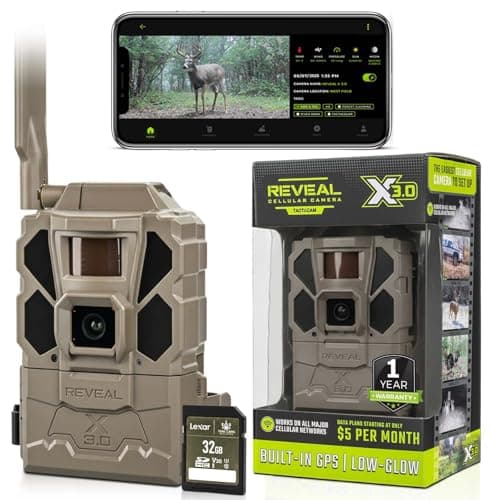
Tactacam Reveal X Gen 3.0
Under $5007.8/10Auto carrier selection, 4K photos, 8 GB internal storage and a 12V input. Plans carry no activation fee and can be paused off-season, which matters if you only hunt part of the year.
$119.99Amazon#ad · Price as of October 5, 2026 · How we make money for the link to Tactacam Reveal X Gen 3.0
Cellular: two cameras, free tier
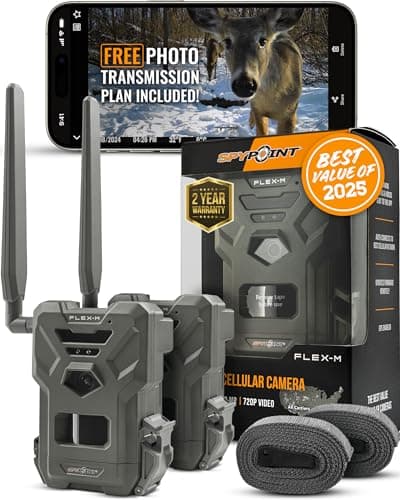
SPYPOINT Flex-M (Twin pack)
Under $5006.8/10The only route here with a genuinely free plan: 100 photos a month per camera, on two cameras. The imaging specs are the weakest on this page.
$89.99Amazon#ad · Price as of October 5, 2026 · How we make money for the link to SPYPOINT Flex-M (Twin pack)
Non-cellular: best night specs on the page
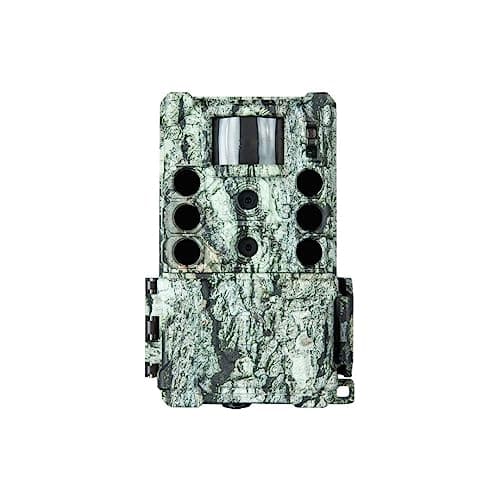
Bushnell Core DS-4K No Glow (non-cellular)
Under $5006.0/10No plan, ever. Dual day and night sensors with a 0.15 s trigger and 120 ft no-glow claims, both better on paper than any cellular camera here.
$164.55Amazon#ad · Price as of October 5, 2026 · How we make money for the link to Bushnell Core DS-4K No Glow (non-cellular)
Non-cellular: the budget card camera
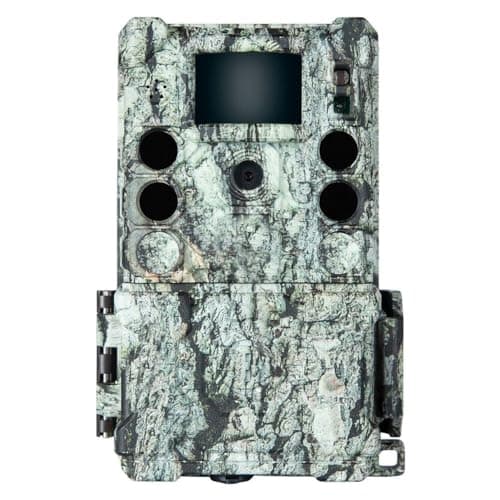
Bushnell Core S-4K No Glow (non-cellular)
Under $5005.9/10Single-sensor no-glow with 0.2 s trigger and 110 ft claims, and nothing to subscribe to. You learn what came in when you pull the card.
$125.81Amazon#ad · Price as of October 5, 2026 · How we make money for the link to Bushnell Core S-4K No Glow (non-cellular)
Every score on this page comes from published specs and the rubric on our How We Choose page. We don't print plan prices — they change, and the pages are linked — but we do print the photo caps, because those are the number that decides whether a plan works for your site.
The real question is not cost, it is timing
Most comparisons of these two start with money, and that's the wrong end. A cellular camera and a card camera answer two different questions:
- A card camera answers "what has been using this place?" You find out when you pull the card. That's a perfectly good answer for scouting a feeder, confirming a crossing or seeing whether hogs are hitting a food plot at all.
- A cellular camera answers "what is here right now?" It can text you while the animals are standing in front of it. That's a different capability, and it only matters if you intend to act on it tonight.
So the honest first question is: if the camera tells you hogs are at the feeder at 11:40 pm, will you do anything about it? If the answer is yes — you'll go sit, or you'll drop a trap gate — cellular earns its plan. If the answer is "I'll look at the photos Saturday," you're paying monthly for a feature you use like a card camera.
Cellular vs non-cellular at a glance
| Cellular | Non-cellular (card) | |
|---|---|---|
| How you get images | Pushed to an app, minutes after the trigger | You walk in and pull the SD card |
| Running cost | A plan per camera, monthly or annual, indefinitely | None after the camera and batteries |
| Image cap | 100 to unlimited photos a month, by tier | Whatever the card holds |
| Free tier available | SPYPOINT only: 100 photos a month per camera | Not applicable — nothing to subscribe to |
| Flash on our picks | Low-glow on all three cellular picks here | No-glow on both Bushnells |
| Best published trigger speed here | 0.5 s (Moultrie Edge 3, SPYPOINT Flex-M) | 0.15 s (Bushnell Core DS-4K) |
| Best published night range here | 100 ft (Moultrie Edge 3) | 120 ft (Bushnell Core DS-4K) |
| Needs cell coverage | Yes. No signal, no camera | No |
| Site visits | Batteries and setup only | Every time you want to know anything |
| Theft recovery | GPS on all three cellular picks here | None. A stolen camera takes its photos with it |
The five, side by side
Three cellular cameras and both non-cellular cameras in our registry, all currently sold on Amazon. One honest limitation up front: our registry carries only two non-cellular cameras, and both are Bushnell, so the card side of this comparison is Bushnell's view of the category rather than the whole market.
| Published spec | Bushnell Core DS-4K No Glow (non-cellular) | Bushnell Core S-4K No Glow (non-cellular) |
|---|---|---|
| Budget tier | Under $500 | Under $500 |
| Carrier | None (non-cellular) | None (non-cellular) |
| Flash | No-glow LED | No-glow |
| Detection range | — | — |
| Trigger speed | 0.15 s (maker's claim) | 0.2 s (maker's claim) |
| Photo / video | Up to 32MP / 4K | Up to 30MP / 4K |
| Screen | 1.5 in color view screen | 1.5 in color viewscreen |
| Battery | AA batteries | AA batteries |
| Data plan | None needed (non-cellular) | None needed (non-cellular) |
| Score | 6.0/10 | 5.9/10 |
Note the Network row on the Bushnells: "None (non-cellular)." That single spec is why they score 1 out of 10 on network flexibility in our rubric and still rank well on best trail camera for night. The rubric weights network flexibility because this site is mostly about cellular cameras; it is not a judgment that a card camera is a worse camera.
What the plans actually cap you at
The plan is the part people underestimate, and the caps are more useful than the prices. Here is how each maker structures it, from their own plan pages, checked 2026-10-05:
| Maker | Free tier | Published photo caps by tier | Notes from the maker |
|---|---|---|---|
| SPYPOINT | Yes: 100 photos a month | Free 100, Basic 250, Standard 1,000, Premium unlimited | "No activation fees. One plan per camera." |
| Tactacam | No | Starter 250, Intermediate 500, Pro unlimited | "No carrier contract required. No activation fee." Plans can be paused off-season |
| Moultrie | No for cellular hardware | Standard 1,000 images and 10 videos, Unlimited, Pro Series | "All cellular connected devices require a paid subscription"; billed per camera |
Sources: SPYPOINT photo transmission plans, Tactacam REVEAL plans, Moultrie plans. Tactacam also prices HD photo and video requests, a Live View add-on and a wind sensor separately, so the tier is a floor rather than a total.
Now put the caps in terms of nights. 100 photos a month is about 3 a day. 250 is about 8. 500 is about 16. 1,000 is about 33. A camera over an active hog feeder regularly fires more than that in a single night, and Texas A&M AgriLife notes feral hogs are largely nocturnal and travel in family groups — a sounder walking through triggers a burst, not a photo. Deer, raccoons and wind-blown brush spend the cap too. A free 100-photo tier on a working feeder is gone inside a week.
That is the honest arithmetic of cellular: the plan tier you'll actually need on a busy site is rarely the cheapest one, and it's billed per camera. Four cameras on four feeders is four plans. A card camera has no cap at all; an SD card holds thousands of images and costs nothing per month, for as long as you own it.
The surprise: the card cameras have better night specs
This is the part that argues hardest for non-cellular, and it's all from published figures:
| Camera | Type | Flash | Night range claim | Trigger claim |
|---|---|---|---|---|
| Bushnell Core DS-4K No Glow | Card | No-glow, dual day/night sensors | 120 ft | 0.15 s |
| Bushnell Core S-4K No Glow | Card | No-glow, single sensor | 110 ft | 0.2 s |
| Moultrie Edge 3 | Cellular | Low-glow | 100 ft | 0.5 s |
| Tactacam Reveal X Gen 3.0 | Cellular | Low-glow IR | 96 ft | Sub-1/2 s |
| SPYPOINT Flex-M (twin) | Cellular | Not stated on the listing or maker page | 90 ft | 0.5 s |
All of those are maker's claims, not measurements we made, and they're each linked in the spec tables above. But the pattern is consistent: the two cameras with no radio in them publish longer night range, faster triggers and no-glow flash, where all three cellular picks are low-glow or unstated (Bushnell DS-4K; Bushnell S-4K; Moultrie Edge 3; Tactacam Reveal X 3.0; SPYPOINT Flex-M).
Flash type is the one that matters near a property line. Low-glow emits a dull red glow that both game and people can see; no-glow doesn't. If the camera faces a county road or a neighbor's fence, no-glow is the safer choice, and in our registry the no-glow cellular options are the SPYPOINT Flex-Dark and Tactacam's higher models rather than the value cameras on this page. Our cellular trail camera rankings sort the whole cellular lineup by night imaging, and best trail camera for night covers the no-glow question across both types.
The card-pull problem at a baited site
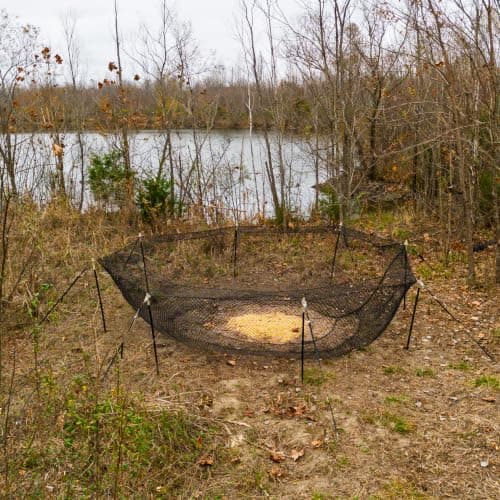
Here is the cost of a card camera that doesn't appear on any spec sheet: to learn anything, you have to walk to the camera. At a scouting camera on a crossing, that's fine. At a baited feeder or a trap you're pre-baiting, it works directly against what you're trying to do.
Texas A&M AgriLife's trap publication is explicit about why. It advises keeping pre-bait inside the trap "to ensure the entire sounder (group) is comfortable entering the trap" ( Placing and Baiting Feral Hog Traps). Comfort is the resource you're building, and every visit spends some of it: scent on the gate, boot tracks in the corn, a vehicle on the road at dusk. A cellular camera lets you watch the site build without touching it.
There's a practical version of the same point for feeders. If you have to drive out to check a card camera, you'll check it less often than you should, which means you learn the pattern a week or two late. Our when are hogs most active page covers what the timestamps are actually telling you once you have them.
Trapping: cellular is not optional
If the camera watches a hog trap, the comparison ends. A card camera physically cannot do the job, because the job is to tell you the whole sounder is inside right now so the gate can drop. That's the difference between catching the group and educating it.
It's also why the trap category in our registry is built around cellular triggers rather than cameras. Our best hog trap cameras page covers the camera-plus-drop systems, best hog trap gates covers who fires the trigger, and how to trap feral hogs walks the whole sequence. If you're trapping, budget the plan as part of the trap, not as a camera accessory.
Which one for your job
Buy cellular if any of these is true: the camera watches a trap; the site is far enough that driving out to check it is a real cost; you want to react the same night; the camera is somewhere you'd want GPS if it walked off; or the property has cell coverage and a sit you'd actually take on short notice. Of the three here, the Tactacam Reveal X Gen 3.0 is the one to pick if you hunt seasonally, because Tactacam lets you pause a plan off-season. The Moultrie Edge 3 is the pick if coverage is marginal, because it auto-connects across all four major networks. The SPYPOINT Flex-M twin pack is the pick if you want two cameras live at the lowest possible running cost, and can live with 100 photos a month each.
Buy non-cellular if the property has no usable signal; you're scouting rather than reacting; you want the best night image for the money with no recurring bill; or you need several cameras and the per-camera plan math doesn't work. The Bushnell Core DS-4K No Glow is the one with the better published specs; the Core S-4K is the budget version of the same idea.
Check coverage before you buy either way. A cellular camera with no bars is a card camera with a subscription. Walk the exact tree the camera will hang on and check your phone there, not at the gate.
The setup most landowners end up with
In practice the answer is usually not one or the other. Most people with a hog problem end up running one cellular camera on the thing that needs a decision — the trap, or the feeder they hunt — and card cameras on everything they're just curious about. One plan instead of five, and no blind spots.
That mix is also the cheapest honest way to cover ground. If you want the cellular rankings, start with best cellular trail cameras; for the head-to-head between the two biggest cellular brands see SPYPOINT vs Tactacam and Tactacam Reveal vs Moultrie Edge. For what the camera is pointed at, see best hog feeders for baiting and the feeders and trail cameras hub.
In detail
The contenders, in full
Cellular: cheapest big-network option
Moultrie Edge 3
Auto-connects to all four major networks with built-in memory and GPS. Low-glow flash, and every Moultrie cellular device needs a paid plan.
Published specsResearched · every spec sourced
| Networks | Auto-connect, all 4 major networks |
|---|---|
| Flash | Low-glow |
| Detection range | 100 ftMaker's claim |
| Flash range | 100 ftMaker's claim |
| Trigger speed | 0.5 sMaker's claim |
| Photo / video | 40MP / 1080p |
| Field of view | 50° |
| Storage | Built-in memory, no SD card required |
| Power | USB-C power input; solar power reporting when paired with Moultrie solar packs |
| GPS | Yes |
| Feeder control | Pairs with Moultrie Bluetooth feeder timers (such as the Pro Hunter III kit) for cellular feeder control |
| Data plan | Paid subscription required for all Moultrie cellular devices; monthly and annual tiers published |
How the 7.4 score breaks down
- Network flexibility (25%)
- 8.5
- Night imaging (25%)
- 6.5
- Power (20%)
- 5.5
- Plan-cost transparency (15%)
- 8
- Value (15%)
- 9
What the specs support
- Auto-connects to the strongest of all four major networks
- Built-in memory, GPS, on-demand photos and Live Aim for setup
- Pairs with Moultrie's Bluetooth feeder timers for cellular feeder control
- Moultrie publishes every plan tier and add-on clearly
Where it falls short
- Low-glow flash, which is more visible to game and people than no-glow
- Every Moultrie cellular device needs a paid subscription; there's no free tier
- Moultrie's spec table doesn't list battery type or runtime
Skip this if…
…The camera will face a road or a neighbor's line where a visible glow could draw attention; pick a no-glow camera.
#ad · Price as of October 5, 2026 · How we make money for the link to Moultrie Edge 3
Cellular: the one you can pause
Tactacam Reveal X Gen 3.0
Auto carrier selection, 4K photos, 8 GB internal storage and a 12V input. Plans carry no activation fee and can be paused off-season, which matters if you only hunt part of the year.
Published specsResearched · every spec sourced
| Networks | Integrated SIM; auto carrier selection; major cellular networks (LTE) |
|---|---|
| Flash | Low-glow IR |
| Flash range | 96 ftMaker's claim |
| Detection range | 96 ft+Maker's claim |
| Trigger speed | Sub-1/2 sMaker's claim |
| Photo / video | 4K (UHD) or 2.5K / 1080p |
| Storage | 8GB internal; optional SD card slot |
| Power | 12 AA batteries (not included); DC 12V input |
| Battery life | 6+ monthsMaker's claim |
| IP rating | IP66 |
| Data plan | Monthly or annual tiers published; no carrier contract or activation fee; can pause off-season |
| Warranty | 1 year from activation |
How the 7.8 score breaks down
- Network flexibility (25%)
- 8.5
- Night imaging (25%)
- 6.5
- Power (20%)
- 7.5
- Plan-cost transparency (15%)
- 8.5
- Value (15%)
- 8.5
What the specs support
- Auto carrier selection on an integrated SIM
- 8GB internal storage plus an optional SD slot, and built-in GPS
- 12V DC input for an external battery or solar panel
- Plans carry no activation fee and can be paused off-season
Where it falls short
- Low-glow flash only
- Runs on 12 AA batteries that aren't included
- 1-year warranty, counted from activation
Skip this if…
…The camera watches a feeder near a road or neighbor and you need no-glow; step up to the Reveal Ultra or Pro 4.0.
#ad · Price as of October 5, 2026 · How we make money for the link to Tactacam Reveal X Gen 3.0
Cellular: two cameras, free tier
SPYPOINT Flex-M (Twin pack)
The only route here with a genuinely free plan: 100 photos a month per camera, on two cameras. The imaging specs are the weakest on this page.
Published specsResearched · every spec sourced
| Networks | Auto multi cell-network, LTE |
|---|---|
| Detection range | 90 ft (motion detection and flash)Maker's claim |
| Trigger speed | 0.5 sMaker's claim |
| Photo / video | 28MP / 720p with sound |
| GPS | Yes |
| IP rating | IP65 |
| Data plan | 100 free photos a month per camera; paid tiers published; no activation fees |
| Warranty | 2 years |
How the 6.8 score breaks down
- Network flexibility (25%)
- 8
- Night imaging (25%)
- 4.5
- Power (20%)
- 4
- Plan-cost transparency (15%)
- 9.5
- Value (15%)
- 9.5
What the specs support
- Free plan: 100 photos a month per camera, with paid tiers published
- Two cameras in one pack
- Auto multi-network LTE with GPS
- 2-year warranty, per SPYPOINT
Where it falls short
- 720p video and a 90 ft detection claim trail the 40MP, 100 ft cameras here
- Flash type (low-glow or no-glow) isn't stated in the listing or on SPYPOINT's page
- SPYPOINT's current FLEX lineup features the newer Flex-M2; this is the older model
Skip this if…
…You want no-glow night video; the Flex-Dark switches to no-glow and records 1080p.
#ad · Price as of October 5, 2026 · How we make money for the link to SPYPOINT Flex-M (Twin pack)
Non-cellular: best night specs on the page
Bushnell Core DS-4K No Glow (non-cellular)
No plan, ever. Dual day and night sensors with a 0.15 s trigger and 120 ft no-glow claims, both better on paper than any cellular camera here.
Published specsResearched · every spec sourced
| Networks | None (non-cellular) |
|---|---|
| Flash | No-glow LED |
| Flash range | 120 ft night rangeMaker's claim |
| Trigger speed | 0.15 sMaker's claim |
| Sensors | Dual sensors (day and night) |
| Photo / video | Up to 32MP / 4K |
| Screen | 1.5 in color view screen |
| Power | AA batteries |
| Data plan | None needed (non-cellular) |
How the 6.0 score breaks down
- Network flexibility (25%)
- 1
- Night imaging (25%)
- 9
- Power (20%)
- 5
- Plan-cost transparency (15%)
- 9
- Value (15%)
- 7.5
What the specs support
- Dual sensors, one for day and one for night
- 0.15 s trigger and 120 ft no-glow night range, both maker's claims
- No data plan to pay for
- Built-in 1.5 in color screen for checking images at the camera
Where it falls short
- Non-cellular: you have to walk in and pull the card, which leaves scent at your feeder or trap
- No remote alerts, so you learn what came in only after the fact
- Bushnell doesn't publish a battery count or runtime on the product page
Skip this if…
…You need to know the sounder is at the trap or feeder tonight; a non-cellular camera can't tell you until you check it.
#ad · Price as of October 5, 2026 · How we make money for the link to Bushnell Core DS-4K No Glow (non-cellular)
Non-cellular: the budget card camera
Bushnell Core S-4K No Glow (non-cellular)
Single-sensor no-glow with 0.2 s trigger and 110 ft claims, and nothing to subscribe to. You learn what came in when you pull the card.
Published specsResearched · every spec sourced
| Networks | None (non-cellular) |
|---|---|
| Flash | No-glow |
| Flash range | 110 ft night rangeMaker's claim |
| Trigger speed | 0.2 sMaker's claim |
| Recovery time | 1 sMaker's claim |
| Sensors | 4K single sensor |
| Photo / video | Up to 30MP / 4K |
| Screen | 1.5 in color viewscreen |
| Power | AA batteries |
| Data plan | None needed (non-cellular) |
How the 5.9 score breaks down
- Network flexibility (25%)
- 1
- Night imaging (25%)
- 8
- Power (20%)
- 5
- Plan-cost transparency (15%)
- 9
- Value (15%)
- 8.5
What the specs support
- No-glow LEDs with a 110 ft night range claim
- 0.2 s trigger and 1 s recovery claims
- No data plan to pay for
Where it falls short
- Non-cellular: every card pull is a trip to the site
- Single sensor, where the DS-4K uses separate day and night sensors
- Battery count and runtime aren't published on the product page
Skip this if…
…You need remote alerts; buy a cellular no-glow camera such as the SPYPOINT Flex-Dark.
#ad · Price as of October 5, 2026 · How we make money for the link to Bushnell Core S-4K No Glow (non-cellular)
How we scored this
Every score, built from the published record
Every pick here is labeled Researched: we read each maker's published specs, manuals and warranty terms, compare products only against others in the same budget tier, and score them on a public rubric. Every figure links to where it came from, and seller performance numbers are labeled “maker's claim,” so you can see exactly what you are buying.
Scores are our editorial read of that documented evidence. Commissions never set a score or decide a pick. The rubric and its weights are published.
What changed
- Published.
Questions
Frequently asked
Is a cellular trail camera worth the monthly plan?
Can you use a cellular trail camera without a plan?
Do non-cellular trail cameras take better pictures?
How many photos a month does a hog feeder camera use?
Do I need cellular for a hog trap?
What happens to a cellular trail camera with no signal?
Receipts
Sources
- SPYPOINT: photo transmission plans page, with per-tier photo caps and "No activation fees. One plan per camera." (checked 2026-10-05)
- Tactacam: REVEAL app and data plans page, with Starter/Intermediate/Pro caps and add-on pricing (checked 2026-10-05)
- Moultrie: camera plans page, including "All cellular connected devices require a paid subscription" (checked 2026-10-05)
- Moultrie: Edge 3 Cellular Trail Camera product page and spec table (checked 2026-09-19)
- Tactacam: REVEAL X 3.0 product page and spec table (checked 2026-09-19)
- SPYPOINT: FLEX-M product page, warranty and photo plan table (checked 2026-09-19)
- Bushnell: CORE DS-4K No Glow Trail Camera product page (checked 2026-09-19)
- Bushnell: CORE S-4K No Glow Trail Camera product page (checked 2026-09-19)
- Texas A&M AgriLife: Placing and Baiting Feral Hog Traps (IRNR-PU-060, Feb. 2011; checked 2026-09-19)
- Texas A&M AgriLife: Feral Hog Ecology (nocturnal activity and sounder behavior; checked 2026-09-19)
Specs come from each maker's own pages or the product listing (linked on every product), hog biology and trapping advice from Texas A&M AgriLife, and rules from TPWD and Texas statute. Prices are set by Amazon and change often, so we don't print them. Where a figure isn't published, we say so. Read the full method.