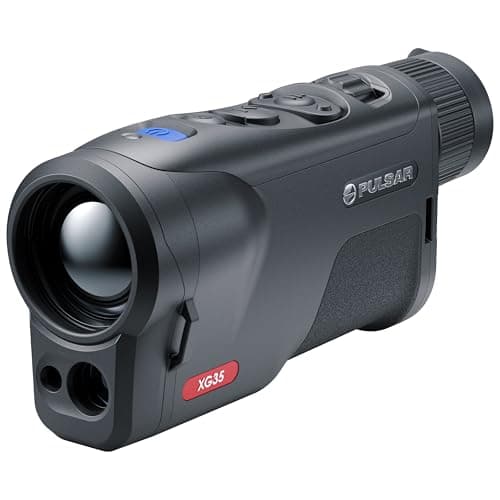
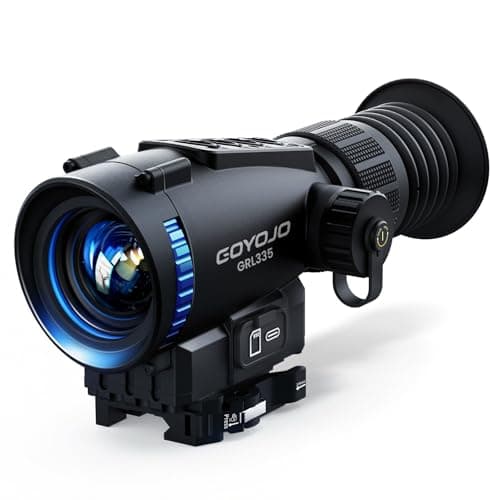
The contenders
Side by side
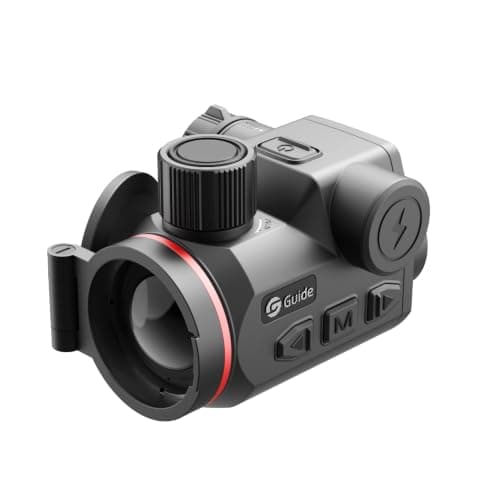
Top clip-on: most sensor per tier
Guide Orion 635
$1,000 to $2,0008.3/10A 640x512, 15 mK sensor behind a 35 mm F0.9 lens at about 10 oz. More sensor than any thermal scope in the same budget tier, and it keeps your day scope's reticle.
$1,999.00Amazon#ad · Price as of October 5, 2026 · How we make money for the link to Guide Orion 635
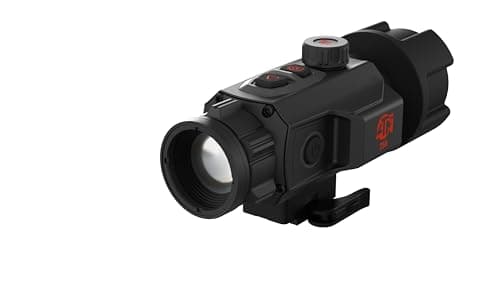
Best-equipped clip-on under $1,000
ATN TICO 6 256
$500 to $1,0007.4/10The entry clip-on with the feature list: 6,000 J, IP67, recoil-activated video, a wireless remote and five years of warranty. ATN publishes a 1-8x day scope limit.
$990.00Amazon#ad · Price as of October 5, 2026 · How we make money for the link to ATN TICO 6 256
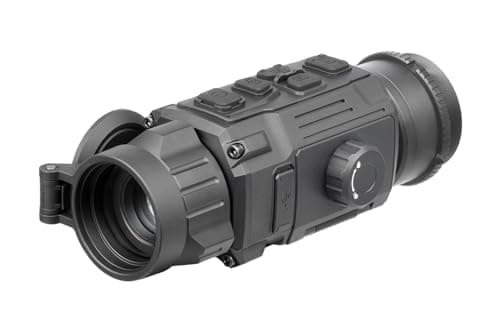
Longest-running clip-on
AGM Rattler-C V2 19-256
$500 to $1,0006.6/10Up to 11.5 hours per battery with two in the box, but the adapter that clamps it to your scope's objective is a separate purchase.
$894.70Amazon#ad · Price as of October 5, 2026 · How we make money for the link to AGM Rattler-C V2 19-256
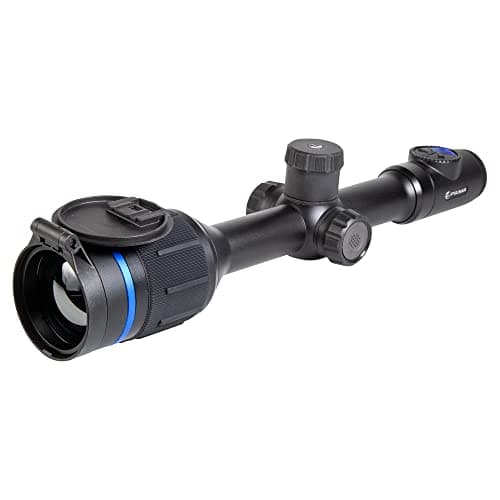
Top scope: the one that replaces everything
Pulsar Thermion 2 XQ50 Pro
$1,000 to $2,0008.6/10Our top-ranked thermal riflescope for hogs. A 50 mm F/1.0 lens, up to 10 hours on dual batteries, IPX7 and 6,000 J, mounted in standard 30 mm rings.
$1,999.97Amazon#ad · Price as of October 5, 2026 · How we make money for the link to Pulsar Thermion 2 XQ50 Pro
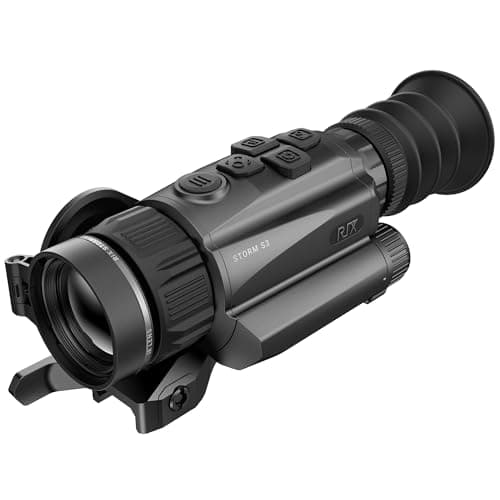
Lightest 384 scope
RIX Storm S3 384 (35 mm)
$1,000 to $2,0007.4/10At about 0.97 lb it weighs less than two of the clip-ons here do on their own, before you add the day scope they clamp to.
$1,499.00Amazon#ad · Price as of October 5, 2026 · How we make money for the link to RIX Storm S3 384 (35 mm)
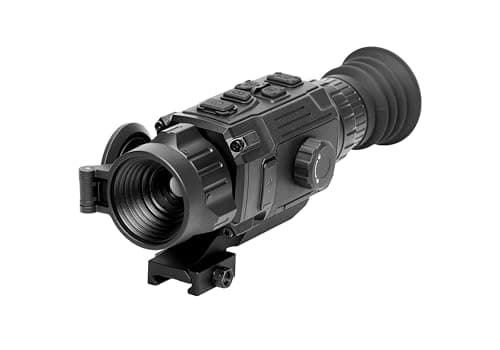
Cheapest way onto the rifle
AGM Rattler V2 19-256
$500 to $1,0007.1/10The entry thermal scope: 11.5 hours, a wide feeder-friendly view and a mount in the box, for roughly what an entry clip-on costs before accessories.
$695.00Amazon#ad · Price as of October 5, 2026 · How we make money for the link to AGM Rattler V2 19-256
Every score on this page comes from published specs and the rubric on our How We Choose page. We don't test optics, so every figure in the table below links to the maker's own page, and the pixel math further down is geometry applied to those published numbers.
What a clip-on actually is
A clip-on thermal, also sold as a front attachment, is a thermal camera with no reticle and no eyepiece of its own. It mounts in front of your existing day scope, either on the rifle's rail ahead of the optic or clamped to the scope's objective bell. You look through your day scope as usual; what you see is the thermal image, with your own reticle sitting on top of it. All three clip-ons here publish 1x base magnification for exactly that reason: a 1x image lets the day scope do the magnifying without shifting where the reticle lands.
A thermal riflescope is the whole optic. It has its own sensor, its own display, its own reticle and its own zero, and it goes where the day scope was. Nothing sits in front of it and nothing has to line up with anything.
Both are rifle-mounted, which means neither one replaces a handheld for finding hogs. TPWD's hunter education rules say not to point a firearm at anything you don't intend to shoot, and to identify your target with binoculars rather than by raising the scope (TPWD shooting safety rules). That logic holds at night: scan with something that isn't attached to the rifle. Our thermal monocular vs thermal scope page covers that side of the setup.
Clip-on vs thermal scope at a glance
| Clip-on thermal | Thermal riflescope | |
|---|---|---|
| What it replaces | Nothing. It adds to the optic you own | The day scope comes off |
| Reticle and zero | Your day scope's, in theory unchanged | Its own, zeroed separately |
| Base magnification | 1x on all three here; the day scope magnifies | 2.5x to 3.5x base on these three |
| Day scope limit | ATN publishes 1-8x as the optimal range for the TICO 6 | Not applicable |
| Mount in the box | Rail mounts yes; the scope-bell adapter is extra on all three | Included on the AGM and RIX; standard 30 mm rings on the Pulsar |
| Weight added to the rifle | 10 oz to 1.12 lb, on top of the day scope's weight | 0.97 lb to 31.7 oz, instead of the day scope's weight |
| Cheapest tier here | $500 to $1,000 (TICO 6, Rattler-C V2) | $500 to $1,000 (Rattler V2 19-256) |
| Most sensor per tier | 640x512 at $1,000 to $2,000 (Guide Orion 635) | 384x288 at $1,000 to $2,000 (Thermion 2 XQ50 Pro, RIX S3) |
| Recording | 64 GB on the TICO 6, 16 GB on the Rattler-C; the Guide Orion page lists none | 16 GB to 32 GB on all three |
The six, side by side
Three clip-ons and three scopes, all currently sold on Amazon. The clip-ons are our top three from best clip-on thermal; the scopes are the entry, lightweight and all-around picks from best thermal scope for hog hunting.
| Published spec | Guide Orion 635 | ATN TICO 6 256 | AGM Rattler-C V2 19-256 |
|---|---|---|---|
| Budget tier | $1,000 to $2,000 | $500 to $1,000 | $500 to $1,000 |
| Sensor | 640x512 VOx | 256x192 VOx | 256x192 |
| Pixel pitch | 12 µm | 12 µm | 12 µm |
| NETD | 15 mK | ≤20 mK | <35 mK |
| Lens | 35 mm, F0.9 | 25 mm germanium, F1.0 | 19 mm |
| Magnification | 1x | 1x optical; for day scopes of 1-8x | 1x base; 1-8x digital |
| Detection range | 1,950 yd (maker's claim) | 1,500 m (maker's claim) | 1,000 m/yd (maker's claim) |
| Display | 0.49-inch 1920x1080 AMOLED | 0.32-inch 800x600 OLED | 1024x768 OLED |
| Battery | Up to 7 h per 18500 (spec table; feature text says 6.5 h); 2 included | About 8 h total on two included 18650s (about 4 h each); USB-C external power | Up to 11.5 h per NE-4400 battery; 2 included; USB-C power bank input |
| IP rating | IP67 | IP67 | IP67 |
| Recoil rating | 6,000 J | 6,000 J | — |
| Weight | 10 oz | 1.12 lb (511 g) | 1.10 lb |
| Warranty | 10 years on thermal sensors | 5 years | — |
| Score | 8.3/10 | 7.4/10 | 6.6/10 |
| Published spec | Pulsar Thermion 2 XQ50 Pro | RIX Storm S3 384 (35 mm) | AGM Rattler V2 19-256 |
|---|---|---|---|
| Budget tier | $1,000 to $2,000 | $1,000 to $2,000 | $500 to $1,000 |
| Sensor | 384x288 (uncooled) | 384x288 | 256x192 |
| Pixel pitch | 17 µm | 12 µm | 12 µm |
| NETD | <25 mK (sNETD <18 mK) | <25 mK | <35 mK |
| Lens | 50 mm, F/1.0 | 35 mm, F1.0 | 19 mm germanium |
| Magnification | 3-12x | 3.5x base; 1-4x digital | 2.5x base; 2.5-20x digital |
| Detection range | 1,800 m (about 1,969 yd) (maker's claim) | About 1,969 yd (maker's claim) | Up to 950 yd (maker's claim) |
| Display | 1024x768 AMOLED | 1024x768 AMOLED | 1024x768 OLED |
| Battery | Internal APS5 plus external APS2, up to 10 h at 22°C; USB-C (5 V/9 V) external power | Swappable 18650, about 4.5 h at 72°F; 5 V USB-C external power | Up to 11.5 h; one replaceable NE-4400 Li-ion, two included |
| IP rating | IPX7 | — | IP67 |
| Recoil rating | 6000 J on rifled weapons; 12 gauge on smoothbores | 1000 g / 6000 J | — |
| Weight | 0.9 kg (31.7 oz) | About 0.97 lb | 1.06 lb |
| Warranty | 3 years; 5 years with registration | 5 years | 5 years (US purchases, per AGM warranty terms) |
| Score | 8.6/10 | 7.4/10 | 7.1/10 |
The zero argument, examined
The reason most people look at a clip-on is zero. You have a rifle you shoot well, with a scope you trust and a load you've confirmed on paper. A clip-on means you don't touch any of that: the thermal goes in front, your reticle stays where it was, and in the morning the rifle is a day rifle again with no re-zero.
That is genuinely the clip-on's advantage, and it's worth money if your rifle has two jobs. But it rests on one assumption: that the clip-on returns to the same place every time you put it on. A front attachment that sits a hair off-axis moves your point of impact, and it does it without changing anything you can see in the reticle. The practical answer is the boring one: whichever mount you end up with, confirm the rifle on paper with the clip-on fitted, then confirm again after you take it off and put it back. Our how to zero a thermal scope guide covers the confirmation routine, and it applies to a clip-on mount just as much as to a scope.
The thermal scope has no alignment to get wrong, because there's nothing in front of it. Its cost is the other way around: it has its own zero to establish, and if it comes off for deer season the day scope needs confirming when it goes back on. Published recoil ratings tell you which units are built to hold a zero at all. The Thermion 2 XQ50 Pro lists 6,000 J, the RIX Storm S3 lists 1,000 g / 6,000 J, and both the TICO 6 and Guide Orion 635 list 6,000 J as clip-ons. AGM publishes no recoil rating for either the Rattler V2 scope or the Rattler-C V2 clip-on, which is a gap worth knowing about on a rifle that recoils hard.
The mount is usually extra, and that changes the math
This is the part that gets left out of clip-on comparisons. Every one of these three ships a way to get onto the rifle, and none of them ships the part that clamps to your day scope's objective bell:
- ATN TICO 6 256: the quick-detach rail mount is included; ATN lists the scope mounting system as an add-on (ATN).
- AGM Rattler-C V2 19-256: an ADM Picatinny mount is included, but the Front Q-R adapter needed to mount it on a day scope is sold separately (AGM).
- Guide Orion 635: Picatinny and bell mounts are listed as optional accessories (Guide Thermal USA).
Compare that with the scopes. The AGM Rattler V2 19-256 includes a custom ADM mount, the RIX Storm S3 includes a Picatinny QD mount, and the Pulsar Thermion 2 XQ50 Pro takes standard 30 mm rings, which means an AR needs a one-piece cantilever mount bought separately. So the honest version is: two of the three scopes here are complete out of the box, and none of the three clip-ons is, if you intend to clamp to the scope rather than to the rail. If your rifle is an AR with a long flattop rail, the rail route may be all you need, and our best thermal scope for an AR-15 page runs the same what's-in-the-box exercise across the whole scope registry.
The magnification ceiling nobody mentions
A clip-on projects a fixed image at 1x. Turning your day scope up to 8x makes that image bigger; it does not make it more detailed. You are enlarging the same pixels. ATN says this out loud on the TICO 6 page, listing 1-8x as the optimal day scope range for the unit. Past that, you're magnifying pixel edges.
Here's what each unit actually resolves. The inches of ground covered by one sensor pixel equal distance in yards multiplied by 0.036, multiplied by pixel pitch in micrometers, divided by lens focal length in millimeters. Texas A&M AgriLife's Feral Hogs in Texas gives the largest adults as about 5 feet long, so 60 inches is the target. At 100 yards, using each maker's published pitch and lens:
| Unit | Type | Pitch / lens | Pixels across a 5 ft hog at 100 yd | Ground across the view at 100 yd |
|---|---|---|---|---|
| Guide Orion 635 | Clip-on | 12 µm / 35 mm | About 49 | About 66 ft |
| ATN TICO 6 256 | Clip-on | 12 µm / 25 mm | About 35 | About 37 ft |
| AGM Rattler-C V2 19-256 | Clip-on | 12 µm / 19 mm | About 26 | About 49 ft |
| Pulsar Thermion 2 XQ50 Pro | Scope | 17 µm / 50 mm | About 49 | About 39 ft |
| RIX Storm S3 384 | Scope | 12 µm / 35 mm | About 49 | About 40 ft |
| AGM Rattler V2 19-256 | Scope | 12 µm / 19 mm | About 26 | About 49 ft |
Two published numbers check that math. AGM lists the Rattler V2 19-256's field of view as 49 by 36 feet at 100 yards (AGM), which is the 49 feet the geometry gives. Pulsar lists 13.1 m at 100 m for the Thermion 2 XQ50 Pro (Pulsar), which works out to about 39 feet across 100 yards, again matching. The full method, with a row for every sensor size we track, is in our 256 vs 384 vs 640 thermal guide.
The takeaway: the format barely matters to detail. A 12 µm sensor behind a 35 mm lens resolves the same whether it's a clip-on or a scope. What decides your image is pitch and lens, not whether the unit has a reticle. And the published detection ranges, 1,950 yards for the Guide Orion and 1,500 m for the TICO 6, are maker's claims about spotting a heat signature, not about telling a sow from a shoat. Sandia National Laboratories' history of the Johnson criteria is the standard reference for why detection, recognition and identification are three different distances; our thermal scope detection range guide works through what each claim is worth in the field.
Sensor per budget tier: the surprise
Line the tiers up and the clip-on comes out ahead on raw sensor, which is the opposite of what most buyers expect:
| Budget tier | Best clip-on sensor here | Best scope sensor here |
|---|---|---|
| $500 to $1,000 | 256x192, 12 µm, 25 mm (TICO 6) | 256x192, 12 µm, 19 mm (Rattler V2) |
| $1,000 to $2,000 | 640x512, 12 µm, 35 mm, 15 mK (Guide Orion 635) | 384x288, 12 µm, 35 mm, <25 mK (RIX Storm S3) |
In the middle tier the Guide Orion 635 puts a 640x512, 15 mK sensor in front of your day scope, where the scopes in the same tier are 384s. That is a real advantage, and it's the reason the Orion tops our clip-on rankings. It comes with a real cost: Guide's product page lists no photo or video recording and no Wi-Fi, where both the TICO 6 and both AGM units record. If you want footage of the sounder, the clip-on with the best sensor is the one that can't save it.
At the entry tier the two are close to even, and that's where the accessory cost tips it. Both 256 units are 12 µm; the TICO 6's 25 mm lens resolves more per hog than the 19 mm Rattler V2 scope. But the Rattler V2 arrives with a mount and a reticle and is ready to shoot, and the TICO 6 still needs a day scope you already own plus, for bell mounting, a part ATN sells separately. For a first thermal on a rifle that hunts mostly at night, the scope is the cheaper complete answer. Our how much does a thermal scope cost page lays out what each tier buys across the whole registry.
Weight and length on the rifle
A clip-on's published weight is not the weight you carry. It adds to whatever your day scope already weighs, because the day scope stays. The scope's published weight is the whole story, because it replaces the optic that was there.
- Clip-ons: Guide Orion 635 at 10 oz, AGM Rattler-C V2 at 1.10 lb, ATN TICO 6 at 1.12 lb (511 g) — each one plus your day scope.
- Scopes: RIX Storm S3 at about 0.97 lb, AGM Rattler V2 at 1.06 lb, Pulsar Thermion 2 XQ50 Pro at 31.7 oz — instead of your day scope.
Read those two lists next to each other and the RIX Storm S3, a complete 384 thermal riflescope with its mount in the box, weighs less than the ATN TICO 6 clip-on does on its own. Length matters too: a front attachment extends forward of the objective, which pushes the whole package out past the handguard and changes how the rifle balances on sticks or a bag. Nobody publishes a combined length for your rifle, so the honest advice is to measure your own setup before you commit to the clip-on route.
Runtime cuts the other way, and it cuts for AGM. The Rattler-C V2 clip-on claims up to 11.5 hours per battery with two included, and the Rattler V2 scope claims the same (AGM Rattler-C V2; AGM Rattler V2). The Pulsar claims up to 10 hours on its internal plus external pack. The TICO 6 is about 4 hours per battery for roughly 8 total, the Guide Orion about 7 hours per 18500, and the RIX Storm S3 about 4.5 hours per 18650 (RIX). Three of these six want a spare battery in your pocket for a full night, and two of those three are the lightest units on the list.
Which one for your rifle
Buy a clip-on if the rifle has two jobs and the day scope is staying. One rifle for deer season and for hogs after dark is the case a clip-on was built for, and if you've already got a scope you shoot well, a front attachment is the only route that doesn't make you learn a new reticle. If your day scope runs at or below 8x, the TICO 6 is ATN's stated fit. If you want the best image on this page and can live without recording, the Guide Orion 635 is the one.
Buy a thermal scope if the rifle is mostly or entirely a night gun. You get a mount in the box on two of the three here, no alignment to worry about, less total weight on the rifle and a purpose-built reticle with zero profiles. For feeder distances on a budget, the Rattler V2 19-256. For open pasture, the Thermion 2 XQ50 Pro. For carrying it a long way, the RIX Storm S3.
Buy neither yet if you don't know where the hogs are entering or how big the sounder is. Both of these are aiming tools. The finding tool is a handheld, and it's cheaper: three thermal monoculars in our registry sit in the under-$500 tier. See best thermal monocular for hunting.
When neither is the right buy
If the whole budget is under $500, neither of these categories has an answer. The cheapest clip-on in our registry sits in the $500 to $1,000 tier, and so does the cheapest thermal riflescope; we explain why there is no sub-$500 thermal scope we can verify on our best thermal scope under $500 page. At that budget the honest routes are a digital night vision scope with an IR illuminator, or a good gun-mounted light. Our thermal vs night vision comparison works through that trade, and the night hog hunting setup guide covers the light-based rig end to end.
Before any of it goes to the field, check the rules in our summary of whether you can hunt hogs at night in Texas, and see the thermal and night vision hub for the rest of the category.
In detail
The contenders, in full
Top clip-on: most sensor per tier
Guide Orion 635
A 640x512, 15 mK sensor behind a 35 mm F0.9 lens at about 10 oz. More sensor than any thermal scope in the same budget tier, and it keeps your day scope's reticle.
Published specsResearched · every spec sourced
| Sensor | 640x512 VOx |
|---|---|
| Pixel pitch | 12 µm |
| NETD | 15 mK |
| Lens | 35 mm, F0.9 |
| Magnification | 1x |
| Refresh rate | 50 Hz |
| Detection range | 1,950 ydMaker's claim |
| Display | 0.49-inch 1920x1080 AMOLED |
| Battery | Up to 7 h per 18500 (spec table; feature text says 6.5 h); 2 included |
| IP rating | IP67 |
| Recoil rating | 6,000 J |
| Weight | 10 oz |
| Warranty | 10 years on thermal sensors |
How the 8.3 score breaks down
- Sensor & lens for hog ID (30%)
- 9.3
- Usability at night (20%)
- 7.5
- Battery & power (15%)
- 6.5
- Durability (15%)
- 8.5
- Warranty & support (10%)
- 9
- Value within its tier (10%)
- 9
What the specs support
- 640x512 sensor, 15 mK NETD and a fast F0.9 35 mm lens
- About 10 oz, light for a 640 clip-on
- IP67 and a 6,000 J recoil rating
- 10-year warranty on the thermal sensor
Where it falls short
- Guide's product page lists no photo/video recording or Wi-Fi
- Up to 6.5-7 hours per 18500, so carry the second battery
- Picatinny and bell mounts are optional accessories
Skip this if…
…You want to record your hunts or stream to a phone; Guide's product page lists neither.
#ad · Price as of October 5, 2026 · How we make money for the link to Guide Orion 635
Best-equipped clip-on under $1,000
ATN TICO 6 256
The entry clip-on with the feature list: 6,000 J, IP67, recoil-activated video, a wireless remote and five years of warranty. ATN publishes a 1-8x day scope limit.
Published specsResearched · every spec sourced
| Sensor | 256x192 VOx |
|---|---|
| Pixel pitch | 12 µm |
| NETD | ≤20 mK |
| Lens | 25 mm germanium, F1.0 |
| Magnification | 1x optical; for day scopes of 1-8x |
| Refresh rate | 50 Hz |
| Detection range | 1,500 mMaker's claim |
| Display | 0.32-inch 800x600 OLED |
| Battery | About 8 h total on two included 18650s (about 4 h each); USB-C external power |
| Recording | 64 GB; video with audio; Recoil Activated Video; Wi-Fi |
| IP rating | IP67 |
| Recoil rating | 6,000 J |
| Weight | 1.12 lb (511 g) |
| Warranty | 5 years |
How the 7.4 score breaks down
- Sensor & lens for hog ID (30%)
- 6
- Usability at night (20%)
- 7.5
- Battery & power (15%)
- 7
- Durability (15%)
- 9
- Warranty & support (10%)
- 9
- Value within its tier (10%)
- 7.5
What the specs support
- Recoil Activated Video and 64 GB of storage
- Wireless remote included
- IP67, 6,000 J recoil rating and a -22°F to 131°F operating range
- 5-year warranty
Where it falls short
- About 4 hours per battery, so plan on a swap mid-night
- The 800x600 display is the lowest resolution among these clip-ons
- The quick-detach rail mount is included; the scope mounting system is an add-on
Skip this if…
…Your day scope runs above 8x; ATN lists 1-8x as the optimal day scope range for this clip-on.
#ad · Price as of October 5, 2026 · How we make money for the link to ATN TICO 6 256
Longest-running clip-on
AGM Rattler-C V2 19-256
Up to 11.5 hours per battery with two in the box, but the adapter that clamps it to your scope's objective is a separate purchase.
Published specsResearched · every spec sourced
| Sensor | 256x192 |
|---|---|
| Pixel pitch | 12 µm |
| NETD | <35 mK |
| Lens | 19 mm |
| Magnification | 1x base; 1-8x digital |
| Refresh rate | 50 Hz |
| Detection range | 1,000 m/ydMaker's claim |
| Display | 1024x768 OLED |
| Battery | Up to 11.5 h per NE-4400 battery; 2 included; USB-C power bank input |
| Recording | 16 GB; Wi-Fi streaming and recording via app |
| IP rating | IP67 |
| Weight | 1.10 lb |
How the 6.6 score breaks down
- Sensor & lens for hog ID (30%)
- 5.2
- Usability at night (20%)
- 7
- Battery & power (15%)
- 9
- Durability (15%)
- 7
- Warranty & support (10%)
- 5.5
- Value within its tier (10%)
- 7
What the specs support
- Rated up to 11.5 hours per battery, with two in the box
- 1024x768 OLED display
- ADM Picatinny mount included
- IP67
Where it falls short
- The Front Q-R adapter needed to mount it on a day scope is sold separately
- Sub-35 mK NETD and a 19 mm lens trail the 25 mm clip-ons in this group
- Warranty terms aren't listed on the product page
Skip this if…
…You want to clamp the thermal onto your scope's objective straight out of the box; that needs AGM's separately sold adapter.
#ad · Price as of October 5, 2026 · How we make money for the link to AGM Rattler-C V2 19-256
Top scope: the one that replaces everything
Pulsar Thermion 2 XQ50 Pro
Our top-ranked thermal riflescope for hogs. A 50 mm F/1.0 lens, up to 10 hours on dual batteries, IPX7 and 6,000 J, mounted in standard 30 mm rings.
Published specsResearched · every spec sourced
| Sensor | 384x288 (uncooled) |
|---|---|
| Pixel pitch | 17 µm |
| NETD | <25 mK (sNETD <18 mK) |
| Lens | 50 mm, F/1.0 |
| Magnification | 3-12x |
| Refresh rate | 50 Hz |
| Field of view | 7.5° horizontal (13.1 m at 100 m) |
| Detection range | 1,800 m (about 1,969 yd)Maker's claim |
| Display | 1024x768 AMOLED |
| Battery | Internal APS5 plus external APS2, up to 10 h at 22°C; USB-C (5 V/9 V) external power |
| Recording | 16 GB internal; Wi-Fi (2.4/5 GHz) to Stream Vision 2 app |
| IP rating | IPX7 |
| Recoil rating | 6000 J on rifled weapons; 12 gauge on smoothbores |
| Operating temperature | -25°C to +50°C |
| Weight | 0.9 kg (31.7 oz) |
| Mount | Standard 30 mm rings |
| Warranty | 3 years; 5 years with registration |
How the 8.6 score breaks down
- Sensor & lens for hog ID (30%)
- 8.5
- Usability at night (20%)
- 8.5
- Battery & power (15%)
- 9
- Durability (15%)
- 9
- Warranty & support (10%)
- 8.5
- Value within its tier (10%)
- 7.5
What the specs support
- Big 50 mm F/1.0 lens with a 3x base: more detail on a hog at field distance than 25-35 mm scopes
- Swappable external APS2 pack on top of the internal battery, up to 10 h, plus USB-C power
- IPX7, 6000 J recoil rating and a -25°C to +50°C operating range, all published
- Mounts in standard 30 mm rings; five zero profiles and 10 reticles
Where it falls short
- 17 µm pixels versus 12 µm on newer 384 scopes; field of view at 3x is narrower than a 35 mm scope
- Heaviest scope in its tier at 31.7 oz
- No built-in rangefinder (that's the Thermion 2 LRF)
Skip this if…
…Your hogs come to a feeder inside 60 yards in thick brush; a 3x base on a 50 mm lens is slower to pick up close movement than a 2x, 25-35 mm scope.
#ad · Price as of October 5, 2026 · How we make money for the link to Pulsar Thermion 2 XQ50 Pro
Lightest 384 scope
RIX Storm S3 384 (35 mm)
At about 0.97 lb it weighs less than two of the clip-ons here do on their own, before you add the day scope they clamp to.
Published specsResearched · every spec sourced
| Sensor | 384x288 |
|---|---|
| Pixel pitch | 12 µm |
| NETD | <25 mK |
| Lens | 35 mm, F1.0 |
| Magnification | 3.5x base; 1-4x digital |
| Refresh rate | 50 Hz |
| Detection range | About 1,969 ydMaker's claim |
| Display | 1024x768 AMOLED |
| Battery | Swappable 18650, about 4.5 h at 72°F; 5 V USB-C external power |
| Recording | 32 GB built-in; Recoil-Activated Video; Wi-Fi to RIX+ app |
| Recoil rating | 1000 g / 6000 J |
| Weight | About 0.97 lb |
| Mount | Picatinny QD mount included |
| Warranty | 5 years |
How the 7.4 score breaks down
- Sensor & lens for hog ID (30%)
- 8
- Usability at night (20%)
- 7.5
- Battery & power (15%)
- 6
- Durability (15%)
- 6
- Warranty & support (10%)
- 9
- Value within its tier (10%)
- 8
What the specs support
- 12 µm 384 sensor with a 35 mm F1.0 lens in a scope under 1 lb
- Five-year warranty and a published 6000 J recoil rating
- Five zero profiles, picture-in-picture and a QD mount in the box
Where it falls short
- About 4.5 h per 18650, so spares are a must for a full night
- RIX doesn't publish an IP rating on the S3 page
- 3.5x base is narrow for close feeder shots
Skip this if…
…You don't want to swap batteries mid-sit; the Pulsar Thermion 2 XQ50 Pro and ATN ThOR 6 Elite both claim 9-10 h.
#ad · Price as of October 5, 2026 · How we make money for the link to RIX Storm S3 384 (35 mm)
Cheapest way onto the rifle
AGM Rattler V2 19-256
The entry thermal scope: 11.5 hours, a wide feeder-friendly view and a mount in the box, for roughly what an entry clip-on costs before accessories.
Published specsResearched · every spec sourced
| Sensor | 256x192 |
|---|---|
| Pixel pitch | 12 µm |
| NETD | <35 mK |
| Lens | 19 mm germanium |
| Magnification | 2.5x base; 2.5-20x digital |
| Refresh rate | 50 Hz |
| Field of view | 9.3° x 6.9° (49 x 36 ft at 100 yd) |
| Detection range | Up to 950 ydMaker's claim |
| Display | 1024x768 OLED |
| Battery | Up to 11.5 h; one replaceable NE-4400 Li-ion, two included |
| Recording | 16 GB; Shot Activated Recording; Wi-Fi to AGM Connect app |
| IP rating | IP67 |
| Weight | 1.06 lb |
| Mount | Custom ADM mount included |
| Warranty | 5 years (US purchases, per AGM warranty terms) |
How the 7.1 score breaks down
- Sensor & lens for hog ID (30%)
- 5.5
- Usability at night (20%)
- 7.5
- Battery & power (15%)
- 9
- Durability (15%)
- 6.5
- Warranty & support (10%)
- 8.5
- Value within its tier (10%)
- 8
What the specs support
- Longest published runtime in its tier (up to 11.5 h), with a second swappable battery included
- Wide 9.3° field of view makes it quick to scan a feeder or food plot
- Full 12 µm spec sheet published: 50 Hz, 1024x768 OLED, IP67
- Five-year warranty for US buyers under AGM's current terms
Where it falls short
- 256x192 sensor and 19 mm lens give the least detail per animal of the 256 scopes here
- <35 mK NETD is less sensitive than the ThOR 6 Mini (≤20 mK) or RIX Storm S2 (<25 mK)
- AGM doesn't publish a recoil rating for this model
Skip this if…
…You need to tell a sow from a big boar past about 150 yards across open pasture; step up to a 384 sensor behind a 35 mm or longer lens.
#ad · Price as of October 5, 2026 · How we make money for the link to AGM Rattler V2 19-256
How we scored this
Every score, built from the published record
Every pick here is labeled Researched: we read each maker's published specs, manuals and warranty terms, compare products only against others in the same budget tier, and score them on a public rubric. Every figure links to where it came from, and seller performance numbers are labeled “maker's claim,” so you can see exactly what you are buying.
Scores are our editorial read of that documented evidence. Commissions never set a score or decide a pick. The rubric and its weights are published.
What changed
- Published.
Questions
Frequently asked
Is a clip-on thermal as good as a thermal scope?
Does a clip-on thermal change my rifle's zero?
What magnification day scope works with a clip-on thermal?
Is a clip-on thermal cheaper than a thermal scope?
Can you use a clip-on thermal as a handheld?
Receipts
Sources
- ATN: TICO 6 256x192 thermal clip-on product page and spec table, including the published 1-8x day scope range (checked 2026-10-05)
- Guide Thermal USA: Orion O635CS thermal clip-on product page and spec table (checked 2026-10-05)
- AGM Global Vision: Rattler-C V2 19-256 product page and specifications (checked 2026-09-19)
- AGM Global Vision: Rattler V2 19-256 product page and spec table, including the 49 x 36 ft field of view at 100 yd (checked 2026-09-19)
- AGM Global Vision: warranty terms (5 years for US purchases on or after Jan 1, 2023) (checked 2026-09-19)
- Pulsar: Thermion 2 XQ50 PRO product page and full specification, including 13.1 m at 100 m (checked 2026-09-19)
- RIX Optics: STORM S3 product page and FAQ (checked 2026-09-19)
- Sandia National Laboratories: History and Evolution of the Johnson Criteria (SAND2015-6368, 2015; via OSTI, checked 2026-09-19)
- TPWD: Hunter Education, Shooting Safety Rules (checked 2026-09-19)
- Texas A&M AgriLife Extension: Feral Hogs in Texas, B-6149 (2004; PDF, checked 2026-09-19)
Specs come from each maker's own pages or the product listing (linked on every product), hog biology and trapping advice from Texas A&M AgriLife, and rules from TPWD and Texas statute. Prices are set by Amazon and change often, so we don't print them. Where a figure isn't published, we say so. Read the full method.